Showing posts with label design ideas. Show all posts

Tuesday, May 26, 2015

Designer Insights with Bill Buyok

By Tudor Davies, Terry's Fabrics

As you may know, Bill Buyok is the founder and owner of Avente Tile. He started the company as an online tile showroom and catalog so that hand-painted ceramic tiles and cement tiles are more easily and broadly available for others who share the same passion. Avente Tile's mission is to search the globe to find the finest and most extraordinary tiles for their customers while providing excellent service and product knowledge. With that in mind, here are the Designer Insights of Bill Buyok.


Editor's Note: Bill Buyok's Designer Insights were originally published Tuesday, May 19 on the Terry's Fabrics Blog by Tudor Davies. It's only one in a collection of Designer Insights compiled by Tudor and his team that profile designers and design enthusiasts. We're honored to have been included in this collection, and thank Terry's Fabrics for this opportunity. If you enjoy Bill's insights, then be sure to visit the Terry's Fabrics blog and peruse all of the Designer Insights.

The following transcript shows the interview questions and Bill's response to each.
  1. In your own words, describe your unique style and creative aesthetic? I’m drawn to classic Spanish, Moroccan, and Italian designs, the nature-inspired design of the Arts & Crafts Movement, and a love for Hispano-Moresque design.
  2. When starting a new project, what is your creative process? Listen to customers, understand their needs and wants. I start with facts, then develop the color scheme and apply pattern, motifs, accent colors and flourishes to establish design and personal style.
  3. Out of the creative people you have worked with, who is it that you respect and admire the most? My customers, who include designers, architects, and residential customers, often envision something extraordinary, unique and bold. Our cement tiles allow customers to create designs and apply color to a pattern of their choice, allowing them to control the creative design process. Thus, the tile’s pattern and color have now been reinvented into something beautiful that I would have never imagined.
  4. When looking for inspiration is there a particular thing you do to get inspired? During my early morning treks through Los Angeles neighborhoods, I find inspiration around me. I then turn those inspirations into design ideas that are unique, fun and useful.
  5. What has brought you to this point in your career? And what is your advice for people looking to follow in your footsteps? Work hard, persevere, and do what you love! Every day presents its own unique challenges that you have to translate to opportunity. Never give up and always believe in yourself. Remember, it’s not how you handle the best days; but, how you handle the challenges and disappointments that really matter.

Tuesday, December 2, 2014

Custom Commercial Cement Tile Inspiration


Customizable cement tiles used in various commercial installations.
Customizable cement tiles, from clockwise (top right), include: Traditional Melilla;
Classic Serengeti; Traditional Gran Cordoba; and Geometric 02 Cement Tile.

Handmade cement tiles are a great choice for commercial, hospitality, and retail spaces. Not only do these tiles deliver an unforgettable decorative impact, but because they are handmade, they can be customized to fit the client's needs, thanks to an extensive palette of colors. If it's inspiration you're craving for your next commercial design project, then make sure to view the dozens of images we've assembled within our Cement Tile Design Ideas section.

Whether a bold Cuban tile pattern in contrasting colors is specified, or a classic cement pattern in harmonizing colors is chosen, you and your client can be assured of a lifetime of usage and viewing enjoyment.

A cement tile mold acts as a blank canvas
A cement tile mold acts as a blank canvas for applying your creativity with customization.

Remember, our handmade cement tiles, which are also called encaustic cement tiles, are made one tile at a time using a method that has been in use for more than a century. It's because of this handmade process that varying amounts of customization is even possible. Of course, whether used as floor tile or wall tile, the long-lasting benefits of cement tile will positively impact and transform any space.

In the meantime, for more information about cement tile selection, installation tips, customization services, or available sizes, shapes and more, please see our new Guide to Buying Handmade Cement Tile.


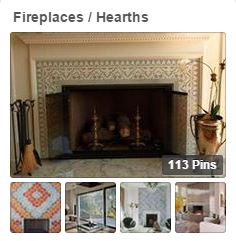
Avente's Pinterest Board of Fireplaces and Hearths

Designing with Tile

fireplaces hearths

Avente's Pinterest Board for Christmas and Winter
"Winter is the time for comfort, for good food and warmth, for the touch of a friendly hand and for a talk beside the fire: it is the time for home." - Edith Sitwell


Cement tiles work well for a fireplace or hearth. The warmth they exude is further enhanced by their ability to be customized to fit any décor, or to complement surrounding materials (such as wood, carpet, concrete, etc.). Our fireplace tile design ideas include both cement and ceramic tile installations using Avente's hand-crafted tiles. There is no better choice than tile when creating a decorative and visually appealing fireplace design.

Further enhancing their allure is the fact that cement tiles can be customized with any color from our Heritage Color Palette. After choosing colors, we recommend a "strike-off" or sample be made to verify the design on the tile before final production. Strike-offs can be shipped directly to you from the factory.

Remember, installing cement tile is a fairly simple process, but it must be done with care in order to achieve the best results. To fully enjoy the versatility of handmade cement tile, we recommend reading our Cement Tile Installation Guide. We are also proud to offer a complete line of Cement Tile Customization Services that will help you meet or exceed your design expectations. Our newly published Guide to Buying Handmade Cement Tile is an especially valuable resource to keep handy. Download a free copy here, and let the inspiration begin!

Let us know how we can assist you with your next project. Please feel free to call our offices at 888.739.4972 or email us at: info@AventeTile.com.


There is no better time than the Holidays to express our appreciation for your business and friendship. May all the joys of the season be yours.

Deer in Moonlight Mural - Rosewood
Deer in Moonlight Ceramic Tile Mural

Take 10% off any online order placed through January 2015. Use coupon code CHEERS.

Tuesday, February 11, 2014

A Tiled Fireplace Will Warm the Home All Year

With heart-shaped candy boxes and cuddly teddy bears taking over store shelves, there's no denying that Cupid has his arrow poised to strike lovers this Valentine's Day. But nothing says love like a cozy fireplace with hand-crafted tiles. With cold days and long nights, there is nothing better than warming up to a fire in the hearth with friends. Make your fireplace the focal point of the room with hand-painted ceramic or cement tiles.

Cuban Cement Tile Border Tiles Frame this Fireplace

The bold colors and intricate Cuban cement tiles patterns create a cozy fireplace. In this case, the border and corner pieces that are normally used to frame a tile rug can be used around the firebox. To avoid cuts and cement tile trim, the cement tile is paired with a plain ceramic tile that compliments the design and helps to simplify the installation. The customer's choice to use our popular Cuban Heritage Design 110 in the rich, warm "C" colorway was smart. The palette provides an intimate location that you will want to cozy up to any time of the year!

Many Tile Options for Your Fireplace

Using cement tile for a fireplace is a fantastic way to add visual appeal to your space. Available in multiple patterns and a broad color palette, cement tiles help create a dramatic focal point that become the theme of the room. However, decorative ceramic tiles, like our Malibu or Portuguese tiles provide eye-catching patterns and designs. Also, our ceramic mosaic tile designs are perfect for adding the right touch to a fireplace, hearth, mantle or chimney. And, don't forget the stunning glazes found in our hand-painted plain or field tile can provide an elegant and classic look, too.

Design Ideas to Help

A fine-looking fireplace fills your home with warmth and beauty, as well as creating a social center for friends and family. Here are a few different design ideas to get you thinking about finding a design and look that speaks to you!


Yuna Cement Tile Fireplace
Cement Tile Fireplace
Spanish Tile Fireplace

Spanish Tile Fireplace
Ceramic Tile Fireplace Mural
Fireplace Tile Mural


Do you have a question about using tile for your fireplace? No problem! Leave your tile question in the comments on this blog and we'll happily answer any questions you may have.


Pinterest logo

Pinterest: Fireplaces & Backsplashes/Walls


Tiled Backsplash and Wall Pinterest Boards

Tiled Fireplace & Hearth Pinterest Boards


"I say to myself that I shall try to make my life like an open fireplace, so that people may be warmed and cheered by it and so go out themselves to warm and cheer." — George Matthew Adams

Winter is in full swing for many parts of our country! Our Pinboard selections for this month reflect both the seasonal changes and the area in our homes that will garner the most use and attention – the fireplace! There’s no doubt that the attractiveness of a crackling, yet soothing fireplace will mesmerize even the heartiest of humans and creatures alike.

With bone-chilling winds, rain and snow, you can keep the warmth and coziness a fireplace emotes year-round with our ceramic tiles or with our extensive collections of handmade cement tiles. Check out how our Classic Cluny Cement Tile was used in this Fireplace Surround design, and the starring role our Traditional Yuna Cement Tile played on this Monochromatic Cement Tile Fireplace. For our friends who enjoy winter in a milder, Mediterranean climate, consider a ceramic tile mural for your outdoor fireplace, such as our Pomegranate Mural, for example.

Inspired? Then visit our pages on houzz.com, our boards on Pinterest, and browse through dozens of our Cement Tile Design Ideas portfolio page where you can find a large collection of projects showcasing our handmade and hand-painted ceramic tile, cement tile, decorative tile, mosaic tile, and so much more. Let us know how we at Avente Tile can assist you!

Tuesday, June 18, 2013

Italian Made: Fashionable Tile, Design

The Italians are famous for their design sense. From the clothing and accessories they design to their timeless architecture and art work, and of course their legendary sports cars. There is no limit to their imagination.

The same determination applies to their design sense when it comes to tile. From Venetian glass mosaic tiles, to ceramic tile that closely resembles heavy brocade patterns, to the crispness of summery linens, it seems the Italians have perfected the art of mimicry.

During the recently held Coverings tile and stone show held in Atlanta, Italian tile manufacturers unveiled their creativity and ingenuity with new twists on patchwork type styles, state-of-the-art anti-bacterial and self-cleaning tiles, time-tested encaustic and majolica patterns, fabric-like textures and embossing, large-format tiles, and quick-installation ceramic tile systems.

Matching is Overrated
Patchworks tiles, such as “Minoo” by Marcel Wander for Bardelli, feature ornate 8”x8” porcelain floor tiles in five silkscreen patterns reminiscent of Persian rugs.

For Mosaico+, renowned mosaic artist Carlo Dal Bianco used mosaics from the company’s various lines to create a series of new decorations. For the “Lacquer” and Inlay” series, he used iridescent mosaics from the Perle collection and square glass chips from Concerto to invoke ancient Chinese dynasties.

For a mixed color palette, Ceramica Sant’Agostino’s “Abita” collection of 8”x24” white body wall tiles boast a diamond effect in three chromatic mixes of beige, lilla and menta.

Philippe Starck also played a role within the ceramic tile sector with the launch of “Flexible Architecture” for Italian manufacturer Ceramica Sant’Agostino. The decorative, modular tile can be specified on one to four sides of the tile or on no sides at all to create an endless array of architectural compositions.


“Minoo” by Marcel Wander for Bardelli.

"Lacquer" by Mosaico+


Philippe Starck's “Flexible Architecture” for Ceramica Sant’Agostino
Philippe Starck's “Flexible Architecture” for Ceramica Sant’Agostino.

Antibacterial & Self-Cleaning
Ceramic tile is inherently hygienic. It contains no VOCs, so it was only natural for Italian manufacturers to collaborate with biotech companies to offer products that promote the antibacterial, antipollution and self-cleaning properties of ceramics.

Among the latest to develop these types of tiles are Fincibec with “Antibact”, Century with “Technica”, Mirage with its “Sundeck” (its zero maintenance decking product), and Panaria, Lea Ceramiche and Cotto d’Este (all part of the Panaria Group) with their antibacterial floor and wall tiles for residential and commercial applications.

Further, as an industry first, Casalgrande Padana unveiled “Bios Self Cleaning Ceramics” that uses HYDROTECT technology from the Japanese brand, TOTO, to create self-cleaning, anti-bacterial and pollution-reducing tiles. The HYDROTECT coating contains two active agents: titanium dioxide, which is photo-catalytic; and a well-balanced formulation of metals that offer antibacterial and antivirus properties. The technology is especially useful for exterior cladding and can be applied to all Casalgrande Padana products.


Lea Ceramiche BioPlank
Lea Ceramiche's "BioPlank"

Vintage Encaustic, Majolica
Inspired by vintage encaustic and majolica tiles, old world historical charm has been renewed with new fervor thanks to high-tech printing methods.

Of these unique collections is “Azulej” – the latest porcelain tiles designed by Patricia Urquiola for Mutina. Inspired by ancient handcrafted majolica made of hydraulic cement, the 8”x8” glazed porcelain tiles are available in three neutral base colors (white, light grey and dark grey) in a choice of nine patterns or as a combination of 27 different designs. Following this trend is the Majolica pattern of Refin’s “Frame” collection. Designed by graphic design firm Studio FM, the large 30”x30” square tiles feature traditional decors from majolica tiles of the 19th and 20th centuries but presented in a more graphic light.

“Vintage” by Cerim, “Cotto Vogue” by Cir and “Concept” by Ragno are a few other collections featuring this unique look.

Vintage by Cerim.

"Azulej" by Mutina designed by Patricia Urquiola.

Planking with Style
The lines of wood and ceramic are blurred once again with a wide-range of plank-sized tiles that made an appearance at Coverings. Not only do these longer tiles resemble wood, but they are now taking on the look of concrete and stone.

“Sunrock” by Atlas Concorde is available in a range of formats including 6”x36” and 9”x36” while Coem’s “Pietra del Friuli”, inspired by stones found in the northeast of Italy, also comes in a 6”x36” plank size. ImolaCeramica’s “Vein” collection mimics vein-cut or cross-cut marble, and Ceramiche Caesar’s “Wabi” is inspired by oak.

Wabi by Ceramiche Caesar.

Tactile Textiles
Textiles and ceramic tile seem to be enjoying a heavenly relationship within the Italian manufacturing arena. From Raw Edge’s second collection for Mutina called “Tex,” a rich, three-dimensional and multi-colored collection of 4.5”x8” rhombus-shaped glazed porcelain tiles, to the “I Tessuti” collection created by Elena Strafella for Cottoveneto, the range of fabric-inspired patterns are not only realistically breathtaking, but they also capture the essence of the designer’s soul.

Additional textile-inspired products include Marazzi’s “Silkstone” line whose decorative ceramic wall tiles are inspired by Indian saris, Japanese kimonos, tulle and silk.


Marazzi's "SilkStone"


"I Tessuti" by Cottoveneto

Large-Format Tiles
In their continuous evolution to better serve the A+D communities, large-format tiles are becoming increasingly comfortable in various settings and environments.

For example Novabell’s “Avant” collection is available in a heavy-duty 20mm paving version in a 24”x24” format and special R12 anti-slip finish while Ceramiche Keope’s “Pecorsi SMART” tiles are available in five stone looks and a 24”x24”x¾” size. Pastorelli’s new 2cm-thick “Quartz Design” series features the same sparkling reflections as quartz flecks, while “Sunrock” from Atlas Concorde gets its inspiration from Travertine.

Further innovations in the large-format tile circle come from Cotto d’Este’s Kerlite series, “Exedra”; Panaria’s “LightQuartz”; “Micron 2.0” by ImolaCeramica; “Gli Alabastri di Rex” by Rex; and “Industrial” by Floor Gres, which reinterprets cement in porcelain slabs as large as 1.2m x 3m.


"Industrial" by Floor Gres
"Industrial" by Floor Gres.

Lastly, “Studies in Gouache” a tile product designed by Diego Grandi for Lea Ceramiche – is the first slim tile with a contemporary bas-relief design. The four decors (grid, scratch, weave and moire b) feature geometric and abstract patterns engraved and sanded into the 3mm tiles. They are offered in the same chromatic range as the company’s “Gouache.10” collection.

“Studies in Gouache” by Lea Ceramiche.
“Studies in Gouache” a tile product designed by Diego Grandi for Lea Ceramiche.

So, which of these Italian tile designs is your favorite? How and where would you use it in your next project? 

Tuesday, April 23, 2013

Cadiz Tiles Add Warmth to Maine Coastal Kitchen

If you follow this blog, you know there's nothing I like better than sharing a tile installation photo from our customers! I received an email a few weeks ago from some good people who live by the Maine coast near Acadia National Park. They were kind enough to show us how they used Avente's Spanish Cadiz Tiles!
The email started like this and included several photos:

"Attached are some closeups of the tiles as I installed them in our kitchen. Also attached is a photo of our cozy house looking eastward out to Penobscot Bay. Thanks for assembling such a pleasing collection of tiles for our selection."


Spanish Cadiz Tiles for Backsplash


Avente Customer's cozy home looking eastward out to Penobscot Bay.


The Ryans, who shared these photos, chose the vibrant hand-painted Spanish Cadiz tiles to add focal points to the white tile backsplashes behind their oven and kitchen sink. We think the unexpected pops of color and patterns add interest and energy to these spaces! It's a great example of how different sizes of decorative tile are used to bring both pattern and color to a design.


Stove backsplash uses Spanish Cadiz 4"x4" & 6"x6" Tiles


Sink backsplash uses Spanish Cadiz 4"x4" Tiles


View of the Kitchen


One aspect about this project that I love is that they choose decorative accent tile based on their desire to add interest and color to their kitchen. Occasionally, I hear, "I love those Spanish tiles; but, they don't work with my home's style."  Often, different styles can complement one another and I have to admit the bold gold and blue in this Spanish Cadiz work well with this New England kitchen's maple cabinets, white field tile and clean, functional layout.

Expect Variation in Hand-Painted Tiles

I have to tell you that the Cadiz wasn't the Ryan's first choice. Originally they ordered some Spanish Burgos 2"x2" tiles.


Spanish Burgos 2"x2" Dot was the First Choice

While the blue glaze in some of the tiles was exactly what they were looking for; some of the tiles in the lot didn't have the same vibrancy the Ryans wanted. This is often the case with hand-painted tiles because the hand of the artist can be seen in each tile. Showing Yankee perseverance, they discussed a few options with me and then asked if they could return the Burgos dots and try the Cadiz 4"x4" and 6"x6" formats. We had a winner! And, I love how they used the tiles differently behind the sink and stove.


Sink Backsplash


Stove Backsplash

Yankee Ingenuity Helps the Layout

The Ryans used a unique way to lay out the tiles that really focused on scale and size rather than color and pattern. Below is a photo of their paper layout demo. They explain, "Here is another aspect of our tile project that might have interest for your blog readers. Before ordering anything, we made a full-size paper mock-up of the two splash areas to be tiled, using colorful squares cut from magazine photos to represent the accent tiles - which allowed us to play with different layout options and really evaluate the impact of potential layouts in situ (on the wall), and in our case, to thus evaluate the interplay of the design of the two separate splash areas. We were trying diagonal accent layouts at first, comparing them to vertical/horizontal patterns, and playing with spacing of the accents. All easy to do with scotch tape!


Layout was simulated using magazine cutouts as Deco Tiles

After the switch from 2-inch to 4-inch tiles as the material we chose to work with, and after the first order of 4-inch had arrived, we again used full-sized paper mock-ups to play with different configurations. And that's when we decided to go for a very different layout from the initial plan, which necessitated ordering a few more tiles. Since the tiles differ in size, the use of proper sizing of the background grid and of the accent tiles also promotes recognition of the required layout that will be necessary and to avoid additional or excessive cuts, awkward edges, or thicker grout lines. Going through the physical mock-up process can be very helpful to generate the most satisfactory end results."

I agree, it's difficult to envision design concepts on any scale and to take into account all of the details. But, it's that work and effort that really shines through on your installation. Not only is the layout clean and professional, but the two backsplash designs work well together to provide a cohesive design. It's always a good idea to lay out the design to get a sense of what works, and to find any flaws you might not have thought about.

Finally, the Ryans pointed out that, "The reason we used paper magazine cutouts for accents is that you get the exact size of accent pieces. I suppose someone could print a set of photocopies of the desired accent tiles and trim to correct size if the printing process does not generate a correct size (tricky). That would produce a more realistic mock-up than the magazine clipping approach."

Ceramic Tile Projects from Avente Customers

If you enjoyed this article, you might enjoy these Tile Talk articles that show how Avente customer's have added style and a personal touch to their homes with hand-painted ceramic tiles. Here are a few posts devoted to tile floor accents and kitchen backsplashes using our hand-painted ceramic tiles.

Cement Tile Projects from Avente Customers

These posts show you how cement tile can be used on floors and kitchen backsplashes. You'll also discover the decisions that each customer experienced as part of the project. I thank these customers for taking the  time to share these tips and ideas.

Tuesday, February 26, 2013

5 Tips for Getting the Best Cement Tile Prices

Cement tiles are handmade. It’s an amazing process that is extremely labor intensive and one that takes time. A manufactured tile can’t provide the same natural variation like the hand of a tile artisan. That is why prices for handmade cement tile start at $9/SF for plain unpolished tile in an 8"x8" format. Patterned tile generally start at about $12/SF to $15/SF and can reach $20/SF for 8"x8" tiles. If you've got some flexibility with your design and color choices, then here’s five ways to get more cement tile for less.

Tip #1
Use existing patterns in standard colorways.

Use existing patterns in standard colorways or in-stock tiles.Cement tile offers the creative homeowner, designer or architect the ability to create custom patterns in specific colorways. This benefit comes at a cost because new molds, custom colors, virtual designs and strike-off samples are required to create the tiles and confirm the look prior to a full-order. Leverage your buying dollar by working with existing patterns and colorways, or choose from in-stock tiles. You’ll still get a great looking installation; but, you’ll avoid the time and costs of customization.

Tip #2
Use only plain tiles.

Use only plain tiles or solid color tiles that don't have a pattern. Cement tiles in single colors make great flooring designs while providing a rustic fluidity because of the inherit variation in color.

For a bold look, you can also use contrasting alternating colors to create a checkerboard pattern.
Or, choose plain tiles in two or three colors to create a rug design for a room. Consider using a different format for the rug border. For instance, use black 8”x8” tiles for a rug in the center of the room, frame the rug with 4”x8” grey tiles, and fill the area outside the border with 8”x8” white tiles.

Tip #3
Limit the use of patterned tile.

Minimize the quantity of patterned tile required and you can save a bundle - especially on large flooring projects. A tile with a complex pattern or a lot of colors takes longer to make and will have a higher rejection rate. Here's a few great ways to enjoy these tiles and still meet your budget. Make a rug with plain tiles framed in a patterned border tile. Framing a solid color field tile with a decorative border is a great way to use cement tiles. This keeps the design simple but not overpowering. You should consider using plain cement tiles or solid color tiles if you are timid about using the colorful stylistic designs found in many cement tile patterns.


Or, create medallions or groupings of four patterned tiles separated by a "grid" or row of solid color tiles. You can reduce the tile cost by 25- to 75-percent when compared to a floor that uses all patterned tiles.

Tip #4
Use large format tiles

Use the largest format or size available to save both manufacturing and installation costs. Generally speaking, a large tile size or format will be much less expensive to manufacture and install than a smaller size format. This is a great choice when using plain cement tiles because you save costs by simply choosing a larger format. We can provide cement tiles up to 14”x14”. You can save 40% by using 12”x12” tiles instead of 4”x4” tiles.


Tile Cost (Unpolished)
Tiles
100 SF
Cost
100 SF
4”x4”
$1.29
930
$1,200
8”x8”
$3.89
230
$900
12”x12”
$7.20
100
$720

Tip #5
Avoid dark blue & green colors.

If you can, avoid dark blue and green colors in your pattern or plain cement tiles. Cement tiles are colored with natural pigments. Red, brown and yellow are generally created by adding iron and iron oxide compounds that are abundant and inexpensive. Dark green and blue colors are created with cobalt compounds. Cobalt is the reason these colors will cost more. The saturated blue and deep green colors can add 20% to the cost of the tile.
These tips are guaranteed to reduce the costs per square foot of any cement tile project. If you are flexible with your design and colors, these tips will allow you to get more cement tile bang for your buck!

Tell us what you think. Would you consider implementing any of these tips on your cement tile project? Do you have a money-saving tip you’d like to share? Or, do you have a question about cement tile that you’d like answered – share it here!

Tuesday, November 27, 2012

Creative floor tiling

It's a bit of a story to this tile project as this section of the floor has been concrete for a few years. I've been a builder and blogger for some time now and we have a home on Cupid's Cay, Eleuthera, Bahamas that we work on every year. There are many more posts to read all dealing with your home on my blog, The Building Blox. Now you know the story about builders finishing their own homes right?

Well this year we decided we would tackle this floor when we returned but there were complications that worked out for the best. We went to the tile store that we had purchased from here in Eleuthera and they no longer carried the same tiles that we had used so it was decision time. We looked through the offerings and due to the increased cost we settled on a beige color tile and got 6 boxes, which worked out to 48 tiles that were each 18" x 18". Now how to make 48 tiles cover the area that we had? I thought about it for a day or so and did an experiment to see if it was going to work. It looked great!


Now once the decision was made I had to start the layout and plan on the concrete floor for how the tiles were to be spaced so that they looked like the design that I had made.


Once that was determined it was time spread out the thin set and lay the tile with the appropriate row spacing.  Now the reason that I did the large tile rows first was so that I would have the level in between to gauge the height of the pieces that I would be adding after.  This way I could determine if they were above or below the tile height and adjust them according.  Some of the thinner pieces needed a bit more thin set to bring them up to the tile height and some pieces had to be shaved on the tile saw because they were too thick.


The outer edge band is made by breaking up tile that we had. The tile store also gave us a box that had been broken to use, which was really nice of them.


As I started down the rows it was very much like making a puzzle.  Over the years we have collected pieces of glass, broken plates, bottle bottoms and a slew of random things on our beach walks and now was the time to use them.  We used everything we had but had run out so we had to make a trip to the north where we knew a beach that would have a new supply and Success! 

The stick you see in the above photo was used to make sure that the pieces were at the right height between the two tiles.

I also added in some blue that I cut out of bottles that I had been saving. The blue around the floor really catches your eye. Any guesses on what bottle they come from?

Luckily for me, throughout the project I had professional supervision. Here she's checking to make sure the thinset is the right consistency!

Broken tile, plates, found tile pieces, bottle bottoms and more all became part of the floor.


The finished floor.


So with a bit of creative thinking a floor that stands out from the rest and also uses a great many recycled pieces was made. The other thing that I didn't mention was that other than my labor this floor cost $200.00 to do. I can honestly say it was a great project and fun to do.

As to the degree of difficulty and if you should attempt something like this? I believe that a person with good DIY skills and/or someone that has done previous tile work could undertake a project like this. The key is of course having the knowledge of how to do it and just as importantly taking the time to plan it out and the patience to make the puzzle work.

Let me know what you think. Like it or not so much? Would you consider undertaking a project like this?

If you hadn't already guessed, the blue bottle pieces are from Bombay Blue Sapphire Gin that I cut with the tile saw.


A short post script.
When I first thought about doing this a good friend, Paul Anater, said it was very similar to what is done in Spain called Trencadis.

Trencadís (Catalan pronunciation: [tɾəŋkəˈðis]) is a type of mosaic used in Catalan modernism, created from broken tile shards. The technique is also called pique assiette. This mosaic is done using broken pieces of ceramic, like tiles and dinnerware

Although its a similar style, I adapted it to the materials I could find here on the island or more accurately, could find on our beach walks. Duel purpose walks- treasures and exercise!