Showing posts with label exterior facades. Show all posts

Tuesday, December 4, 2012

Persian Tile: A Form of Art and Religious Expression


Sheikh Lutf Allah Mosque Peacock Dome
Sheikh Lutf Allah Mosque is one of the architectural masterpieces of Safavid Iranian architecture, standing on the eastern side of Naghsh-i Jahan Square, Isfahan, Iran.
Image via: www.IslamicArts.org 

The impact of Persian tiles occupies a prominent place in the history of Islamic art. Recognized for having one of the richest and varied art legacies, Persia (now Iran) used this form of art to decorate palaces, public buildings, monuments, mausoleums, and religious buildings, such as mosques and theological schools.

According to the Iran Chamber Society, “The history of Iranian tile dates back to the prehistoric period. It holds an important position among the various decorative arts in Iranian architecture. The four main decorative features can be categorized here as well. They include stone carving, brick work, stucco and tile panels. Using an intricate method of manufacturing, design and the type of materials used in the four methods mentioned above, the methods have evolved as a result of natural factors, economical and political effects.” 


Interior arcade of Sheikh Lutf Allah Mosque, Isfahan, Iran.
Image via  www.IslamicArts.org.

It's because of their expertise in handling raw material, and especially because of their artistry, Persian tile makers found themselves in great demand. Their talents were sought in all corners of the vast Islamic empire. Over the centuries, creative artisans used colored stones and brick to create geometric patterns on structures. The rudimentary patterns then developed into natural subjects, such as plants, animals and humans. These masterful creations grace both the interior and exterior of historic Iranian structures.


A mihrab is a niche set into the middle of the qibla wall of a building in order to indicate the direction of Mecca. (Early 14th century).
Image via Los Angeles County Museum of Art (LACMA).

The art of tile manufacturing reached its peak of perfection and beauty at the end of the 13th century. Moraq tiles (mosaic style) panels created with this technique were made to withstand the elements of time. “Tiles in such colors as yellow, blue, brown, black, turquoise, green and white were cut and carved into small pieces according to a previously prepared pattern,” says the Iran Chamber Society. Further, “These pieces were placed close together and liquid plaster poured over to fill in all the opening and gaps. After the plaster dried and hardened, a large single piece tile panel had been created, which was then plastered onto the required wall of the building. Timurid monuments in Herat, Samarkend and Bokhara were covered by this decorative technique. Among the most famous monuments decorated in this style are the Goharshad Mosque (1418 CE), the Molana Mosque (1444 CE), the Jameh Mosque of Yazd (1456 CE), the Jameh Mosque of Varamin (1322 CE), and the Madrassa of Khan in Shiraz (1615 CE),” the Society added.


Imam Mosque, Isfahan, Iran.
Imam Mosque, Isfahan. Image via www.IslamicArts.org.

Of the many tile masterpieces found in Iran is the Shah Mosque in Isfahan. The dome of this religious building, which originates from the 17th century, serves as a wonderful example for mosaic tile, as well as cuerda seca tiles. A variety of tile had to be manufactured in order to keep a consistent look throughout its vast halls that were covered in mosaic tile.


Detail of one of many tiled walls of the Jameh Mosque, Yazd, Iran.
Image via www.IslamicArts.org

Also of importance to the tile-making techniques of the Persian empire was the the Safavid dynasty (1502-1736). It was during this time that ornamental mosaic pieces were often replaced using the haft rang (seven colors) technique. Images were first painted onto plain rectangular tiles, glazed, and then fired. Aside from economic reasons, the seven colors method gave artisans freedom with their creativity, as well as more time to stylize their works of art.


The complex of the Friday mosque of Yazd; found in the 12th century.
Situated adjacent to the center of the town of Yazd, the complex of the Friday mosque of Yazd was found in the 12th century. However, what stands on the site today is the new mosque (masjid-i jadid) built in 1324 under the Il Khanids. Image via www.IslamicArts.org.

It's unfortunate that this glorious form of art wasn't extensively documented throughout the ages. The patterns and designs were a closely guarded secret, and therefore, the techniques were only passed down orally from father to son, or from master to student.


Vakil Mosque, Shiraz, Iran.
Vakil Mosque, located in Shiraz, Iran, is a beautiful mosque built in the mid-18th century by Karim Khan.
Image via www.IslamicArts.org.

Sadly, this concludes my exploration of tile through the Middle East. Before I get too old, I would really like to explore the country that I was born in, Turkey, as well as Iran, where my husband was born. The architecture, the history, and knowledge that Islamic nations provided not only to their people, but to far-reaching lands, shouldn't be dismissed.

I hope you enjoyed reading this series as much as I enjoyed researching and writing it. Have you gained a greater appreciation of tile? How would you implement current tile patterns and colors into contemporary or modern designs?

Tuesday, November 6, 2012

Turkish Tile: Artistry Through the Ages


The significance of Turkish ceramic tiles occupies a prominent place in the history of Islamic art. Its deeply enriched heritage, which can be traced as far back as the Uighurs of the 8th and 9th centuries, owes its subsequent development to Karakhanid, Ghaznavid, and Iranian Seljuk art.


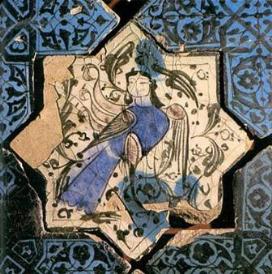
Turkish tile from Aladdin Palace, Konya, Turkey
Throne scene on a star-shaped tile using the Iranian-Seljuk minai technique. Aladdin Palace, Konya, Turkey. Image via www.turkishculture.org.
Siren on a star-shaped tile from Kubadabad Palace
Siren on a star-shaped tile, underglaze painting, Kubadabad Palace, c. 1236. Karatay Madrasah Museum, Konya, Turkey. Image via www.turkishculture.org.

Countries with colorful histories, such as Turkey with its sovereign past that includes the Byzantine and Ottoman empires, have always provided a deep-rooted fascination to outsiders because of their culture, traditions, food, and most importantly, the art produced within the country. It’s through this art that we, the current generation, are allowed to take a brief glimpse through the artisans mind and eyes of what was seen, felt, and experienced at the time.


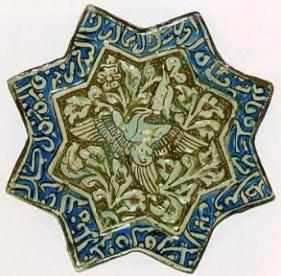
Star-shaped ceramic tile from Kubadabad Palace
Sphinx on a star-shaped tile using the luster technique. Kubadabad Palace, c. 1236. Karatay Madrasah Museum, Konya, Turkey. Image via www.turkishculture.org.

Turkish Ceramic Tile Develops

When the Seljuks (Turkic nomads from Turkmenistan who were related to the Uighurs) victoriously conquered the Byzantines at Malazgrit in the early part of the 11th century, they brought with them their knowledge and talent for creating works of art on ceramic materials. As a result, a distinctive style of Seljuk art and architecture emerged by the 13th century. Seljuk mosques, medreses (a building or group of buildings used for teaching Islamic theology), tombs, and palaces were lavishly decorated with these exquisite, handmade tiles vividly in turquoise, cobalt blue, eggplant, and black. 


Seljuk tile from the second half of the 13th century.
Seljuk tile from the second half of the 13th century. Image via www.turkishculture.org.


By the late 15th and early 16th centuries, a new period in Ottoman tile and ceramic-making had emerged in Iznik. Artisans employed in the studios of the Ottoman court were sent to Iznik so their designs could be interpreted upon the ceramic wares and tiles that would adorn the palaces. As a result of the patronage, Iznik was known as the most artistically and technically advanced ceramic region.
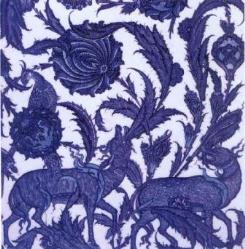
Animal and flower figures, 16th century, Topkapi Palace, Istanbul, Turkey.
Animal and flower figures, 16th century, Topkapi Palace, Istanbul, Turkey. Image via www.turkishculture.org.
Early on, the Iznik style of ceramic artwork became distinctive with its blue and white designs and motifs of foliage, Arabesque patterns, and Chinese clouds. Court-appointed artisans were now imitating the 15th century Chinese Ming porcelains that had begun to permeate the Ottoman court.

By the middle of the 16th century, natural motifs such as plants, flowers, ships, animals, and even people, began to appear on ceramic tile. With their wide variety of vivid colors, the demand for ceramic tile as decorations surged with the extensive building programs undertaken by Suleiman I (1520-1566) and his successors. Countless examples of mosques and tombs across the Ottoman Empire were adorned with the products of the Iznik potters' skill.

Turkish Tile-Making Techniques

During the Anatolian Seljuk period, architectural decoration involved the use of glazed and unglazed bricks were used to produce a variety of patterns on the façades of buildings. The most frequently color used for the glaze was turquoise, followed by cobalt blue, eggplant violet, and sometimes black. Hexagonal, triangular, square, and rectangular monochrome tiles were also used in creating architectural details.

Panel of Hexagonal Tiles.
Panel of Hexagonal Tiles. Image via www.turkishculture.org.
However, unlike brick, these geometric shapes were used for indoor applications. The geometric tiles, made from a hard, yellowish paste, were glazed with vibrant hues of turquoise, cobalt blue, violet, and occasionally, green. There are also rare examples of these geometric tiles in existence that possess traces of gilding.

Further, the Anatolian Seljuks also incorporated extensive use of mosaic tile art for the interiors of domes, transitions to domes, vaults, mihrab niches, and walls.

Unfortunately, by the 18th century, the ceramic industry in Iznik had died out completely and another city, Kutahya, replaced it as the leading ceramic arts center in western Anatolia. Kutahya succeeded where Iznik failed in its ability to keep up with orders while maintain their renown product integrity. However, during the first half of the 19th century, Kutahya's ceramics industry also suffered a downturn.

Polychrome tiles, underglaze painting, harem of the Topkapi Sarayi, Istanbul, 16th century.
Polychrome tiles, underglaze painting, harem of the Topkapi Sarayi, Istanbul, 16th century. Image via www.turkishculture.org.
Lastly, there is a widely held belief that figurative painting in Islamic art is prohibited, in accordance with the Koran. According to Turkish Culture, “Religious rulings issued only in the 9th century discouraged the representation of any living beings capable of movement, but they were not rigidly enforced until the 15th century. Figural art is especially rich in tiles, as well as stone and stucco reliefs of the Seljuk period, adorning both secular and religious relief monuments. The subjects included nobility as well as servants, hunters and hunting animals, trees, birds, sphinxes, lions, sirens, dragons and double-headed eagles.”

The tiled hearth of the crown prince’s apartment in Topkapi Place, Istanbul, Turkey.
The tiled hearth of the crown prince’s apartment in Topkapi Place, Istanbul, Turkey. Image via www.turkishculture.org.
To view the products of today’s ceramic tile producers, visit the Turkish Ceramics Promotions Group. You can also plan to visit Unicera, the annual fair in Istanbul, Turkey where you can view and visit with Turkey’s producers of ceramic, stone and bathroom products  like to visit the annual ceramic and stone Unicera International Ceramic Bathroom and Kitchen Fair in Istanbul, Turkey, February 27-March 3, 2013.

How would you use Iznik-patterned tiles that are still produced today? Have you been to Turkey to see any of the above-pictured pieces?