
Tuesday, February 14, 2012

My Love Affair with Tile

Happy Valentines Day! This is a day dedicated to love and today I discuss My Love Affair with Tile.

Bird of My Heart Tile
Bird of my Heart Tile

Hand Painted Tiles Kindle the Flame

I love tile. Even as a kid I was fascinated by their bright colors, patterns and shapes. I admire tile for its ability to transform a home. Tile can create texture or depth. Tile can add a splash of color for an accent or create visual interest with patterns. The enormous variety of tile also allows you to be creative.

In a quest to find hand painted tiles with an old world design similar to some I had seen from Spain, Avente Tile was born. I couldn’t find any designs in local showrooms, tile stores or online. Once I found the right tiles, I fell in love with them. It was then I decided to start a company to sell hand painted tiles. These niche tiles were ideal for a web-based company. I’ve always enjoyed learning about art and architecture, history and culture, and tile is a great connection.

Colorful Tiles
Color & Bright - Tiles Delight

Love What You Do

I started the company in 2003 as way to share my enthusiasm about artisan and hand-crafted tile. I believe that you need to love what you do. If you have a passion for something, you’re bound to do it well. I spent ten years in corporate America working as a mechanical engineer. I did well; but, my heart wasn’t in it. People that love what they do, do it with passion. Money is never the driver – it’s the joy you get out of what you do. I probably work twice as hard as I did as an engineer; but, I enjoy every day and look forward to the challenges I face. I am surrounded by people I admire and respect and who respect me. Don’t get me wrong we all encounter days filled with frustration or disappointment. The key is to find something you love (or let it find you) and make it your own creation.

Tile Artisan Glazing Tile
The Hand of an Artist Touches Every Tile

Keeping the Passion Burning

Now you know about me and my love for tile. How has it evolved or changed? Or, perhaps the quintessential question, how do you maintain passion? Anyone who has been in a relationship for more than five years asks the same question. It’s great to have that impassioned night of discovery; but, it can easily become a tepid relationship or chore. You have to learn to grow, change and embrace the differences. And of course, you have to share some common values. Tile started as a passionate love affair with color, design, and pattern.

Amazing how an object, a piece of clay, makes us share this world in wonderful and unique ways.

I maintain the passion when a customer tells me how thrilled they are with their new installation that includes Avente Tile. I cultivate passion with knowledge and understanding. The ways in which a tile are made are varied and unique. My passion is fueled by knowing a piece of clay sculpted into a relief tile and touched by the hand of an artist in Guatemala will be part of an architect's inspired Beverly Hills bathroom. It’s the story of legends and it happens every day. It makes me feel so connected to the world and people in a very special way. Amazing how an object, a piece of clay, makes us share this world in wonderful and unique ways.

Hand Crafted Tiles Create Stunning Installations
Hand Crafted Tiles provide Inspiration for Design

That’s how my passion for tile started and evolved. Never forget how much beauty there is in the world and enjoy it every day. May you also find your passion and make it something you can cherish and cultivate.


Portions of this post were published on JB Bartkowiaki's blog, Building Moxie. JB wondered how my passion for tile evolved and I was thrilled to have an opportunity to write a post about something I love. If you are not following JB's blog or Twitter feed,I recommend that you do - especially if you are a DIY! His fun and quirky perspective is fun and helpful. I met JB through Twitter and he continues to provide great tips and make me laugh. JB's Twitter handle is @BuildingMoxie . You can read the post in it's original form Bill Buyok :: Finding Passion in Life with Tile.


Tuesday, February 7, 2012

Cement Tile and Efflorescence

I’ll admit it; today’s post is a little dry and somewhat technical. But, if you're going to have a cement tile product installed, it is required reading. Today’s post is about a physical phenomenon called efflorescence and how it relates to cement tile. Hopefully, by the time we’re done you’ll understand what is it, where it comes from, how to remove it or stop it.

Efflorescence on Pavers
Photo via The Brick Paver Dr.

What is Efflorescence?

Efflorescence is a powdery substance or incrustation the sometimes forms on cement tiles. It’s important to remember that efflorescence is a normal physical phenomenon. It can occur in any material containing Portland cement including clay, terracotta, and concrete. It commonly looks like a white powder or salt on cement tile. The word, efflorescence, has French origins and means to flower.

Efflorescence does not damage the tile or cause structural problems. But, it's pretty darn ugly to look at.

Where does Efflorescence come from?

Efflorescence occurs when when soluble salts and materials come to the surface of concrete and mortars. Ever boiled a pot dry or rinsed your car with a hose in full sun? Notice how there is salt ring or residue left? As the water leaves and evaporates, it leaves the salt behind. Efflorescence is a similar phenomenon. As cement or cement tiles dry, the lime in the cement rises to the surface with the water and reacts with carbon dioxide in the air to form calcium carbonate. In this case, a white powder or film forms on the tile's face. It's induced by low temperatures, moist conditions, condensation, rain and water. It can occur very soon after exposure to moist or cool conditions or more gradually in sub-grade concrete installations (like a subterranean parking garage).

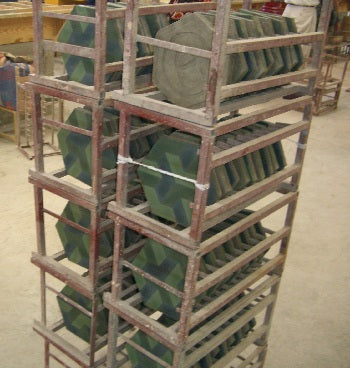
Cement tiles are hydraulically pressed and then placed in racks. The tiles are soaked in water baths in order to achieve water saturation and guarantees proper cement hydration. Then tiles are left to dry for 10 days and cure before shipping.

Racked Cement Tiles Await a Water Bath to Cure the Cement

Water Bath for Curing Cement Tiles

Because of how they are made and shipped, efflorescence may be present when cement tiles are taken out of the boxes. More commonly, it may occur right after installation especially when installed on cement subfloors.

Efflorescence like I described above is sometimes referred to as 'powdery' efflorescence and is the most common. However, there are two types of efflorescence. The other type is called 'crystalline' efflorescence. When powdery efflorescence goes through cycles of being deposited on the surface it can form larger crystals that strongly bond to the surface. It is important to note since different cleaning treatments are designed to work on a specific type of efflorescence.

If there is no water source, to create capillary water flow through the tile, efflorescence can't occur. An ounce of prevention...

How do I Prevent or Stop Efflorescence?

In laying cement floor tiles, be sure to install over a stable cured cement subfloor. It is critical that the cement base be completely cured before laying floor tiles. If the concrete subfloor is not, moisture may seep up into the tiles and cause efflorescence to appear on the tile surface. If there is no water source, to create capillary water flow through the tile, efflorescence can't occur. An ounce of prevention is always better than a pound of cure.

How do I Remove Efflorescence?

Efflorescence that appears on the tile before installation will generally come off during the installation process. You may be able to sand small localized areas. Use a piece of wet sandpaper (200 grit), wet the tile, and sand the area.

When efflorescence occurs after installation, first try to remove the efflorescence by cleaning the tiles thoroughly. Use a floor polisher with green pad, a neutral soap and plentiful water. Remember, you'll need to let the tiles thoroughly dry to confirm the efflorescence has been removed and stopped.

We are told that penetrating sealer in fact stops efflorescence from resurfacing. So if you are still having a problem area, this is the next step. I would suggest you do a small test portion of the tiles in the least noticeable area and make sure to use a high quality penetrating sealer. Read our post about Sealing Cement Tile.

Additionally, efflorescence cleaners are available. I have no experience with the products so make sure to test them on a loose tile or hidden area to ensure the results. Carefully follow the directions provided by the manufacturer and avoid any acid-based products that will damage the concrete tile.

Other Good Resources on Efflorescence

To find out more about this topic, I recommend these articles. Remember, these posts discuss efflorescence with respect to masonry or ceramic tile and may not directly apply to cement tile.

Tuesday, January 31, 2012

Cuban Tiles

This week's post first appeared last fall on Todd Vendituoli's blog, Building Blox. Todd asked me to provide some insight on a tile he had seen often in the Bahama Islands, Cuban tile. I've had many questions recently about Cuban tile, so I hope Tile Talk readers can gain some understanding about Cuban tiles from this post. If you are not following Todd's blog or Twitter feed, you really should. His unique perspective as a builder with experience in the Bahamas and the US is both valuable an insightful. I met Todd through Twitter and his passion and enthusiasm for social media is unstoppable. Todd's Twitter handle is @TALV58. And, you might also enjoy Todd's guest post on this site, The Joy Of Tile.


Cuban Tiles are Cement Tiles

Cuban Tiles are a moniker for cement tiles. I fell in love with these tiles when I encountered them in old buildings and churches from my travels in Central America and Mexico. Many installations were over a hundred years old and the tiles still looked amazing. I've never been to Cuba; but, everyone I speak to that has visited the island tells great stories about the architecture (some sadly in decay), old American cars, charming people and, of course, the tile.

Cuban Tile installation in a library in Old Havana, Cuba
Cuban Tile installation - Library in Old Havana, Cuba
Photo Courtesy of Aguayo Tile

How Cuban Tiles are Made

As the name implies, cement tiles are made from a mix of Portland cement, marble powder, fine sand and mineral-based pigments. This top 1/8" of the tile's surface is the decorative pattern you see. For each color that is required, blended pigments are placed in the corresponding section of a mold. The mold is removed and the back of the tile is filled with non-pigmented concrete and then hydraulically pressed. Because of this process, Cuban tiles are sometimes called hydraulic tiles. No firing is required and the tiles simply dry and cure for a few weeks after pressing. This process is similar to concrete that is poured in place for a sidewalk or driveway.

Cement Tile Mold
Cement Tile Mold
Photo Courtesy of Aguayo Tile

The Making of Cement Tile is a labor of love. After watching these tiles being made, I have a true appreciation for the artisan and their craft. Especially after watching a tile maker hand pour different colors in an elaborate pattern like those found in Cuban Tiles.

A Brief History of Cuban Tiles

Cement tiles became know as Cuban tiles because of their ubiquitous use in both residential and commercial applications on the island of Cuba when it was a tropical playground. The patterns in Cuban tiles are generally more elaborate than found in other cement tiles. Cuban tiles use bold, bright colors like salmon or indigo. Also prominent in Cuban Tiles is the use of double borders. Cuban Tile is de rigueur flooring for Miami homes built in the Spanish Mediterranean Revival period. In fact, Cuban Tile flooring was popular in Southern Florida homes built between 1920 - 1950. However, the patterns were often less intricate and the color palette more subdued. The 1960's construction boom in the USA and Western Europe demanded economical buildings materials that brought an end to the common use of Cuban Tiles in both residential and commercial application.

Cuban Tile Installation
Cuban Tiles in a House in Old Havana
Typical Double Border and Bright Colors
Photo Courtesy of Aguayo Tile

Fortunately, there has been a resurgence by architects and interior designers to use Cuban Tiles because of their durability and design flexibility. Also, thanks to companies like Aguyao Tile, Cuban Tile pattens have been re-discovered from old homes and crumbling estates in Havana and Camagüey, Cuba. In many cases, the structures were in such a state of disrepair that debris was removed to find the stunning Cuban floor tile. Since many of the old buildings are being destroyed or renovated, we are fortunate these designs are now preserved. Theses historical patterns are available today in our Cuban Heritage Collection. These Cuban Tiles revive patterns recovered from great estates and regal buildings in Havana and Camagüey. All of the Cuban tiles come in three colorways with one colorway based on the original colors found in Cuba.

Cuban Tile Installations

Cement tiles are being used again all over the country and in some new and exciting applications. Here's a bathroom that uses the tiles on the floor, wall, and ceiling.

Cuban Tile Bathroom Installation
Photo Courtesy of Aguayo Tile Customer

And, here's a more traditional installation completed this year for a home in Florida.

Cuban Tile Installation
Recent Cuban Tile Installation in Florida
Photo Courtesy of Avente Tile Customer

There are few products that offer the jaw-dropping beauty of Cuban tiles. Because it is a green product, very durable and available in limitless colors and patterns, it's easy to understand why Cuban tiles are a design classic that is here to stay.

Tuesday, January 24, 2012

Tile Talk Newsletter - January 2012

Ring in the New Year with Malibu Tile!

Happy New Year! As you finalize your list of resolutions and un-deck the halls, don't forget to ring in the new year with tile! We're celebrating with our newest edition of hand painted artisan Malibu tiles. The patterns, colors and glazes pay homage to Malibu Potteries of California.

Zuma A Malibu Tile Zuma B Malibu Tile Del Norte B Malibu Tile Estrella B Malibu Tile
Zuma A Zuma B Del Norte B Estrella B

>> See the collection of Malibu Tiles

The decorative tile patterns include liner tiles for creating borders (Flora A, Flora B, Faro A, Faro B), complete patterns for insets, stair risers, and back splashes and quarter designs (Floris A and Floris B) for larger spaces and murals.

Carrillo B Malibu Tile Catalina A Malibu Tile Flora A Malibu Tile Kanan A Malibu Tile
Carrillo B Catalina A Flora A Kanan A

>> See the collection of Malibu Tiles

The tiles are available in a 6"x6", 4"x4" and 3"x3" format. Currently, only the 6"x6" tiles are available on our online catalog. The other sizes are scaled versions of the same pattern. Most patterns are available in two colorways.

>> Read Our Blog Post about Malibu Tiles


Project Pick: Teruel Kitchen Backsplash

Teruel Kitchen Backsplash

This month's project pick photo shows how an Avente Tile customer created a kitchen backsplash using the Teruel Pattern from our classic Spanish line. This classic Spanish patterns was laid 'on point' or the diagonal using the Teruel 6"x6" format. The bright blue pattern has a stylistic flower pattern with deep burgundy and yellow accents. An interesting cross-hatch pattern is created with the tile's border when laid on point that complements the light cross hatch pattern on each individual tile. I love the pattern created with these tiles! Notice how a blue color scheme is created with the bright blue bottles? And, doesn't the tile really complement this color?

Hand Painted Spanish Tile - Teruel Pattern
Hand Painted Spanish Tile
Teruel 6"x6" Pattern


Other Spanish Teruel Formats

Hand Painted Spanish Tile: Teruel 4x4 Hand Painted Spanish Tile: Teruel 3x6 Hand Painted Spanish Tile: Teruel 3x3 Hand Painted Spanish Tile: Teruel 2x2
Teruel 4"x4" Teruel 3"x6" Liner Teruel 3"x3" Corner Teruel 2"x2" Dot

The Spanish line is a classic collection of traditional patterns. Each pattern has tile in these formats: 3"x3" corners, 3"x6" border tiles or liners, 6"x6" tiles, 4"x4" tiles, 2"x2" and 1.5"x1.5" dots. Because of the different formats that are available, it's easy to create a design for any room using these lines. If you like bold patterns, use the 6"x6" or 4"x4" tiles for an entire backsplash. Or, create a simple accent using 3"x6" liners with an accent field tile. Or, add the dots as accents to field tile laid on point.


Tile Tip:

Use decorative tiles accents with terracotta or stone pavers. A repeating offset pattern is a great way to add color and interest to your floor. Select a variety of decorative tiles from our Malibu, Barcelona, Spanish, or Portuguese tile lines. You can even mix or match from different lines for a more modern look.

The decorative inset tile should be about one third the length of the paver. For instance, if you are installing 12"x12" pavers, use 4"x4" deco tiles for the inset pattern; use 2" dots for 6"x6" pavers.

Decorative Tiles work well with floor pavers in an off-sett pattern
Deco tiles insets are used in this offset pattern

See other great ways to use decorative tiles in our recent post about Four Ways to Use Hand Painted Tiles.

Tuesday, January 17, 2012

Malibu Tiles

We are excited to start the year and celebrate our newest edition of hand painted artisan tiles, aptly called Malibu. The patterns, colors and glazes pay homage to Malibu Potteries of California.

Malibu tile on a fountain at the Adamson House in Malibu, CA
Image Source: Travelin' Local blog post
A Garden Tour of Malibu’s Adamson House

These tiles are created with the cuerda seca technique that produces deep, rich colors from the pooled glazes. The Cuerda seca method of tile decoration was brought to Spain by the Moors. The technique was popularized and arguably brought to it's highest art form by Malibu Potteries in the late 1920's. You can still find tile from Malibu Potteries and Catalina Potteries in historical buildings, public spaces and estates in Southern California and Beverly Hills. The use of decorative tile is a characteristic of Spanish Colonial Revival architecture that was popular in Los Angeles at the same time. The Adamson House in Malibu, California displays an impressive collection of Malibu tile and is great place to visit - especially if you love tile or architecture.

Malibu Tile - Catalina
Malibu Tile - Catalina 6" x 6" (A Colorway)

Avente's Malibu tile line is created by hand using classic and historical patterns. Most patterns are available in two colorways. These tiles are suitable for all indoor applications including walls and floors. They can be used in outdoor locations; but, not in frosty environments. Some of the patterns and colorways are stocked for quick shipping. Others are made to order.

Malibu Tile - Catalina
Malibu Tile - Catalina 6" x 6" (B Colorway)

The decorative tile patterns include liner tiles for creating borders (Flora A, Flora B, Faro A, Faro B), complete patterns for insets, stair risers, and back splashes and quarter designs (Floris A and Floris B) for larger spaces and murals.

Malibu Tile - Zuma
Malibu Tile - Zuma 6" x 6" (B Colorway)

The tiles are available in a 6"x6", 4"x4" and 3"x3" format. Currently, only the 6"x6" tiles are shown on our online catalog. The other sizes are scaled versions of the same pattern.

Malibu Tile - Zuma
Malibu Tile - Zuma 6" x 6" (A Colorway)

The following patterns and colorways are stocked for quick shipping:

Malibu tiles have a fascinating and rich history. This classic line of hand-painted tiles is sure to impress and create a timeless look that endures.

Tuesday, January 10, 2012

What are Encaustic Cement Tiles?

It a new year and it’s always good to start the year out on the right foot. So, today’s post is about clearing up the mystery with encaustic cement tiles. I often get calls asking if we have a specific encaustic cement tile in stock. It happened again just the other day. And, when that happens, I always have to stop and explain that there is no such thing as encaustic cement tiles. I’m sure the customer really doesn’t want to hear me describe the differences – they just want to get their tile.

Encaustic tile made in the United States
Examples of Encaustic Tile made in the US
Image courtesy of Filmore Clark

However, it’s important to understand the difference and what an encaustic tile is and what a cement tile is. The names get confused by everyone even by tile manufactures and tile vendors. Both tiles are un-glazed; but, there are very important differences. Encaustic tile is generally frost-proof and can be used in any outdoor applications. Cement tile can't be used in locations subjected to hard freezes and is more commonly found in Mediterranean or Tropical climates. Now you know why I ask what tile you are looking for and where it will be used?

Encaustic tiles are made of two or more colors of clay which are inlaid together to create the pattern. Then the tiles are fired. Encaustic tiles have been around since medieval times but encaustic tile as an art form reached its apex in the mid 1800’s when renowned maker, Minton's Ltd , became the supplier of durable decorative finishes for walls and floors in churches, public buildings, grand palaces. Even the US Capitol sports a Minton encaustic tile floor.

A Minton encaustic tile floor in an office at the United States Capitol
A Minton encaustic tile floor in an office at the United States Capitol.
Image from Wikipedia

To this day, England has the most prevalent encaustic tile installations because Minton tile is an English company.

Cement tiles are made of concrete and the color in the pattern comes from mineral pigments which are mixed and poured into a mold. The mold is removed and the gray cement is fills the rest of the tile body, then the tile is hydraulically pressed and the tile is cured for about 3 weeks. This method was developed in the mid-19th century and hasn't changed much since then. You can get a pretty good idea of how cement tiles are made by watching this video.

Alcala Cement Tile Patio mediterranean patio

To be even more accurate, cement tiles should be called concrete tiles because cement is one of the materials used to make concrete. However, I’d be thrilled if folks wouldn't call them encaustic cement tiles - because no such tile exists.

There's two other posts that help explain the Difference between Encaustic and Cement tile by Zoe Voigt on Tile Style and Cuban tile isn't encaustic, it's cement. It's not really cement either, it's concrete. by Paul Anater on Kitchen and Residential Design.

Avente Tile does not sell encaustic tile. But, a fellow pattern addict and lover of artisan tile, Lee Nicholson was kind enough to share some photos of encaustic tiles you can find in her Art Tile Showroom, Filmore Clark. The showroom offers the best in American art tile and is located West Hollywood, California.

Encaustic tile made in the United States
Examples of Encaustic Tile made in the US
Image courtesy of Filmore Clark

We hope this post has helped you understand the difference between encaustic and cement tile. It is important to make sure you know what tile you want and what will work best for your installation. I hope your new year is off to great start, too! If you have questions about cement or encaustic tiles, post a comment below and we'll find an answer.

Tuesday, January 3, 2012

11 Top Selling Tiles of 2011

As we start to embrace another year, it's always fun to reflect at the past year and see the most popular selling tiles of 2011. The past year showed a growing demand for one of my favorite products, cement tile. But, our timeless ceramic tile patterns, including the Portuguese, Spanish and Antigua Colonial, had a strong showing, too. In 2010, our most popular tile was a white ceramic tile, Yucatan Blanco 6" x 6" Hand Painted Field Tile. In 2011, our top selling tile was a tie between a black and white 8" x 8" solid color cement tile. With all the stunning colors and amazing patterned tiles we have, it's hard to believe we sell more white tile than anything else. So without further ado, here's Avente Tile's Top 11 tiles of 2011! Well, there are 12 since there was a tie for first place.

  1. Mission Tile Black - 8" x 8" Solid Color Cement Tile

    Mission Black Cement Tile

  2. Mission Tile White - 8" x 8" Solid Color Cement Tile

    Mission White Cement Tile

  3. Cuban Heritage Pattern 140-3B - 8" x 8" Cement Tile

    Cuban Heritage Pattern 140-3B

  4. Mission Tile Octagonal - 8" x 8" Cement Tile

    Mission Tile Octagonal

  5. Traditional Bayahibe - 8" x 8" Cement Tile

    Bayahibe Cement Tile

  6. Classic Serengeti X - 8" x 8" Cement Tile

    Classic Serengeti Cement Tile

  7. Portuguese Ruan - 6" x 6" Ceramic Tile

    Portuguese Ruan Ceramic Tile

  8. Cuban Heritage Pattern 140-4A - 8" x 8" Cement Tile

    Cuban Heritage Pattern 140-4A Cement Tile

  9. Mission Tile Espanola - 8" x 8" Cement Tile

    Mission Tile Espanola

  10. Cuban Heritage Pattern 160-2A - 8" x 8" Cement Tile

    Cuban Heritage Pattern 160-2A Cement Tile

  11. Classic Bordeaux (B Colorway) - 8" x 8" Cement Tile

    Classic Bordeaux Cement Tile

  12. Antigua Colonial Capuchinas Relief (Sand) - 6" x 6" Ceramic Tile

    Antigua Colonial Capuchinas Relief  Ceramic Tile

Do you have a favorite? Let us know by adding your comment below. You can also compare to last year to see the Top 10 Hand Painted Tiles of 2010. We wish you a happy and healthy 2011 filled with beautiful tile!