Showing posts with label bathroom tile. Show all posts

Tuesday, June 2, 2015

Hexagon Cement Tile – Patterned and Plain

Star and Hexagonal Tile Panel, 13th-14th century (Nishapur, Iran).
Image via The Metropolitan Museum of Art.

Steeped in a rich history of architectural, design and natural elements, the hexagon is a fundamental shape when it comes to building. The six-sided polygon, which can be found in honeycombs, crystals, snowflakes, and most importantly tile, creates a classic yet distinguished look.

Arabesque Hexagon Spanish Paver Tile | Avente Tile

Beginning in late 2013, it was evident the hexagon was once again climbing in ranks as a desirable shape in the designs and patterns of tile. During Coverings 2015, hexagons played a more sophisticated role in terms of visual and tactile significance with increased offerings in cement, encaustic, glass, porcelain, ceramic and stone.

Also of importance was how the hexagonal shape was used in everything from small mosaic tiles to large format tiles, as both a flooring and wall tile. Patterns, textures and embossing further elevated the hexagon’s allure among the attendees of Coverings.

In a further testament to its time-tested flexibility within the design and architecture segments, the hexagon is often used to create the illusion of a cube by connecting every other vertex to the center, forming three diamonds, and shading each diamond differently, as shown below.

Geometric Cube A 8" Hexagon Cement Tile | Avente Tile

With their simultaneously modern and historical background, hexagons are continuing their rise in popularity with the increase of renovation efforts in both public and private spaces, such as homes, retail spaces, hospitality venues, and more.

Mission Hexagonal Frame 8" Cement Tile | Avente Tile

Lastly, depending upon the look and feel you’re trying to exude with hexagonal tiles, your hardest decision may just rely upon the size of the tile. Do you want to create a high energy, dramatic environment with smaller formats, or would you rather create a more laid back, relaxing atmosphere with a larger format of hexagon tiles? It’s all up to you, and that’s the beauty of this classic shape ‒ it becomes what you want it to be!


For more information and inspiration about patterned and plain hexagon tiles, visit our comprehensive Hexagon Cement Tile Buying Guide.


Tile Shapes: Hexagons  | Avente Tile's Pinterest Board

“There is geometry in the humming of the strings, there is music in the spacing of the spheres.” 
~ Pythagoras 

Geometrical shapes and patterns are currently enjoying their time in the design spotlight, most especially hexagons. From fabrics and textiles to furniture, and of course tiles, this rediscovered polygon is meeting the demands of various decorative styles. 

Using handmade cement tiles for your remodeling/renovation, or new construction project will not only enhance the look of your home, it will also play a well-deserved role in retail and hospitality spaces. Rest assured the cement tile you choose will withstand the test of time. For whichever project you choose to conquer, Avente Tile is here to help you reach your design goal. Our extensive Cement Tile Design Ideas gallery features a large collection of projects dedicated to adding excitement in any space. How can we help inspire you today?


Tuesday, March 24, 2015

3 Ways to Create Style with Plain Hexagon Tile


With it's classic six-sided shape, the hexagon is gaining and maintaining it's elegant prowess in design circles (pun intended) once again. Here are three ways plain hexagon tiles lead to an overall stylish look. Our style guide below uses both ceramic, porcelain, and cement tiles - all available from Avente Tile.

Hexagon Style Tip #1. Create a simple pattern with plain hexagon tile in two or three colors.  The hexagon format was common in the 1920s. These small-format "penny hexagons" or the penny hex in white was typically used for kitchen and bath floors. It gained some notoriety again in the 1960s, and now, it is once again is a design staple that provides interest without being over-used.

Hexagon tile, the size of pennies, were popular in the 1920's.
Penny-sized hexagon tiles, popular in the 1920s, were typically used as flooring in the kitchen and bath.
A simple repeating pattern in black and white works great with hexagon tiles. Stylistic floral patterns and simple borders can also be used with this fun, interlocking shape.

Hexagon Style Tip #2. Use hexagon tile with hand-painted glazes or cement tile in the same color. Sound boring? Not really, use an interesting glaze that exhibits variation from tile to tile. Or, use hand-painted glazes or cement tile to achieve the look you're after. The natural variation in color provides an absolutely stunning look that hides dirt, provides a sense of texture or depth, and lots of interest. It's also a more straight-forward design approach for the DIY group.

Arabesque Hexagon Spanish Pavers in Cotto Dark, all in the same color, can create a rustic look similar to this.

Hexagon tile looks great with hand-painted glazes.
Hexagon tile looks great with hand-painted glazes. The variation of hand-applied glazes create a look that exudes depth, texture and interest.

Saltillo tile provide rustic charm because the terracotta has a lot of natural variation in color
Hexagon Saltillo tiles provide rustic charm with the natural color variations found in terracotta.

Hexagon Style Tip #3. Blend ceramic tile glaze colors or cement tile colors and texture to unique, one-of-kind designs. Feeling creative? Like to work with colors? Then this option is perfect for you. Create a colorful mosaic of hexagon tiles using three to five colors, then choose a size to accommodate the scale of the space.

6" Arabesque Hexagon Spanish Paver Tile in Normandy Cream and Vintage texture

Hexagonal cement tile from our Arabesque line.
Hexagonal cement tile from our Arabesque cement tile collection. Pictured above is a blend of red and brown tiles, our Duoro Blend, with a Vintage texture

It's easy to see why this classic shape never falls from grace. Hexagon tile, or hex tiles, are just a great way to add both style and grace to any design.

Next week get's really fun! I'll show you three ways to create style with patterned hexagon tile. Patterned  hexagon tiles can be very playful - the hexagon pattern can almost disappear or form truly unique modular mosaic patterns. If you haven't seen patterned hexagon tile at play, I think you'll be surprised!

Tuesday, January 27, 2015

Decorative Geometrical Tile Coda


Two weeks ago I introduced our new decorative glazed ceramic tiles. In that post, Geometrical Ceramic Tiles Ring in the New Year,  I explained how two popular cement tile patterns, our Geo 10 and Traditional Anillos, are now available in a glazed ceramic tile format.  I also promised to to share some additional forthcoming patterns and I'm excited to unveil them now.

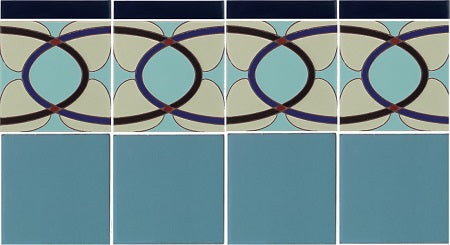
Geometrical Ellipse A Wainscot Concept
Geometrical Ellipse A - Wainscot Concept

Ellipse is one of my favorite new motifs that works great as single or double row accent strip for a kitchen backsplash or bathroom wainscot. The simple, soothing inter-connected ellipse pattern is slightly contemporary but takes its design cue from Art Deco styles.

Geometrical Ellipse B is a new glazed ceramic tile pattern

Further, the hand-painted glazes provide traditional artisan craftsmanship and variation. The patterns are all more contemporary than our traditional Spanish and Malibu lines.

Geometrical tile pattern glazes are from the Malibu Field Tile palette and make designing easy and fun. In fact, the flexibility in the Geometrical deco line lies in  the ability to pair and complement the patterns with colors from the 50+ available glazes from our Malibu Field Tile collection. To make it easy, all the colors used in the pattern are identified on the site. Malibu Field Tile are available in 3"x3", 6"x6", 4"x4", 4"x5", 6"x6" and 4" Hexagon. You'll also find a full line of trim and molding.

Aragon is another new pattern using a classic cross and quatrefoil motif.  It's available in four standard colorways.  I love the simplicity in this classic black and gray colorway.

Argon is a Moorish-inspired pattern shown here in classic black and grey
Geometrical Aragon is a Moorish-inspired pattern shown here in classic black and grey

The colors and pattern motif can really change the mood. Look what happens when the same pattern has soothing earth tones juxtaposed to charcoal to create a checkerboard. The cherry red glaze outlines each cross and makes it really pop.

Geometrical Aragon 2CD is a new decorative ceramic tile pattern
Geometrical Aragon is new pattern. Colorway 2CD is shown here.

Malibu Cherry Red is a stunning glaze with lots of natural variation. I can't wait to see a fireplace or pool sideboard adorned in the color. I'll let the color segue into another new pattern, Weave. Here, the Geometrical Weave pattern uses that bright red and white to really add a pop of color and bold design.

Weave is pattern in the new Geometrical line.
Shown here in Cherry Red and White.

Red not your color? Want to mix up the pattern? Look at how playful and sophisticated, this pattern can be when a mix of colors is used.

A mix of colors in the Weave pattern break all the rules
A mix of colors in the Geometrical Weave B pattern breaks all the rules

Remember, the Geometric glazed ceramic tile patterns are available in 6-, 5-, 4-, and 3-inch square formats. Each pattern is offered in at least four colorways. These high-fired, quality tiles are suitable for indoor or outdoor use. The tiles are hand-painted in the USA using the traditional "Cuerda Seca" (dry cord) technique. Expect variation in the glaze colors, as well as a slight relief from pooled glazes. These tiles can also be made for submerged wet applications, such as pools, by applying a clear overglaze. For floor applications, grit can be added to the glaze to reduce slippage. Tiles are made-to-order so please allow about four weeks, including transit times, for delivery.

Want to see more? Take a look at all of our glazed decorative Geometrical tiles. These tiles offer the prefect decorative solution.


Tuesday, December 16, 2014

Tile Backsplash Ideas for Modern Vanities


Maybe your bathroom is stuck in the 60s or maybe you just need to freshen things up a bit. The vanity backsplash serves both a functional and aesthetic purpose, adding decorative features to your bathroom while simultaneously protecting your walls from moisture. A backsplash allows you to personalize your bathroom with a style that mirrors your own taste, character, and lifestyle.


Red Bathroom Backsplash
Photography by highfithome

So how can we choose a backsplash for a modern vanity? By nature, modern design is chic, trendy, fashionable, and in vogue. Your options for backsplashes are wide-ranging, not only based on the materials available, but the orientation of the tiles, techniques used, and molding features. You can visit Trade Winds Imports to find unique, designer quality modern bathroom vanities.

Modern Bathroom Backsplash Ideas
There are many different types of backsplash ideas you can use in the bathroom.

Style of Decorative Tile Backsplash:
  • Handmade Cement Tile
  • Natural Stone Tile
  • Glass Tiles
  • Mosaic Tiles
  • Mirrored Backsplash Panels
  • Classic White Subway Tile
  • Metallic tiles
  • Themed Tiles
  • Classic White Subway Tiles
Matching Your Countertop
For vanities with travertine tops, you can match your counter with a travertine backsplash. Other materials, such as natural stone and synthetic stones like Phoenix stone, can also be complemented with a nice stone tile that matches the hues and patterns of your countertop. Dark Emperador, quartz, and marble are all ideal candidates for a gorgeous stone backsplash.


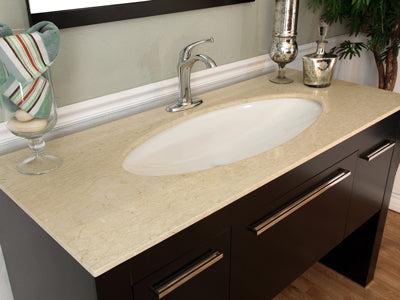
Modern Vanity with Cream Marble Top
The Corinth Vanity comes with an elegant cream marble counter top.
Handmade Cement Tile
Beautifully hand-crafted cement tile always creates a stunning effect. You can make your bathroom stand out by pulling together elements that mirror your personal preference. As an extra tip, tile to the ceiling to make your bathroom look bigger. This will accentuate the verticality of the room.

Glass Backsplash
Modern and contemporary vanities have an especially enticing visual appeal when paired with a glass backsplash. You can even have the back of the glass hand-painted to create a silky smooth finish that flickers with vibrant spectrums of light. Similarly, metallic tiles can bring in the same "flash" and eye-grabbing qualities.

Tiling Size & Patterns
As for shape and tile patterns, staying in line with modern design patterns will create a well-organized and uniform design. For modern applications, large tile typically creates the best effect. Less business and more simplistic and streamlined designs. Although you can experiment with laying tile diagonally in the shape of a diamond, a square tile pattern maintains the sharp edges that are characteristic of modern vanities. There are also a variety of techniques you can use including bullnose, cap, and cove.


White Subway Tile in the Bathroom
Classic White Subway Tiles. Photography by Urban Apartments

Conclusion: Tiling it All Together
Finding the right backsplash for a modern vanity adds the icing on the cake and can really help pull together the entire design. Remember to try these tips to keep tile costs down.

About the Author
Cheryl Khan is a Design Consultant at TradeWindsImports.com, a fellow community member of KBTribeChat. Cheryl is knowledgeable about all phases of home remodeling, including complete kitchen and bath renovations.

Wednesday, October 1, 2014

Cuban Tile Makes Grand Entrance for Resort Hotel


The hypnotic pattern of our Cuban Heritage Design 110-3B 8x8 handmade cement tile features prominently in this resort's airy and grand entry. Nestled between architectural elements of arches and columns, this handmade cement tile rug, which features an original Cuban tile pattern and a polished finish, will withstand decades of high foot traffic with proper care and maintenance. Not only is it beautiful, but it adds to the sustainability factor with its long lifecycle.

Looking closely at the 110 3B cement tile pattern, you can see and appreciate the subtlest of details and the artisanal touches that went into making this tile. The tiniest nuances are accentuated with color and/or flowing decoration. Coupled with details and precision, handmade cement tiles are unlike any other flooring choice.

The colors used in this pattern, from our Heritage Cement Tile Color Palette include:


Radiance


Pecan Pie


White


Ash Gray


Steel Blue

Tips for Creating a Cement Tile Rug

The key to creating a long-lasting, successful cement tile rug installation is planning, and a good sketch or drawing done to scale showing the placement of the tiles. Here are some tips to get you started. For more information or advice, visit our page on How to Create a Cement Tile Rug Design:

  • Use the same size border tile as field tile. It makes the installation and layout much easier.
  • If you choose to use border tiles that are a different size from your field tile, your rug width and length must be a multiple of both tile sizes to avoid unsightly cuts in the border pattern. Don't run the border to the edge of the room.
  • Allow for at least one or more rows of solid colored field tile outside the border.
  • Center the rug in the main area of an irregularly shaped hallway or entry.
  • An extremely level surface is critical for any cement tile floor installation.

Handcrafted cement tiles are capable of grabbing the attention of anyone who enters your home or establishment from the moment your guests walk in. Read more about How to Create a Cement Tile Rug Design.

For more information about cement tile selection, customization services, or available sizes, shapes and more, please see our new Guide to Buying Handmade Cement Tile.


Pinterest logo

Autumnal Musings

autumn-fall

color-orange

"I cannot endure to waste anything so precious as autumnal sunshine by staying in the house." — Nathaniel Hawthorne

The trees have begun to shed their coats of leaves in preparation for their winter hibernation. With their shades of green, gold, orange and brown, we seem them fluttering onto the streets and lawns in the same way a child goes down a playground slide.

Autumn is a curious season where we take joy in Mother Nature's last hurrah until the awakening in Spring. The same sentiment holds true for upcoming remodeling or redesigning projects. Now is the perfect time to place your order for those Cuban cement tiles you've been eyeing for your patio, kitchen, bathroom, entry, and more. Add customization services, and you'll be all set for your project, with the tiles in hand and ready to be installed.

Just like Mother Nature, every good thing takes time. Handmade cement tiles are just that  handmade. Because of the Old World techniques our manufacturers still employ, some things just can't be, and shouldn't be, rushed.

Save on Spanish Cadiz Tile

Our hand-painted, Cadiz Spanish tile makes a bold design statement when used for a kitchen backsplash or stair risers.
Hand Painted Spanish Tile - Valencia PatternOur Spanish Cadiz 6"x6" Ceramic Tile is part of our extensive Spanish Ceramic tile collection. The pattern is created using traditional Majolica glazing techniques and each tile is hand-brushed by the artist.

Brighten your home with the warm gold and deep blue in this Spanish ceramic tile. This month only, we're offering 10% off any Cadiz 6"x6" purchase made. Discount applies only to stock on hand. You must place your order over the phone and mention the "FALL" coupon code at the time of purchase.

Tuesday, July 22, 2014

Porcelain Tile vs. Ceramic Tile


Since launching our new line of Porcelain Pool Tile earlier this month, we've been getting a lot of questions about what makes porcelain tile better than ceramic tile. More commonly, the question is simply, "What is the difference between porcelain and ceramic tile?" It’s a question I gladly welcome and one that is fairly easy to answer.

Glazed porcelain tiles, like the blue tiles used for this fountain, are good choice for pools and spas.
Glazed porcelain tiles, like the blue tiles used for this fountain, are a good choice for pools and spas.

Homeowners often discuss ceramic and porcelain interchangeably, as if they were one and the same. To add confusion, tile shop salespeople often extol the superiority of porcelain and claim there is a chasm that separates the two. Porcelain tile tends to be more expensive and this is one reason salespeople will try to "justify" porcelain to those not versed in tile’s technical details.

Porcelain tile is a type of ceramic tile and nothing more. In other words, all porcelain tiles are ceramic tiles; but, not all ceramic tiles are porcelain. Porcelain and ceramic tiles are very similar, especially when compared to cement tiles, quarry tile, glass tiles or stone. Porcelain, by definition, is a ceramic material made by heating materials, including clay in the form of kaolin, in a kiln to temperatures between 2,200 °F and 2,500 °F. Porcelain has high strength and translucence because of the formation of glass and minerals within the fired body at these high temperatures. Porcelain derives its present name from the Old Italian porcellana (cowrie shell) because of its resemblance to the translucent surface of the shell. While all of this might be interesting, it has very little relevance to porcelain tile.

What Makes Porcelain Tile – Water Absorption Rate
A tile can be a porcelain tile IF AND ONLY IF it has a water absorption rate of 0.5% as defined by American Society for Testing and Materials (ASTM) C373. To pass the test, a group of tiles is fired and then weighed. The tiles are boiled for five hours and then they sit in water for another 24 hours. Then, the tile is weighed again. If the tile weighs less than half of one-percent more as a result of water absorbing into its surface, then it is considered porcelain. No cowrie shells here.

Porcelain tile is typically extruded and will have less impurities than ceramic. It may be rectified and usually contains more kaolin than ceramic. However, the defining difference is that porcelain must have 0.5% or less water absorption rate.

Some ceramic tiles, like these decorative Malibu tiles, on the stair risers are rated for freeze/thaw cycles.
Some ceramic tiles, like these decorative Malibu tiles on the stair risers, are rated for freeze/thaw cycles.

Porcelain Tile Certification
Due to confusion and dishonest tile companies, the Porcelain Tile Certification Agency (PTCA) was created to certify tile as being porcelain or not. So, according to the PTCA, a tile has to meet ASTM C373 standards of water absorption to be branded as porcelain. A company does this by sending in five tile samples for testing, paying a fee, submitting a participation agreement, and renewing certification every three years. After certification, a company may use the "Certified Porcelain Tile" branding.

Only a score of North American tile companies have received Porcelain Tile Certification.

Why Tile Water Absorption Matters
Unless explicitly recommended, laying either porcelain or ceramic tile outside is typically not recommended in frosty environments. The primary concern: if the clay bisque or body absorbs water and you live in an area that freezes, your tile will crack when exposed to freeze/thaw cycles. That’s why it's imperative to know if the tile is rated for freeze/thaw cycles. You might argue that a glazed ceramic is imperious to water and it is. However, there is enough latent water in the bisque, often after installing, that can damage the tile when it freezes. If you live in an area, like Los Angeles or the Mediterranean, that is not subjected to hard freezing, then you don’t have to worry about this problem. Avente tiles that are rated for freeze/thaw cycles include:

  • Porcelain Pool Tiles – Plain (solid-color) porcelain tiles that have been freeze/thaw tested. They are great for spas, fountains or any outdoor application.
  • Yucatan Field Tile – Vitreous tiles are another type of ceramic tile that generally absorb very little water. We've used these tiles for projects in Colorado cabins at 7,000 ft. elevations that aren't used in the winter. The tiles are in great shape, year after year!
  • Malibu Decorative Tiles – Decorative ceramic tiles that have been freeze/thaw tested and pay homage to the Spanish Revival period of Los Angeles.
  • Malibu Field Tiles – Plain (solid-color) ceramic tiles that have been freeze/thaw tested and coordinate perfectly with our Malibu decos.

While conventional wisdom has been to keep porcelain or ceramic tile away from the outside, you can see there are lots of options for ceramic tiles that are suitable for exterior use.

Benefits of Porcelain Tiles
Porcelain does offer some benefits that you won’t find with ceramic. However, for most residential application most of these benefits are "gold cladding inside a steel suit of armor." In other words, while true, you probably won’t benefit from them – especially if using a glazed porcelain tile.

Porcelain clay is more dense than ceramic clay. Therefore, porcelain tiles are less porous than ceramic and this makes porcelain tile harder and more impervious to moisture than ceramic tile. The increased density also makes it more durable and better suited for heavy usage than ceramic tile. For instance, unglazed porcelain in a restaurant is the best choice for a hotel lobby or restaurant entry. Unglazed porcelain has through-body composition and color. Chip a glazed ceramic tile and you find a different color underneath the top glaze. Chip the porcelain and the color keeps on going--the chip is nearly invisible.

While both porcelain and ceramic are fired, porcelain is fired at higher temperatures for a longer time than ceramic. Additionally, porcelain has higher feldspar content, which adds to its durability. The strength in porcelain tiles means they resist wear and abrasion and the Porcelain Enamel Institute (PEI) ratings for porcelain tile tend to be at the top of the scale (4-5). The PEI ratings for ceramic tile can land just about anywhere on the scale from 1-5. The PEI ratings is commonly referred to as “abrasion resistance” and is probably the most commonly used industry rating for wear. PEI Ratings of 5 are good for heavy residential and commercial traffic, whereas a PEI 1 is recommended for wall applications only.

Porcelain tile and vitreous tile work well for an outdoor patio subjected to freeze/thaw cycles.
Porcelain or vitreous tile work well for an outdoor counter subjected to freeze/thaw cycles.

Find the Right Tile for the Project
I've had people request decorative porcelain tiles with a PEI 5 rating. I've asked them, "Where are you using the tile?" The customer replies, "On my kitchen wall. I want the best tile!" Different tiles and tile materials are manufactured for different applications to provide the best results. Take into account the application first and also who will be doing the installation. Ceramic tiles are less dense than porcelain tiles and usually a far easier material for homeowners and DIY installers to cut. Porcelain requires experience to cut because it is very hard and brittle compared to ceramic. Remember, ceramic tile will be less expensive than porcelain tile. While porcelain has many benefits, ceramic may the best choice for the job!

Tuesday, December 17, 2013

Favorite Portuguese Tile Installations

This month, Avente pays homage to the classic styles of Portuguese Tiles. In last week's post, Arpi Nalbandian started the month-long celebration by introducing the rich history and culture of Portugal, and the important role hand-painted ceramic tile has played. Portugal is a great place for ceramic tile lovers like me – it’s used everywhere. The Portuguese have been using tiles to decorate and protect interior and exterior walls since the 15th century. Every town and city has buildings with brightly patterned walls. Today, I'd like to share my favorite residential installations using our line of Portuguese Tile.

Portuguese Oporto Kitchen Backsplash

Kitchen Backsplash with Oporto 6x6 Tiles
Kitchen Backsplash with 6"x6" Oporto Portuguese Ceramic Tiles

Portuguese Oporto 6x6 Hand Painted Tile
Oporto 6"x6"
Nothing says Portuguese tile more than glossy tile with blue and white glazes. My first pick uses those striking blue and white colors – so evocative of Portuguese tile – and adds a touch of red and green with a stylized flower and stem. When this tile is used for the entire kitchen backsplash, the pattern creates eye-catching, decorative appeal and color. In keeping with the blue color scheme, Portuguese Oporto provides the perfect complement to the electric blue field tile on the countertop. Notice how the blues are not an exact match? The plain blue tile came from a different supplier; but, works well. With hand-painted tiles, you don’t need to find an exact glaze match to use with other tiles because their natural variation allows them to blend easily with colors of the same hue.

Portuguese Oporto Tile provide decorative appeal and color in this kitchen backsplash.
Portuguese Oporto tiles provide decorative appeal and color in this kitchen backsplash. 
Portuguese Oporto 3"x6" Border Tile is Hand Painted
Oporto 3"x6"

The same Oporto 6"x6" tile used for the backsplash, is also used on the bar. However, they framed the bar installation using the 3"x6" border tile and the same electric blue tile found on the counter.

The 3"x6" liner has a top and bottom stripe of warm yellow that really sets them off from the main pattern. Avente's Portuguese tiled are hand-painted by an artisan tile maker and fired twice. The first firing sets the glaze. Then a second clear, over-glaze is applied to provide a glossy finish ideal for kitchens and baths. Easy to clean, safe and very sanitary.

Portuguese Braganza Tiles

The Portuguese Braganza pattern is a classic pattern with an unusual color palette including pistachio green, azure blue, and terracotta against a bright yellow background. My favorite is the 6"x6" format when used on an entire wall. However, you'll see it more commonly used for stair risers, a pool sideboard, or outdoor patio liner.

A medallion of hand painted Portuguese Braganaza tiles
A medallion of Portuguese Braganza tiles

Our Portuguese tiles are great accent tiles for a floor or wall. Create medallions using four 3"x3" tiles and place randomly or in a pattern on the floor. As accents, they work well with both large and small format tiles.


Kitchen with Braganza 3"x3" Medallions

The "terracotta stems" of the leaf pattern that radiate from the center really make the tile pop when they're used as an accent to our Arabesque Cement Tile Pavers or any of our Classic Rustic Pavers.


A medallion of Portuguese Braganza 3x3 tiles on terracotta
Detailed view: A medallion of Portuguese Braganza 3"x3" tiles on terracotta.

The smaller Braganza dots are available in both 2" and 1" square formats.


Portuguese 2"x2" Tiles used  as accents with 6"x6" plain tile
Portuguese 2"x2" tiles are used here as accents with 6"x6" plain tile

Portuguese Ruan: A Sophisticated Geometric Pattern

If you want a less floral pattern, the Portuguese Ruan is stunning and a great choice for bath or kitchen. The deep, inky cobalt blue and gold accents provide a straight-forward color palette. The geometric Moorish influences make this pattern work well for a more sophisticated look.


Grouping of  four Portuguese Ruan 6"x6" tiles
Grouping of four Portuguese Ruan 6"x6" tiles

I hope today's post will inspire you to be a bit more like the Portuguese - start using tile just about everywhere. 

Three cheers for the Portuguese!

Tuesday, September 17, 2013

Interview with Lilywork Artisan Tile, LLC

Today's post is the second in our Tile Artisans Interview Series. It’s a joy to share their love of tile. By getting to meet the artisan, you begin to discover both their techniques and inspirations. I met Esther of Lilywork Tile about eight years ago at Coverings, an annual tile and stone trade show. I was captivated by the unusual dance that her complex glazes played with unusual textures and classic patterns. Esther has a passion for tile and you’ll find that in every Lilywork Artisan Tile that is made. — Bill Buyok


Bosphorous/Rosette Focal by Lilywork Artisan Tile, LLC

1. How and when did you start creating your tiles?
Both Paul and Esther, owners of Lilywork, come from art backgrounds. Paul studied at the Tyler School of Art in Philadelphia. During this time, his mentor, Will Mead of Peace Valley Tile, introduced him to tile-making. It was here that Paul developed a passion for the craft that has been with him for the last 14 years. Paul had worked tirelessly to hone his craft, balancing his own business and, until recently, holding the position of Mold-maker at Moravian Pottery and Tile Works in Bucks County, PA. Esther, the other half of Lilywork, got her start at the Hartford Art School. Originally starting in printmaking and textiles, Esther quickly found her niche in tile-making. “I realized the layering of pattern, texture and color I wanted could best be achieved in the ceramic arts.”


Herringbone Backsplash by Lilywork Artisan Tile, LLC

2. As an artisan, what inspires your creations?
Lilywork owners gain inspiration from travels, pulling ideas from architecture and cultures across Europe and the Near East.


Ravenna Listello by Lilywork Artisan Tile, LLC

3. Now, of the many designs and projects, which stands out as your favorite? Why?
One of our favorite recently completed projects is a residential backsplash. It is a traditional space in a historic home using Lilywork field tile in the herringbone pattern. It also incorporates one of our more interesting textured field tiles, Bosphorous, and three-dimensional rosettes into the focal area. We were able to work more closely during the backsplash design process for this project.


Backsplash with 4" Field and Star+Cross Focal
by Lilywork Artisan Tile, LLC

4. What was the proudest moment for you and your hand-made tile business?
One year ago, this past April, we both began to work exclusively for our own company. It is something special to look back at what had been built from the ground up and now could sustain us, especially during a time when the economy was uncertain.


Concept 1 by Lilywork Artisan Tile, LLC

5. In promoting your creations, and to help gain greater exposure, which digital platforms do you use (Blogging, Facebook, Twitter, Pinterest, Instagram, etc.)? How do you use them to promote your hand-made tile business?
Facebook has been helpful for showing studio process shots. It is invaluable for designers, dealers and prospective clients to see and understand the hand-made process.


Concept 2 by Lilywork Artisan Tile, LLC


Concept 3 by Lilywork Artisan Tile, LLC

6. Which of these social media platforms has helped your business the most? How?
We self-promote via our website, and Facebook, which have been useful tools for people familiar with our business to further explore our products and concepts. Houzz has introduced our business to a wider market not yet familiar with Lilywork. We would like to work more with Pinterest, as time permits.


Babylonia Listello with 1" Field Tile by Lilywork Artisan Tile, LLC

7. Where do you see the company going from this point forward?
Lilywork recently moved to Stonington, CT, and we look forward to working locally, and direct to the trade in our new location.


Iznik Listello with 2" Decoratives by Lilywork Artisan Tile, LLC

Name: Paul & Esther Halferty
Company(s) Name: Lilywork Artisan Tile, LLC
Email: info@lilywork.com
Phone: 215-859-8753, 860-599-6050

Facebook: www.facebook.com/LilyworkTile
Website: www.lilywork.com


If you enjoyed this post, you might also enjoy reading about these Tile Artisans: