Showing posts with label glazed decorative tile. Show all posts

Tuesday, January 27, 2015

Decorative Geometrical Tile Coda


Two weeks ago I introduced our new decorative glazed ceramic tiles. In that post, Geometrical Ceramic Tiles Ring in the New Year,  I explained how two popular cement tile patterns, our Geo 10 and Traditional Anillos, are now available in a glazed ceramic tile format.  I also promised to to share some additional forthcoming patterns and I'm excited to unveil them now.
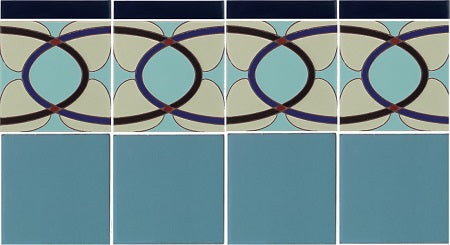
Geometrical Ellipse A Wainscot Concept
Geometrical Ellipse A - Wainscot Concept

Ellipse is one of my favorite new motifs that works great as single or double row accent strip for a kitchen backsplash or bathroom wainscot. The simple, soothing inter-connected ellipse pattern is slightly contemporary but takes its design cue from Art Deco styles.

Geometrical Ellipse B is a new glazed ceramic tile pattern

Further, the hand-painted glazes provide traditional artisan craftsmanship and variation. The patterns are all more contemporary than our traditional Spanish and Malibu lines.

Geometrical tile pattern glazes are from the Malibu Field Tile palette and make designing easy and fun. In fact, the flexibility in the Geometrical deco line lies in  the ability to pair and complement the patterns with colors from the 50+ available glazes from our Malibu Field Tile collection. To make it easy, all the colors used in the pattern are identified on the site. Malibu Field Tile are available in 3"x3", 6"x6", 4"x4", 4"x5", 6"x6" and 4" Hexagon. You'll also find a full line of trim and molding.

Aragon is another new pattern using a classic cross and quatrefoil motif.  It's available in four standard colorways.  I love the simplicity in this classic black and gray colorway.

Argon is a Moorish-inspired pattern shown here in classic black and grey
Geometrical Aragon is a Moorish-inspired pattern shown here in classic black and grey

The colors and pattern motif can really change the mood. Look what happens when the same pattern has soothing earth tones juxtaposed to charcoal to create a checkerboard. The cherry red glaze outlines each cross and makes it really pop.

Geometrical Aragon 2CD is a new decorative ceramic tile pattern
Geometrical Aragon is new pattern. Colorway 2CD is shown here.

Malibu Cherry Red is a stunning glaze with lots of natural variation. I can't wait to see a fireplace or pool sideboard adorned in the color. I'll let the color segue into another new pattern, Weave. Here, the Geometrical Weave pattern uses that bright red and white to really add a pop of color and bold design.

Weave is pattern in the new Geometrical line.
Shown here in Cherry Red and White.

Red not your color? Want to mix up the pattern? Look at how playful and sophisticated, this pattern can be when a mix of colors is used.

A mix of colors in the Weave pattern break all the rules
A mix of colors in the Geometrical Weave B pattern breaks all the rules

Remember, the Geometric glazed ceramic tile patterns are available in 6-, 5-, 4-, and 3-inch square formats. Each pattern is offered in at least four colorways. These high-fired, quality tiles are suitable for indoor or outdoor use. The tiles are hand-painted in the USA using the traditional "Cuerda Seca" (dry cord) technique. Expect variation in the glaze colors, as well as a slight relief from pooled glazes. These tiles can also be made for submerged wet applications, such as pools, by applying a clear overglaze. For floor applications, grit can be added to the glaze to reduce slippage. Tiles are made-to-order so please allow about four weeks, including transit times, for delivery.

Want to see more? Take a look at all of our glazed decorative Geometrical tiles. These tiles offer the prefect decorative solution.


Tuesday, August 12, 2014

Decorative Tile in Commercial Design


While I prefer the quiet residential neighborhoods for my morning walks in Los Angeles, crossing commercial swaths and busy streets can't be avoided in California's most populous city of 3.8 million people. Surprisingly, I've discovered some stunning uses of decorative tile in commercial design on the storefronts and facades of many buildings that pay homage to this state's romance with tile during the early 1900s.

Decorative tile adorn this commercial building on Wilshire Blvd. in Beverly Hills
Decorative tile adorn this building on Wilshire Blvd. in Beverly Hills
An up-close look at the pattern details of a commercial tile facade.
An up-close look at the pattern details of the tile facade.

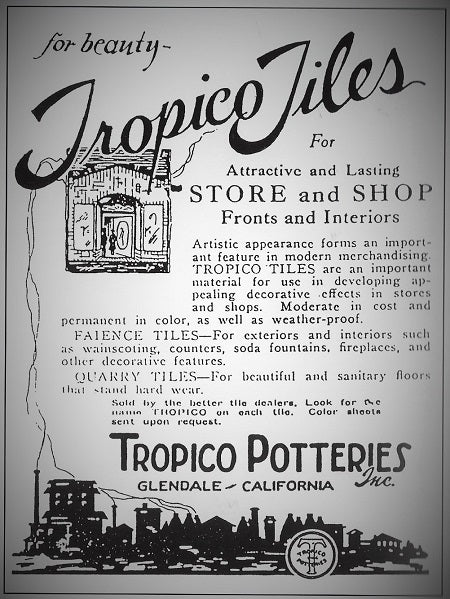
You may remember last month's post, A Book Recommendation for California Tile where I review California Tile: The Golden Era 1910-1940: Hispano-Moresque to Woolenius. An example of California's love for tile, specifically for commercial or business use, can be found on page 172 of the publication with this vintage advertisement for Glendale, CA-based Tropico Tiles by Tropico Potteries.

Tropico Tiles Ad showing the influence of Decorative Tiles in Commercial Design
Tropico Potteries advertisement from The Building Review, June 1922.
Courtesy of the Tile Heritage Foundation Library.

Further illustrating the expansive use of richly patterned tile, or faience tiles as they were commonly referred to about a century ago, can be found along quaint storefronts along South La Brea Avenue, where each business boasts its own unique decorative tile design.

Spanish and Moorish designs influence the border patterns.
Spanish and Moorish designs influence the border patterns along this storefront.

The strong Spanish and Moorish influences are seen in the border pattern motifs and use of terracotta colors in the main field.

This original commercial tile installation can be found on S. La Brea Ave. in Los Angeles, CA
This original commercial tile installation can be found on S. La Brea Ave. in Los Angeles.

A true testament to the durability of tile is not just time; but, their ability to withstand harsh urban environments, as well as repeated abrasive cleaning of graffiti in this urban locale.

Tiles stand the test of time and graffiti in L.A.'s urban locale.
The use of bright orange, yellow, black, turquoise and aqua colors are tell-tale signs of the optimistic color palette commonly used in the early 1900s.

Bright colors on the tiles date the tiles to the early 1900s
The bright colors date the tiles to the early 1900s.
You can see how classic tile patterns and design are always being re-interpreted with updated colors, such as the bright yellow and turquoise, mixed with new designs, such as the triangular accent strip.

The designs you've seen thus far were all found on storefronts – below the window panes, down to the sidewalk. They are reminiscent of a slower time when folks walked the boulevard for their needs. Unfortunately, these commercial installations are nearly invisible now as we zoom past storefronts in our cars, making sure to meet deadlines imposed by a harried schedule.

Lastly, I want to share a rather unique installation that perfectly illustrates how a classic pattern and color palette can remain nearly unchanged from a pattern still available today.

Tiles create interest in this unusual commercial application.

In the image above, you'll notice that the tiles create a cascade-like effect below the Spanish Baroque architectural details of this structure. The tile design flows up from below the ground level to just below the second level. The tile pattern, which has the look of water, effortlessly draws attention to the details.

Tile ribbons cascade from the Spanish Baroque window details.
Tile ribbons cascade from the the Spanish Baroque window details down to the ground where solid-colored field tiles are placed.

Tile ribbons cascading from the Spanish Baroque window details emulate a trickling stream.
Tile ribbons start and end with a classic Spanish tile pattern.
Upon closer look, you can see that the tile ribbons start and end with a classic Spanish tile pattern.

Decorative Tiles in this historic installation match a pattern Avente sells today.
The decorative tiles used in this historic installation match a pattern Avente Tile sells today. How's that for timelessness?

The hand-painted tile that you see in this design looks very similar to our Barcelona Design Quarter San Jose tile.
Avente Barcelona's San Jose Tile Design Quarter

There's something to be said for classic tile patterns and colors – even in commercial design. Do you agree? For Spanish Tile Design inspiration, see our extensive collection of Hand Painted Spanish Tile Design Ideas.


Tuesday, April 15, 2014

Tile Patterns: Playing with Pinwheel Designs


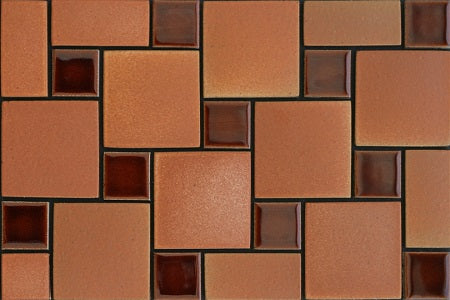
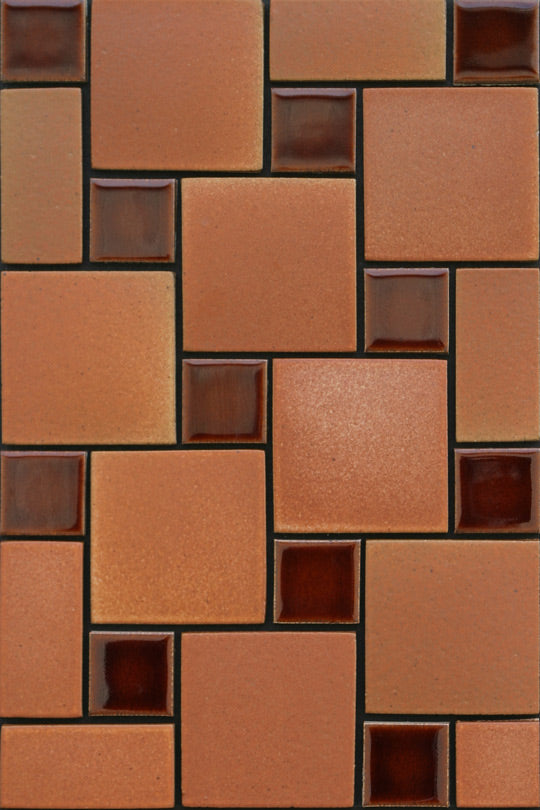
The pinwheel pattern is a popular and versatile tile layout that adds great visual interest by integrating solid color with decorative tiles into a timeless design. Here's a great example of a pinwheel tile pattern that pairs glazed ceramic dots with large ceramic tiles in a matte finish.

A pinwheel pattern with striking gloss and matte finishes.
A pinwheel pattern with Yucatan Glazes in striking gloss and matte finishes.
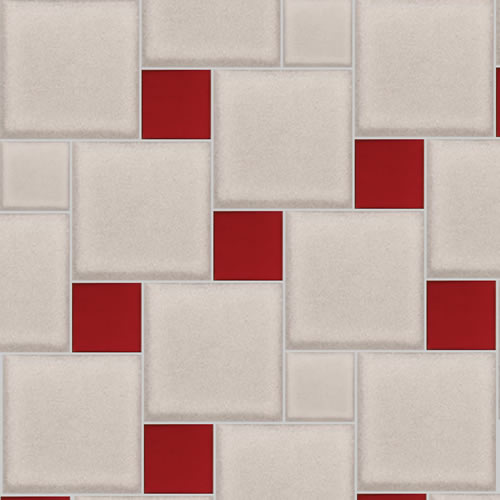
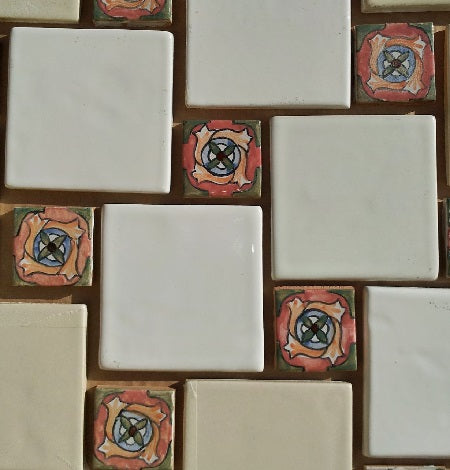
You can create a pinwheel pattern using only plain, solid color field tile. In the example above, tiles in similar colors are set-off by contrasting matte and gloss glazes. You can also add brightly glazed tiles with neutral colors to add a punch of color. If you're hesitant of using too much color in the pattern, then consider randomly alternating the brighter colors dots with dots in the same glaze as the larger tile, as seen in the example below.

Brightly colored glazed tiles can be randomly added to add interest to the design.

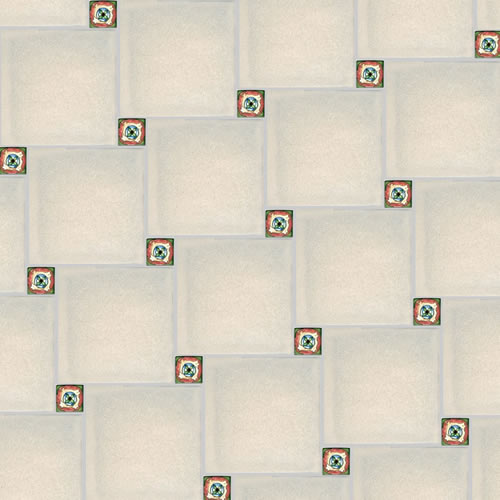
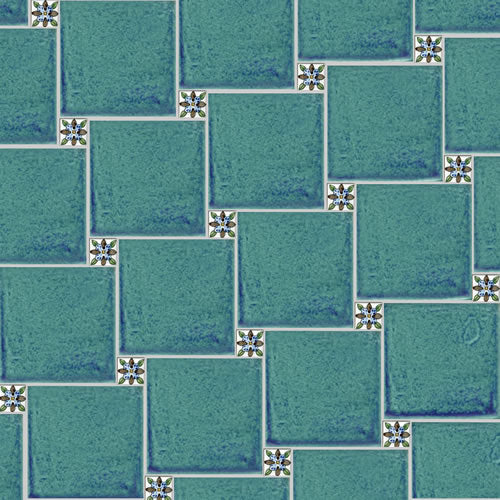
Or, you could choose to incorporate decorative tile with plain field tile, as seen in the two concepts show below.

Decorative 1" ceramic tiles, referred to as dots, can be paired with 4" plain white tile.

Decorative 1" ceramic tile dots are paired here with 4" plain blue tile.

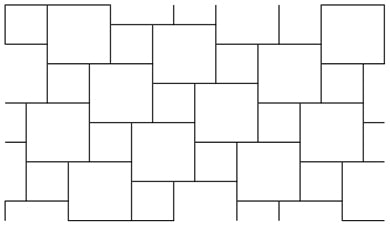
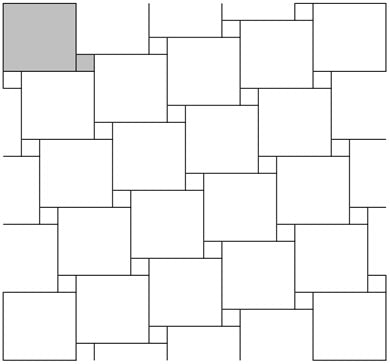
The pinwheel pattern is created by combining two different tile formats, usually with squares of different sizes.

A pinwheel pattern for tile often uses two different sizes of square tile.
A pinwheel pattern for tile often uses different sizes of square tile.

But, you can also create a pinwheel using tiles in different formats, such as squares and rectangles.

A Pinwheel Pattern for tile can use both square and rectangular formats.

When using square formats, you can use two squares that are relatively close in size.

Large Square / Medium Square Pinwheel
The pinwheel pattern is a common tile layout.

Or, you can use squares that are distinctly different in size.

Small "dot" tiles used with a much larger format tile create a pinwheel.
Small "dot" tiles can be used with larger format tile to create a pinwheel.

The pinwheel pattern works equally well on floor installations as it does for a backsplash or wall. In this installation, Mission Red Rustic Pavers in different formats are paired with glazed field tile. This random pattern draws its design inspiration from the classic pinwheel pattern.

This random floor tile pattern draws its inspiration from the pinwheel pattern.
This random pattern draws its inspiration from the pinwheel pattern.

Tile Tip: Calculating Other Tile Formats
If you aren't using a standard layout where we provide the ratio of tiles required, or you find yourself with uncommon tile sizes, then you'll need to calculate the tiles required by finding the ratio of small tiles to larger tiles using the exact area of each tile. So, measure the tiles and get out the calculator, then follow these easy steps
  1. Find the exact square inches of each tile to get an accurate amount. Do NOT use the tile's nominal dimensions.
  2. Find the area of the large tile in inches.
  3. Find the area of the smaller tile in inches.
  4. Divide the the area of the smaller tile by the larger tile.
  5. The ratio can be used to determine the number of smaller and larger tiles required for any job.
Example
Say the exact dimensions of the larger tile are 12"x12"; the smaller tile dimensions are 4"x4".
  • 12"x12" = 144 sq. inches
  • 4"x4" = 16 sq. inches
  • 16 / 144 = 0.1111
For a tile job that requires coverage of 100 sq. ft., you'll need 11.11 sq. ft. of 4"x4" and 88.89 sq. ft.of the larger format tile.

A Tile's Nominal Size 
Remember that tile is sold in nominal sizes. A 12"x12" tile might be as small as 11-5/8" or as big as 12-1/2".  Nominal means "about." Read more about nominal tiles sizes on our website.

The percentages shown are based on a full layout with no cuts. Actual percentages will vary depending on the area to be tiled and the layout.

Tile Tip
Perform a dry layout before you start. Layout the tiles in the pinwheel pattern using the grout width you desire. When you do this before installing, you will be able to pinpoint problems. Remember, with any layout, you want to avoid small cuts, cuts on small tile, and cuts by doorways on flooring tile. You will minimize waste, save time and avoid problems with a dry layout.

A dry layout with Andalucia dots & Yucatan Milkweed 4"x4"
This dry layout features our Spanish Andalucia ceramic tile dots and Yucatan ceramic tile in Milkweed 4"x4".

To see more tile layout patterns besides the pinwheel pattern discussed here, see our post on Rustic Cement Tile Paver Patterns.


To learn more about tile patterns, see my previous posts on Tile Tips for the Pattern Addict and Tile Tips for the Pattern Shy. You'll be a pattern pro!

Tuesday, July 3, 2012

Spanish Tile as Building Material, Part 2

In my last blog post, Spanish Tile as a Building Material, Part 1, I wrote about the extensive use of ceramic tile as an architectural and sustainable necessity in the city of Zaragoza, the capital of the region of Aragon. In Part 2 of this three-part series, my focus will be on Teruel (a World Heritage site as designated by UNESCO). 
A memorial to the tragic story of "The Lovers of Teruel" is further decorated with various shapes, sizes and colors of ceramic tile.
The entrance to the fortress-like city of Teruel features a depiction of the young lovers Juan Diego de Marcilla and Isabel de Segura Teruel.  
As an admirer of all things tile, and as one who is accustomed to looking down at floors, this visit to Teruel had my attention happily transfixed upon this city's well-preserved walls and massive towers.

Ceramic’s Role in Mudejar Art

As a center for Mudejar art, a style influenced by Islamic tradition and more contemporary European architectural styles, the fortress-like city is characterized by its extensive use of brick and ceramic tile not only within the centuries-old structures, but also on their façades.

The brick and ceramic tile staircase leading up to Teruel.
This brick and ceramic tile staircase leads to the city of Teruel.

According to UNESCO, the Mudejar art in the Aragon region developed as a result of the Christian Reconquest in the early 12th century. Following a series of campaigns to recapture territory from the Moors, such as in Spain and Portugal, Christians of the region allowed the Moors to remain on the reconquered territories, going so far as to allowing the Moors to keep their own culture and religion, most importantly, their expression of art. 

Because of the symbiotic relationship between Gothic style and Muslim influences, Mudejar art and architecture flourished in the Teruel region, as can be seen in this picturesque city’s churches and cathedrals, most notably the cathedral tower (1257), the tower of the church of La Merced (late 16th century), the tower of San Martin (1315), the tower of the church of San Pedro (14th century), and the tower of the church of El Salvador (12th-13th centuries). Further examples of the importance of glazed ceramic tile products as a building material are not only evident on these graceful towers, but also throughout this enchanting historical city.

The tower of El Salvador features multiple levels of white and green ceramic tiles.
The breath-taking view from the top of El Salvador’s tower.
The twin tower of San Martin, El Salvador, dates from the beginning of the 14th century, although it was rebuilt in 1677 after it collapsed. The tower has several levels bordered with tiling in rhomboid patterns, borders and semi-circular arches, decorated with white and green tiles.

The white and green ceramics used throughout the city feature rhomboid patterns, borders and semi-circular arches.

The white and green ceramics used throughout the city feature rhomboid patterns, borders and semi-circular arches.
Here's an up-close look at the various shapes and sizes of the white and green ceramic tiles used throughout the city of Teruel. 
In my next post, I’ll take you on a journey to Valencia, where Cevisama, (the International Ceramic Tile and Bath Furnishings Show) is held annually. In the meantime, you can check out the beautiful hand-painted ceramic Spanish tiles offered by Avente Tile

Many thanks to Tile of Spain, the umbrella brand managed jointly by the Trade Commission of Spain in Miami, FL, and the Spanish Ceramic Tile Manufacturer’s Association (ASCER) in Valencia, Spain, for the opportunity in participating in their “Reign in Spain A&D Tour.”