Showing posts with label accent tile. Show all posts

Tuesday, January 13, 2015

Geometrical Ceramic Tiles Ring in the New Year


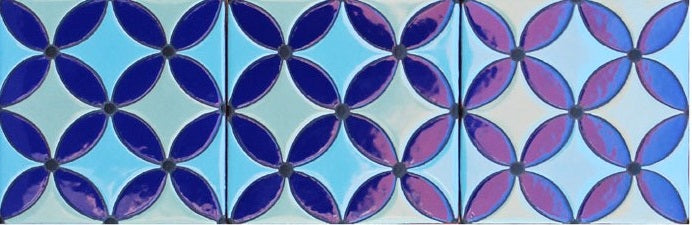
As the new year starts with full force, I think it only fitting to share some of our new tile patterns and lines. This week, I share our new glazed ceramic line. It's a small line that carriers a large, and very popular, design punch. Our Geometric Geo 10 and Traditional Anillos, or Ring pattern, has been very popular in cement, so it's with great pleasure that we are now offering both patterns in a glazed ceramic tile format.

Transition Geo 10 in Glazed Ceramic Mimics Our Geo 10 Cement Tile
Geometrical Circles B in Glazed Ceramic mimics our Geo 10 Cement Tile
The new line, Geometrical Ceramic Tile, melds classic, hand-painted glaze techniques with modern, geometric patterns to achieve an absolutely stunning look. Ideal for kitchen backsplashes, accent strips or anywhere a splash of color, pattern and more modern design is wanted.

 Transition Rings pattern mimics our Anillos cement tile
Our Geometrical Rings A pattern mimics our Anillos cement tile
The glazed ceramic tile patterns are available in 6-, 5-, 4-, and 3-inch square formats. Each pattern will be offered in four colorways, and several new patterns will be released by the end of the month. You can complement these decorative tiles with field tile and trim from from our Malibu Field Tile.

Transition Geo 10E is one of the new patterns and colors available in glazed ceramic tile
Geometrical Ceramic Tile 10E is one of the new patterns and colors available in a glazed ceramic tile format

If you have a small backsplash area where a large pattern or cement tile in an 8"x8" format is hard to fit, we recommend using our Geometrical Ceramic Tile line. Or, if you want to carry the same geometric motif with a different look, these tiles offer the prefect decorative solution!

Tuesday, August 12, 2014

Decorative Tile in Commercial Design


While I prefer the quiet residential neighborhoods for my morning walks in Los Angeles, crossing commercial swaths and busy streets can't be avoided in California's most populous city of 3.8 million people. Surprisingly, I've discovered some stunning uses of decorative tile in commercial design on the storefronts and facades of many buildings that pay homage to this state's romance with tile during the early 1900s.

Decorative tile adorn this commercial building on Wilshire Blvd. in Beverly Hills
Decorative tile adorn this building on Wilshire Blvd. in Beverly Hills
An up-close look at the pattern details of a commercial tile facade.
An up-close look at the pattern details of the tile facade.

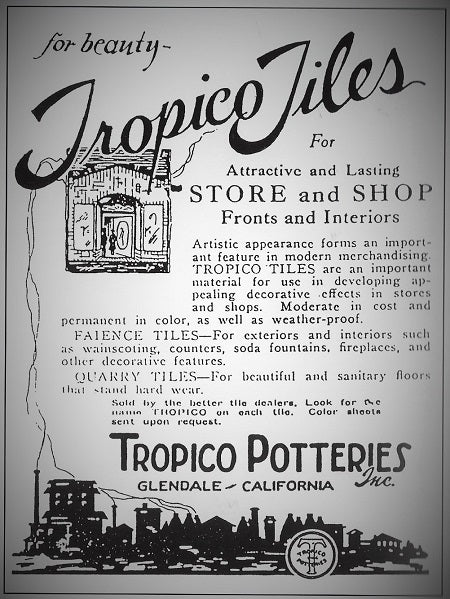
You may remember last month's post, A Book Recommendation for California Tile where I review California Tile: The Golden Era 1910-1940: Hispano-Moresque to Woolenius. An example of California's love for tile, specifically for commercial or business use, can be found on page 172 of the publication with this vintage advertisement for Glendale, CA-based Tropico Tiles by Tropico Potteries.

Tropico Tiles Ad showing the influence of Decorative Tiles in Commercial Design
Tropico Potteries advertisement from The Building Review, June 1922.
Courtesy of the Tile Heritage Foundation Library.

Further illustrating the expansive use of richly patterned tile, or faience tiles as they were commonly referred to about a century ago, can be found along quaint storefronts along South La Brea Avenue, where each business boasts its own unique decorative tile design.

Spanish and Moorish designs influence the border patterns.
Spanish and Moorish designs influence the border patterns along this storefront.

The strong Spanish and Moorish influences are seen in the border pattern motifs and use of terracotta colors in the main field.

This original commercial tile installation can be found on S. La Brea Ave. in Los Angeles, CA
This original commercial tile installation can be found on S. La Brea Ave. in Los Angeles.

A true testament to the durability of tile is not just time; but, their ability to withstand harsh urban environments, as well as repeated abrasive cleaning of graffiti in this urban locale.

Tiles stand the test of time and graffiti in L.A.'s urban locale.
The use of bright orange, yellow, black, turquoise and aqua colors are tell-tale signs of the optimistic color palette commonly used in the early 1900s.

Bright colors on the tiles date the tiles to the early 1900s
The bright colors date the tiles to the early 1900s.
You can see how classic tile patterns and design are always being re-interpreted with updated colors, such as the bright yellow and turquoise, mixed with new designs, such as the triangular accent strip.

The designs you've seen thus far were all found on storefronts – below the window panes, down to the sidewalk. They are reminiscent of a slower time when folks walked the boulevard for their needs. Unfortunately, these commercial installations are nearly invisible now as we zoom past storefronts in our cars, making sure to meet deadlines imposed by a harried schedule.

Lastly, I want to share a rather unique installation that perfectly illustrates how a classic pattern and color palette can remain nearly unchanged from a pattern still available today.

Tiles create interest in this unusual commercial application.

In the image above, you'll notice that the tiles create a cascade-like effect below the Spanish Baroque architectural details of this structure. The tile design flows up from below the ground level to just below the second level. The tile pattern, which has the look of water, effortlessly draws attention to the details.

Tile ribbons cascade from the Spanish Baroque window details.
Tile ribbons cascade from the the Spanish Baroque window details down to the ground where solid-colored field tiles are placed.

Tile ribbons cascading from the Spanish Baroque window details emulate a trickling stream.
Tile ribbons start and end with a classic Spanish tile pattern.
Upon closer look, you can see that the tile ribbons start and end with a classic Spanish tile pattern.

Decorative Tiles in this historic installation match a pattern Avente sells today.
The decorative tiles used in this historic installation match a pattern Avente Tile sells today. How's that for timelessness?

The hand-painted tile that you see in this design looks very similar to our Barcelona Design Quarter San Jose tile.
Avente Barcelona's San Jose Tile Design Quarter

There's something to be said for classic tile patterns and colors – even in commercial design. Do you agree? For Spanish Tile Design inspiration, see our extensive collection of Hand Painted Spanish Tile Design Ideas.


Tuesday, May 27, 2014

Spanish Tile Details Charm this Los Angeles Neighborhood


The Memorial Day holiday marks the unofficial start of summer for just about everybody in America. I hope you enjoyed yours. For me, here in Los Angeles, I know summer is almost here not just by the long, warmer days but the early and relentless songs of the mockingbird - sometimes too early and way too long into the night.  These longer days allow longer walks in my Los Angeles neighborhood.

Spanish Tile adorn the riser and column on this Los Angeles home
Spanish tile adorn the riser and column on this Los Angeles home.

During each walk, I usually spy decorative tiles in outdoor settings that adorn the Spanish and Mediterranean homes that were influenced by Mission, Spanish, and Spanish Revival architecture. The asymmetrical arch is a rich architectural feature; but, look at the Spanish tile on the column. These are original tile circa 1928.

Spanish Tile on a column circa 1928

Brightly colored tile are influences of Spanish Revival architecture
Brightly colored tile are influences of Spanish Revival architecture. 

I do have a soft spot for tile and love seeing how decorative tile is used to add a splash of color or touch of interest to a home. Exterior stair risers are of course a common home for Spanish tile. This small, inviting patio places Spanish paver tiles and decorative Spanish tiles both on point. This "on point" layout for pavers can help small spaces like a front patio seem more expansive.

Both pavers and decorative riser tiles are on point in this open courtyard.
Both pavers and decorative riser tiles are "on point" in this open courtyard.

For a more private patio, the owner of the home below chose a high wall with Moroccan details and wood for the entry. And who wouldn't want a turret for their second-story bedroom? It's almost story book material!


Spanish tile, wood and Moroccan detailing provide a provide a provide entry.
Spanish tile, wood and Moroccan detailing provide an inviting entry.

But, let's get a closer look at those Spanish stair riser tiles.

Spanish tiles in the same pattern adorn these stair risers
Spanish tiles in the same pattern adorn these stair risers.

Not as common is the use of patterned cement tile. There is one unique example that I want to share. I love the quaint look of patterned cement tiles placed in the cement walk of this home.


Patterned cement tile placed in a poured cement walkway
Patterned cement tile placed in a poured cement walkway add interest.

The color and pattern in the walk guide you to this stunning recessed entry.


The cement tiles in the walk complement the color and pattern in this entry
The cement tiles in the walk complement the color and pattern in this entry.

I hope you enjoyed exploring just a few of my favorite homes near the Los Angeles neighborhood where I reside. These are great examples of  how Spanish tile and cement tile can be used to complement an existing design, while adding curb appeal. Throughout the summer, we'll explore more homes in the neighborhood and share additional ways to bring tile outside!

Want to add some Spanish tile charm to your home? Then look through our Spanish tiles or browse our Ceramic Tile Design Ideas where you can find a large collection of projects showcasing our handmade and hand-painted Spanish tile. Let us know how we at Avente Tile can assist you!


Tuesday, February 18, 2014

Designing with Tile: Fireplaces & Hearths

An ever-increasing back-to-basics philosophy is leading homeowners towards the path of refreshing and renewing the look of their living areas. Be it a fresh coat of paint, updated flooring, dramatic lighting, and so on, the need for a soothing environment trumps even the most prudent of budgets.

Happily, along with this desire for something new and different, fireplaces are also enjoying their place in the renewal process with the limitless decorative possibilities of handmade cement tile, porcelain tile, glass tile, ceramic tile, and mosaic tile.

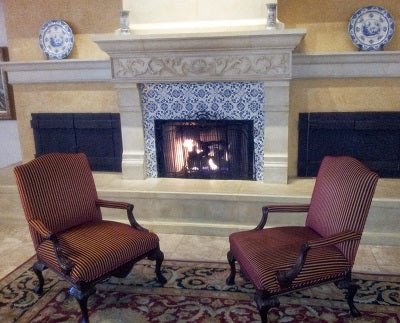
An inviting fireplace with charming handpainted tiles

The increased awareness of tile’s long-lasting beauty has not only made kitchen and bathroom backsplashes a showpiece, but the same theory has held true for fireplace hearths and surrounds as well. With a surge in home remodeling projects and newly built homes, homeowners are looking for something different and more personalized to their taste, character and lifestyle. Designers, bloggers, and design-oriented publications have dutifully observed this trend, and have embraced the use of decorative tile fireplaces.

Tile offers flexibility to the architect and designer like no other material with its expansive color palette, sustainable properties, and timeless patterns and designs. Let's first look at handcrafted cement tiles, which provide both long life and distinctive beauty.

Using a gray-scale color palette, or any other monochromatic color scheme, creates a look that is understated, yet beautiful. Consider a two-tone color scheme (shown below) if you'd like to pair cement tile with natural stone. Although not one piece will stand out over another, all aspects of the space work together to create a cohesive design.

Yuna cement tile fireplace
The gray and white tones of the Yuna traditional cement tiles frame this fireplace and perfectly coordinate with the marble hearth and mantle.

Further, the versatility of cement tile as a building material is not restricted solely to indoor spaces. You can transfer the same rich and silky feeling of cement tile to the outdoors where you and your guests can experience a new environment.

Remember, although cement tile can be used outdoors, it cannot be used in frosty environments. If your project is located where frost or freezing temperatures are common, then you should use a porcelain or vitreous tiles for your project. Here are some wonderful examples of indoor/outdoor tile fireplaces.

Outdoor living area with a fireplace featuring a ceramic tile Pomegranate mural
Outdoor living area with a fireplace featuring a ceramic tile Pomegranate mural.


Spanish ceramic tile outdoor fireplace
Spanish style fireplace with imported ceramic tiles.
Image via Studio H Landscape Architecture.


The firebox was built off the floor so the fire could be visible from the bed. Moroccan tile from Urban Archaeology.
The firebox was built off the floor so the fire could be visible from the bed.
Moroccan tile from Urban Archaeology. Image via House Beautiful.


A mid-century modern, two-sided fireplace featuring tile by Heath Ceramics. Image via Apartment Therapy.
A mid-century modern, two-sided fireplace featuring tile by Heath Ceramics.
Image via Apartment Therapy.


e right at home with the terracotta floor pavers, stone molding and black granite mantle and bench.
Hand-painted Albacete Spanish ceramic tiles are right at home with the terracotta floor pavers, stone molding and black granite mantle and bench.


Bruce Palmer Interior Design used glass mosaic tiles by Walker Zanger to create a contemporary fireplace. Image via Houzz.

Which type of tile would you use for your next indoor or outdoor fireplace or hearth project? Do you prefer to make your fireplace a focal point of the room, or would you rather it blend in?


Tuesday, December 3, 2013

Portuguese Ceramic Tile Artistry

Panel of Portuguese ceramic tiles by Jorge Colaço (1922)
Panel of Portuguese ceramic tiles by Jorge Colaço (1922), representing Henry the Navigator at the Sagres Promonory. Lisbon, Pavilhão Carlos Lopes. Photo by Joaquim Alves Gaspar, Lisboa, Portugal

According to the curators of the Palácio Nacional de Sintra (National Palace of Sintra) in Portugal, the use of azulejos (a form of Portuguese or Spanish painted, tin-glazed, ceramic tile) in decoration is unique when compared with other countries by the way it adapts to architecture on a monumental scale. During the 15th century, the azulejos spread to the Iberian Peninsula and flourished together with other Mudéjar crafts. In that period, the azulejos used in Portugal came from Seville, the only supplier manufacturing center in the first half of the 16th century. Before that, and until the second half of the 15th century, only the alicatado (mosaic formed of polygonal, colored glazed tiles) was in use.

Now, you too can bring the look and feel of Portugal into your home by using our Portuguese Ceramic Tiles in your next project. Inspired by centuries-old styles from Portugal, these decorative ceramic tiles are beautifully hand-painted on red bisque and finished with a high-gloss glaze. Crazing is normal, adding character and uniqueness to each tile. Each hand-painted design includes borders, corners, large decorative tiles and accent dots. The vibrant colors of our decorative Portuguese ceramic tile collection, such as this kitchen backsplash using our Oporto series, stands out when paired with our Portuguese Natural Ceramic Tiles.

As always, our first priority is to offer excellent ceramic tile products backed by our expertise and customer service. So, how can we help you with your ceramic tile needs today?

Featured Tile


Portuguese Oporto 6x6 Hand Painted Ceramic Tile

Portuguese Oporto 6" x 6" Hand Painted Ceramic Tile

Portuguese Portalegre 6 x 6 Hand Painted Ceramic Tile

Portuguese Portalegre 6" x 6" Hand Painted Ceramic Tile

Portuguese Ruan 6 x 6 Hand Painted Ceramic Tile

Portuguese Ruan 6" x 6" Hand Painted Ceramic Tile

Portuguese Natural 6 x 6 Hand Painted Ceramic Tile

Portuguese Natural 6" x 6" Hand Painted Ceramic Tile


Pinterest logo

Pinterest: Ceramic Tile & The Holidays

Destination: Portugal
Color: Blue
"People are happier at Yuletime because they take the milk of human kindness out of the deep freeze" — Arnold Glasow

Now that Thanksgiving is over, the frenzy of shopping and cooking for the winter holidays begins. Aside from feeling overwhelmed, these celebrations happily rejuvenate the feelings of warmth that only family and friends can offer.

Throughout these holidays, the kitchen and main living spaces will be the most popular areas. With your guests undoubtedly chatting, eating, or lending you a hand, you'll want to keep things simple, organized and clean. When you choose one of our hand-painted Portuguese, Spanish, California, or Malibu ceramic tiles, complemented by our hand-painted ceramic field tiles, you'll definitely keep things simple because ceramic tile is not only easy to clean, it's also hypoallergenic, and inherently antimicrobial!

Did we inspire you? Then visit our pages on houzz.com, our boards on Pinterest, and browse through dozens of our Ceramic Tile Design Ideas portfolio page where you can find a large collection of projects showcasing our handmade and hand-painted ceramic tile, cement tile, decorative tile, mosaic tile, and so much more. Let us know how we at Avente Tile can assist you!


Tuesday, September 17, 2013

Interview with Lilywork Artisan Tile, LLC

Today's post is the second in our Tile Artisans Interview Series. It’s a joy to share their love of tile. By getting to meet the artisan, you begin to discover both their techniques and inspirations. I met Esther of Lilywork Tile about eight years ago at Coverings, an annual tile and stone trade show. I was captivated by the unusual dance that her complex glazes played with unusual textures and classic patterns. Esther has a passion for tile and you’ll find that in every Lilywork Artisan Tile that is made. — Bill Buyok


Bosphorous/Rosette Focal by Lilywork Artisan Tile, LLC

1. How and when did you start creating your tiles?
Both Paul and Esther, owners of Lilywork, come from art backgrounds. Paul studied at the Tyler School of Art in Philadelphia. During this time, his mentor, Will Mead of Peace Valley Tile, introduced him to tile-making. It was here that Paul developed a passion for the craft that has been with him for the last 14 years. Paul had worked tirelessly to hone his craft, balancing his own business and, until recently, holding the position of Mold-maker at Moravian Pottery and Tile Works in Bucks County, PA. Esther, the other half of Lilywork, got her start at the Hartford Art School. Originally starting in printmaking and textiles, Esther quickly found her niche in tile-making. “I realized the layering of pattern, texture and color I wanted could best be achieved in the ceramic arts.”


Herringbone Backsplash by Lilywork Artisan Tile, LLC

2. As an artisan, what inspires your creations?
Lilywork owners gain inspiration from travels, pulling ideas from architecture and cultures across Europe and the Near East.


Ravenna Listello by Lilywork Artisan Tile, LLC

3. Now, of the many designs and projects, which stands out as your favorite? Why?
One of our favorite recently completed projects is a residential backsplash. It is a traditional space in a historic home using Lilywork field tile in the herringbone pattern. It also incorporates one of our more interesting textured field tiles, Bosphorous, and three-dimensional rosettes into the focal area. We were able to work more closely during the backsplash design process for this project.


Backsplash with 4" Field and Star+Cross Focal
by Lilywork Artisan Tile, LLC

4. What was the proudest moment for you and your hand-made tile business?
One year ago, this past April, we both began to work exclusively for our own company. It is something special to look back at what had been built from the ground up and now could sustain us, especially during a time when the economy was uncertain.


Concept 1 by Lilywork Artisan Tile, LLC

5. In promoting your creations, and to help gain greater exposure, which digital platforms do you use (Blogging, Facebook, Twitter, Pinterest, Instagram, etc.)? How do you use them to promote your hand-made tile business?
Facebook has been helpful for showing studio process shots. It is invaluable for designers, dealers and prospective clients to see and understand the hand-made process.


Concept 2 by Lilywork Artisan Tile, LLC


Concept 3 by Lilywork Artisan Tile, LLC

6. Which of these social media platforms has helped your business the most? How?
We self-promote via our website, and Facebook, which have been useful tools for people familiar with our business to further explore our products and concepts. Houzz has introduced our business to a wider market not yet familiar with Lilywork. We would like to work more with Pinterest, as time permits.


Babylonia Listello with 1" Field Tile by Lilywork Artisan Tile, LLC

7. Where do you see the company going from this point forward?
Lilywork recently moved to Stonington, CT, and we look forward to working locally, and direct to the trade in our new location.


Iznik Listello with 2" Decoratives by Lilywork Artisan Tile, LLC

Name: Paul & Esther Halferty
Company(s) Name: Lilywork Artisan Tile, LLC
Email: info@lilywork.com
Phone: 215-859-8753, 860-599-6050

Facebook: www.facebook.com/LilyworkTile
Website: www.lilywork.com


If you enjoyed this post, you might also enjoy reading about these Tile Artisans:

Tuesday, June 11, 2013

Affordable Luxury with Hand-Painted Field Tiles

Enjoy Long-Lasting, Affordable Luxury with Hand-Painted Ceramic Tiles

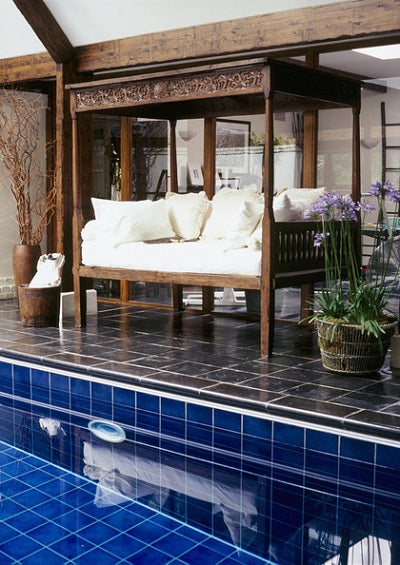
Enjoy Long-Lasting Luxury with Hand-Painted Ceramic Pool Tiles
Image via Lonny Magazine.

With summer just around the corner, it's time to clean and restore the backyard for a season full of fun and great memories. Along with washing the outdoor furniture, cleaning the grill for upcoming BBQs, and testing outdoor equipment, don't forget to refresh and update the look of your swimming pool with new richly colored, hand-painted ceramic field tile.

Field tile, or solid colored tile, is a tile found in the main "field" or area of an installation covering the walls, floors or steps of your swimming pool. In essence, field tile refers to a solid color tile. Of course, you can pair field tile with decorative ceramic tile to create a spectacular custom design.

In addition to their wide variety of uses, hand-painted ceramic tile offers more versatility and value than any other material with their resistance to abrasion, freeze/thaw conditions, and color permanence properties. With such a wide variety of deep, rich colors and sizes to choose from, ceramic tile gives you the freedom to create beautiful swimming pool designs that will withstand the elements. Here are several tile collections for you to consider when you're ready to update your pool tile:

Arles is a handmade tile with stunning, reactive glazes that are full of movement. Inspired by the fields of Provence, France, this series is available in five colorways.
Cracked Ice is composed of unique glass tiles in a myriad of geometric shapes, and several rich colors.
Pillow Chiclet offers a classic shape with a touch of softness. The wonderful translucent colors are hand-painted onto softly domed "pillow-like" tiles.
Yucatan takes its inspiration from old sprawling haciendas and villas found throughout the Mexican peninsular state.


Featured Tile


Yucatan Cobalt Ceramic Til
Yucatan Cobalt

Cracked Ice Slate Blue


Pillow Chiclet Royal


Arles Mist Ceramic Field Tile
Arles Mist


Pinterest logo

Pinterest: Celebrating Summer

Avente Tile's Blue Pinterest BoardAvente Tile's Pool and Ponds Pinterest Board
"And so with the sunshine and the great bursts of leaves growing on the trees, just as things grow in fast movies, I had that familiar conviction that life was beginning over again with the summer." - F. Scott Fitzgerald, The Great Gatsby

School is out, and dreams of summer adventures wait! For this month's Pinterest focus, we chose two of our Pinterest boards that best reflect this exuberance of upcoming trips and longer, fun-filled days.

Alongside summer's energy comes the urge to start a new project, perhaps one that has been set aside for years. Replacing cracked or broken pool tile or finally installing that fountain or water feature you've always wanted for the garden - now's the time!

Using handmade or hand-painted ceramic tile for your next outdoor project will not only enhance the look of your home, but you can rest assured the tile you choose will withstand the elements, too. For whatever project you choose, Avente Tile is here to help you reach any design goal on any budget. Our extensive ceramic tile Design Ideas gallery features a large collection of projects dedicated to inspiring you and your living space. How can we help inspire you?


Project Pick: Fountain with Spanish Tiles

Fountain with Spanish Tiles
The peaceful sounds of a water feature are enhanced by the presence of delightful hand-painted tile. Spanish Andalucia tiles are used to frame this outdoor fountain grotto, while Spanish Brushed Natural tiles are used around the front edge. Finally, the water's bright blue is enhanced with our Yucatan Cobalt tiles for the water level.

Like all our hand-painted tiles, the patterns are hand-brushed by the tile artisan. The Spanish tiles are created using the traditional Majolica glazing techniques. Because the hand of the artist is at work, you will see variation from tile to tile. Remember, these tiles can't be used in outdoor environments subjected to freeze/thaw cycles.

Feeling inspired? Take a look at our complete collection of hand-painted Spanish ceramic tile, read more about on this design, Fountain with Spanish Tiles, or explore other ceramic tile design ideas.