
Showing posts with label circles. Show all posts

Tuesday, January 13, 2015

Geometrical Ceramic Tiles Ring in the New Year


As the new year starts with full force, I think it only fitting to share some of our new tile patterns and lines. This week, I share our new glazed ceramic line. It's a small line that carriers a large, and very popular, design punch. Our Geometric Geo 10 and Traditional Anillos, or Ring pattern, has been very popular in cement, so it's with great pleasure that we are now offering both patterns in a glazed ceramic tile format.
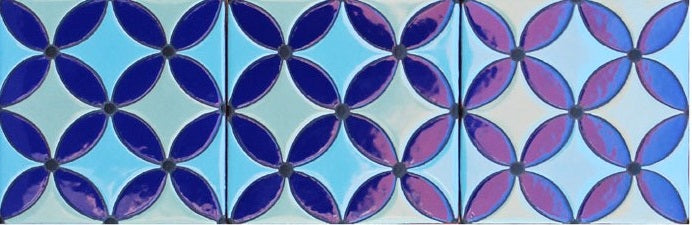
Transition Geo 10 in Glazed Ceramic Mimics Our Geo 10 Cement Tile
Geometrical Circles B in Glazed Ceramic mimics our Geo 10 Cement Tile
The new line, Geometrical Ceramic Tile, melds classic, hand-painted glaze techniques with modern, geometric patterns to achieve an absolutely stunning look. Ideal for kitchen backsplashes, accent strips or anywhere a splash of color, pattern and more modern design is wanted.

 Transition Rings pattern mimics our Anillos cement tile
Our Geometrical Rings A pattern mimics our Anillos cement tile
The glazed ceramic tile patterns are available in 6-, 5-, 4-, and 3-inch square formats. Each pattern will be offered in four colorways, and several new patterns will be released by the end of the month. You can complement these decorative tiles with field tile and trim from from our Malibu Field Tile.

Transition Geo 10E is one of the new patterns and colors available in glazed ceramic tile
Geometrical Ceramic Tile 10E is one of the new patterns and colors available in a glazed ceramic tile format

If you have a small backsplash area where a large pattern or cement tile in an 8"x8" format is hard to fit, we recommend using our Geometrical Ceramic Tile line. Or, if you want to carry the same geometric motif with a different look, these tiles offer the prefect decorative solution!

Monday, September 15, 2014

Interlocking Circles: The Power and History of Pattern in Design


For thousands of years, geometric shapes and symbols have decorated homes, structures, religious buildings and art work. Influenced by nature (such as the perfect hexagon of a honeycomb made by bees), geometry has, in essence, shaped our world.

Interlocking circle patterns graces the floor tiles of this corridor.
Interlocking circle patterns grace the floor tiles of this establishment's corridor. 

Seemingly, the most prolific use of geometry and shapes is the Islamic culture. Because followers of Islam were not allowed to use human forms in art or other creative channels, geometric shapes came to represent their view of the world around them.


A closer look at the interlocking circle pattern.

According to Math Munch, a website dedicated to mathematics, "Humans have been in awe of the symmetrical laws that seem to govern the universe for thousands of years, and they've developed a type of artwork called Sacred Geometry, a way of thinking that gives spiritual significance to geometric shapes. Sacred geometry can be found in religious artwork from many different cultures, and often uses tilings of regular polygons, the Platonic solids, and interlocking circles arranged in symmetric patterns."

Example of Islamic geometry in mosaic tile art form
Example of Islamic geometry in mosaic tile art form. Image via Math Munch.

In the case of our Geo 10 cement tile design, we have four overlapping/interlocking circles. According to John Lockerbie of catnaps.org, "It is a common pattern in Arabic and Islamic geometrical design work. The sinuous lines have equal weight and the spaces contained by the lines are equal in their visual weight, though alternate shapes appear set at right angles in a regular pattern."


Avente Tile's Geo 10 cement tile pattern features interlocking circles.

Interestingly, circles and curves seem to dominate Islamic arts and culture, from calligraphy to cursive writing to interlocking circles. With the interlocking circle pattern, the Flower of Life holds the most meaning as it depicts the basic molecular beginning of life. According to Andrew Monkman's post Sacred Geometry - Flower of Life, "The most common form of the 'Flower of Life' is a hexagonal pattern (where the center of each circle is on the circumference of six surrounding circles of the same diameter), made up of 19 complete circles and 36 partial circular arcs, enclosed by a large circle.

The Flower of Life pattern contains a vast Akashic system of information.
"Indelibly etched on the walls of temple of the Osirion at Abydos, Egypt, the Flower of Life contains a vast Akashic system of information, including templates for the five Platonic Solids." Image via Sacred Geometry.

A slightly modified version of this pattern can be found in our Geometric Moroccan Circle pattern:


Avente Tile's Geometric Moroccan Circle tile pattern,

Taking the interlocking circle element even further is Avente's Geo 35 pattern with its more modern version of an ancient pattern.

Avente Tile's Geo 35 cement tile pattern.

As you can see, Avente's Geometric line, or Geo Cement Tiles, pay distinct homage to the time-tested and centuries-old interlocking circle patterns found throughout all Islamic art forms.