Showing posts with label kitchen backsplash. Show all posts

Tuesday, July 28, 2015

Tile Tips for an Eye-Catching Backsplash


This post is a contribution to the Range Hoods Inc July Blog Hop & $50 Amazon Gift Card Giveaway. As a blog hop participant, we've been asked to write about Summer DIY & Home Improvement. Check out the link to read other DIY contributions, learn more about the blog hop, and a chance to win a $50 Amazon Gift Card.

A kitchen backsplash is one place you’ll be looking at a lot while you enjoy your home. It’s also one place that allows you to really emphasize your style. Creating an eye-catching backsplash that reflects your style and taste is easy with tile.

Patchwork designs create an eye-catching backsplash.
Patchwork designs create an eye-catching backsplash but take planning to achieve a balanced blend of color and pattern.

The choices and options are endless and range from a traditional fruit-themed mural, multi-colored mosaic, colorful Spanish tile patterns, or a muted bold pattern with cement tile. Consider the style and color palette of your cabinets, flooring, appliances and range hood. Then follow these three important tips that will point you in the right direction to create a winning kitchen backsplash. Don’t be afraid to splurge a little on the backsplash. It’s a small area and one you’ll enjoy almost every day!

  1. Decide on the countertop you want first. Then you can start talking tile and backsplash designs. Make sure the two complement each other. Don't draw attention away from a stunning counter with a busy tiled background. If the countertop is plain or simple, then let the backsplash be the focal point. Here are a few photos that show the "yen and yang" relationship of a counter and backsplash.  In the patchwork above, bold colors and strong patterns are placed next to clean white cabinets and counters with stainless steel appliances and hardware. The backsplash is both eye-catching and appealing because the cement tile patchwork is the dominant focal point.

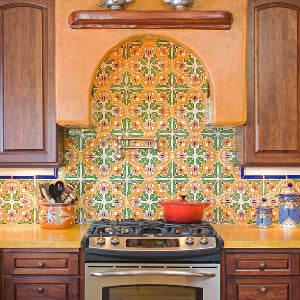
    Here’s another example of a bold, colorful backsplash that uses traditional hand-painted Spanish decorative ceramic tiles that really catch your eye. A plain counter, in a similar color that is dominant in the tile pattern, doesn’t take your attention away from the backsplash.

    Balance decorative pattern tiles in a backsplash with plain colors on the counter and floor.
    Above, a Spanish-inspired tile creates a bright and bold backsplash using Barcelona San Jose 6" x 6".  The tile pairs nicely with a simple solid-color counter.

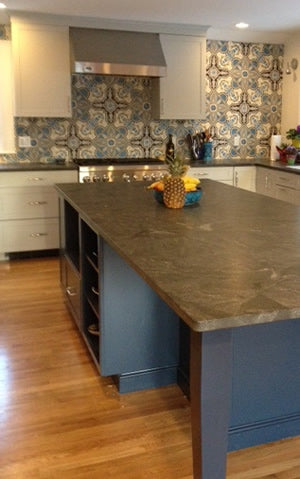
    Alternatively, the pattern in the cement tile backsplash below gets your attention while integrating a bold pattern that works flawlessly with the counter. Bold patterns can often be “toned down” with similar colors, neutral colors or colors without high contrast.

    A bold cement tile pattern is muted with neutral colors and hues similar to the counter and cabinets.

    Below, the Indian Teal brown granite countertop takes center stage. The decorative dots of hand-painted Spanish tile and plain field tile are the supporting cast.

    Small decorative accent tile or dots keep the backsplash interesting and don't detract from the handsome counter.

    The French cement tile backsplash pattern behind the stove below was customized to complement the colors in the granite counter and floor.  The backsplash tiles provide the eye-catching focal point; but, the porcelain flooring and granite counter really support the overall color palette, style and feel of the design.

    Consistent color choice with the decorative tile, counter, and floor make this design work.


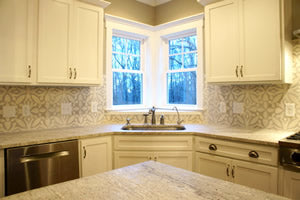
  2. Work with the available space. You can't fit 10 pounds of gold into a 5-pound sack. Large tiles with big patterns just don't work in that tiny wall space behind the sink with a big picture window - no matter how much you love that tile. It sounds obvious; but pictures make it very clear.

    Find the right scale of patterned tile to fit your space.

    Above, Cuban Heritage Design 110 2B 8″ x 8″ cement tiles require eight tiles to complete both the cross and medallion pattern. It works well for a large wall with no cabinets. The same impact could not be achieved below. There is only 18” between the cabinets and counter. However, decorative tile placed randomly throughout the backsplash and grouped to form a medallion create a warm, Tuscan feel.

    Olive tiles on a rustic ceramic body give this kitchen a Tuscan feel.
    Smaller tiles can be used randomly or grouped to create a medallion.

    Consider creating a mural with smaller, decorative tiles and frame with a lavish, textured molding if you don't have space for large pattern tiles.

    A framed tile murals below the range-hood accommodates the space perfectly.


  3. Define your style. A kitchen designer can really help. First, though, try to define the experience you want to achieve, the importance of aesthetics versus “ease of maintenance.” What colors do you like? Do you like clean lines and contemporary designs or classic patterns? Bright colors or muted colors? Vivid colors or earth tones? Here's a few examples of classic and contemporary styles that use tiles to define the design.

    Fruit, vegetable and flowers are a classic kitchen theme for a kitchen backsplash.
    Fruit, vegetable and flowers are a classic kitchen theme for a kitchen backsplash.

    Traditional cement tile patterns in hip colors work with this updated contemporary kitchen.
    Traditional cement tile patterns in hip colors work with this updated contemporary kitchen.

    If too much pattern scares you, consider "blocking tiles" to create one or two interest areas.

    Consider using Pinterest to collect ideas you like. Not only will you discover a theme that works, you’ll also be able to share your vision with your designer or friend who is helping with the design.
As you find your style and look for tile, keep these three rules in mind and you will end up with an eye-catching backsplash that you’ll love for years to come.  Don't miss the other posts that are part of Range Hoods Inc July Blog Hop & $50 Amazon Gift Card Giveaway.


Here's links to the other Blog Hop posts:

  1. July Blog Hop Post #1: 5 Elements of an Artful Kitchen by Artful Kitchens
  2. July Blog Hop Post #2: Budget Outdoor Décor Hacks… By Snazzy Little Things


What are you waiting for?  Get your chance to win a $50 Amazon Gift Card!

Tuesday, May 19, 2015

Elevations Relief Cement Wall Tile from Avente Tile


Last month, I reported some of my favorite tile trends and finds from Coverings in the my blog post Tile Trends 2015: Variety is the Spice of Tile. One of the most unique new tile designs I spotted at the show is a relief cement wall tile line from Aguayo Tiles called Elevations. Without further ado, Avente Tile is proud to announce the premier of this exciting design line of relief cement tiles.

Elevations is a new cement tile in relief for walls
Elevations is a new cement tile in relief for walls.
Shown here is Drop in the color Chocolate Mousse.

Avente Tile partnered with Aguayo Cement Tiles a decade ago because of their generations-long commitment to producing quality cement tiles. This line is truly unique for the industry because it eloquently combines geometric shapes in both convex and concave relief that, and because of its extensive color palette of more than 60 colors.


Elevations Concave Rectangles used as shower accent wall.
Shown in black, white, and shades of grey.

Six shapes are available: Drop, Concave Rectangles, Petals, 3D Hexagon, Concave Hexagons, and Angles. The edgy, contemporary designs of high relief geometrical tiles really stand out for their architectural value. They are suited for wall applications and can be installed with or without grout. Additionally, the tiles are available with a standard smooth surface or an optional waxed finish that provides a classy, satin sheen. The tile come pre-sealed with a penetrating sealer and are ready to install.


Concave Hexagon tile in Jet Black with a waxed finish

3D Hexagon tile in three shades of grey. Standard finish installed without grout.

Angles relief cement tiles in grey with standard finish.

Ordering Elevations Relief Cement Tile
These new, architecturally inspired tiles are available now. However, we recommend you purchase strike-offs in the colors you desire before placing a full order. Allow about three weeks for strike-offs to be made and delivered. Strike-offs are shipped via UPS International Air Freight from the factory and cost about $150-$200 per sq. ft.

Discover the architectural collection of cement relief tile, Elevations, online now. When placing a full order, allow a lead time of 8 to 10 weeks for your tiles to be crafted by hand, carefully packed and shipped. Like all our cement tiles, these shapes can be customized with your choice of colors from the Heritage Color Palette. Tiles can be purchased with a standard finish or waxed finished. All tiles come pre-sealed from the factory with a penetrating sealer. If you have any questions, just contact us to let us know what you need.


More Exciting Cement Tiles from Avente Tile
We've got more new cement tile lines that will be ready very soon. Next week, we'll show you our new Hexagonal Cement Tiles. Coverings 2015 provided us with some exciting new tile designs that we can't wait to share with you in the coming weeks.

Tuesday, March 17, 2015

Tile Inspiration For Your Next Kitchen Remodel

Guest post by Jane Blanchard, Modernize

Kitchen Tile
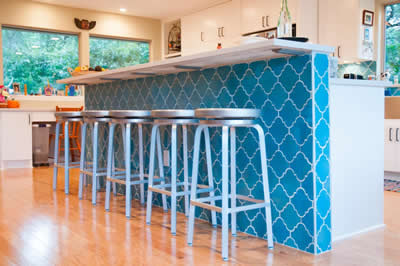
Vibrant blue Arabesque tile adds visual interest. Image via Modernize.
Tile is a popular choice for kitchen floors and backsplashes, so popular that even the priciest and most custom options can seem bland. One tile company is changing that, one beautifully unique tile at a time.

One thing you'll never find at Avente Tile is tile that looks like, well, any other tile you've seen at home improvement stores or most flooring and tile warehouses when seeking inspiration for your kitchen remodel. Avente specializes in handcrafted tiles that are guaranteed to make your floors or backsplashes stand out from the subway tile and stone tile crowd.


Handmade Cement Tile

If you've never heard of handmade cement tiles, you will. Though they haven't gained widespread popularity in the U.S. yet, handmade cement tiles are used the world over for their bright, true colors and their intricate hand-painted designs. One of the most popular uses for cement tiles is the creation of "rugs" on floors by strategically laying coordinating tiles in a pattern that mimics Persian or other rugs. Perfect for kitchens, where fiber or synthetic rugs can be a hazard, a tile "rug" gives bold color and visual interest while remaining durable and easy to clean. The wide range of colors are perfect for adding a pop of color to an accent area of a kitchen floor, or for inspiring your remodel to new heights of glamour.


Kitchen Tile Backsplash
Relief tiles add depth and dimension to this kitchen's backsplash. Image via Modernize.


Hand Painted Relief Tile

As tiled backsplashes become an integral part of any kitchen remodel, so do the options for backsplash-ready tiles. You've no doubt seen glass, stone, and even pebble backsplashes, but you've likely seen nothing as classically beautiful as hand-painted relief tile. Marrying the lovely forms of sculpture to lightweight tiles, relief tiles are perfect for mixing with other ceramic tiles to create unforgettable backsplashes that are one of a kind. These tiles are the perfect inspiration for traditional, retro or transitional kitchens, but proceed with caution -- the designs are so alluring that they run the risk of taking your kitchen remodel in a whole new direction.

For more tile tips and tricks, please visit Modernize.com.

Tuesday, November 25, 2014

Cement Tile Patchwork Makes Kitchen Backsplash Sing


Patchwork tile floors and walls using encaustic cement tile are incredibly popular. Patchwork is a great way to add color and pattern to any room. The cheerful designs make you smile.

A cement tile patchwork design was used for this kitchen backsplash
A cement tile patchwork design was used for this kitchen backsplash.
Photo credit: Avente Customer, Laurie Suarez.

Last week, I received a call from our customer Laurie Suarez of in San Clemente, CA. She was interested in using our Bayahibe C for a powder room wall and wanted to know how much inventory we had. In February of this year, I worked with Laurie on a patchwork design for her kitchen backsplash. I couldn't help but ask her how the project came out. She told me she loved her kitchen. She explained, "The cement tile patchwork really provided the pop of color she wanted for her white kitchen." A few days later, she was kind enough to share these photos with me.

Cement tile patchwork designs provide a colorful focal point for this kitchen
Image credit: Avente Customer, Laurie Saurez.

I have to agree, Laurie did a great job blending the different colors and patterns from our Traditional Cement Tile collection. While it may appear that a patchwork design is a random hodgepodge of tiles, it takes planning and smart choices to get the colors and patterns to make a design. Laurie admitted that she worked with several different layouts to achieve her design and that it took some time.

DESIGN TIP - Patchwork designs take planning to achieve a balanced layout with color and pattern. Try different layouts on paper. Print the layout you like best for your tile installer to use.

The use of quarter design patterns makes this cement tile patchwork unique
The use of quarter design patterns makes this cement tile patchwork unique.

You often seen patchworks in contemporary design. The large open space and clean lines of this architectural style allow a wall or floor to be the focal point for the spartan details. However, the use of complete quarter design patterns is rare for patchworks. Most often, only one of the four tiles in the quarter design is used so the pattern is not completed.

Laurie's kitchen has some contemporary design elements with its open layout. However, I think it offers a very traditional feel because of the details: the Quaker-style cabinetry with vintage steel pulls and pendant lights with reeded glass. What I love about Laurie's design and what makes it unique is that she almost exclusively uses quarter-design patterns. Additionally, she tastefully blends the colorful, eclectic look of patchwork with traditional details.

Cement tile patchwork designs take planning to achieve a balanced blending of color and pattern
Patchwork designs take planning to achieve a balanced blending of color and pattern
Photo credit: Avente Customer, Laurie Suarez.
When cement tile patchwork designs adorn a wainscot or backsplash, they provide a focal point that brightens the room. Laurie was also careful with her color palette. For the patterns, she used a blend of different blue and yellow shades on white backgrounds. To avoid a garish look, follow Laurie's cue and stick to a color palette. Kudos to Laurie for flawlessly executing her patchwork design. I love this kitchen!

You also should know that Laurie took the last of our Bayahibe C stock and will have it installed in her powder room wall. I can't wait to see the photos of that installation. Thank you Laurie for your business and sharing what you did. Nice job! Interested in using cement tile for next home improvement project? With a range of design possibilities, handmade cement tiles will transform any space. See our Guide to Buying Handmade Cement Tile to get started today!

Finally, during this week of Thanksgiving, all of us at Avente Tile are thankful for our wonderful customers who support us, work with us, and allow us to do what we love! Happy Thanksgiving.

Tuesday, September 9, 2014

Glazed Bricks Provide Versatility for Classic to Contemporary Design

Our newest line of tile takes its cue from simplicity and ease. If you like the classic look of subway tile, then you're to love the look of our Glazed Brick series. This versatile line is great for backsplashes and walls for both residential and commercial applications.


Avente Tile's Glazed Thin Brick comes in six colors.

Pick a Color or Use Them All!
Our glazed think brick is available in six colors: cinnamon, mustard, pewter, storm, white, and washed. Use a single color or use both whites for a tranquil, contemporary design. However, because I love color, I think the tiles are most captivating when an array of colors is used to create a mosaic.

Mustard
Cinnamon
Pewter

Storm
White
Washed
Our Glazed Brick is in stock and ready to ship. It is frost-resistant; but, not frost proof. As with all of our hand-glazed items, natural variation is inherent in color, texture and finish. Approximate dimensions are: 2-1/4" x 9-1/4" x 3/4"-thick.

Horizontal Glazed Brick Layouts
Classic and timeless, horizontal layouts honor the love of subway tiles. Keep it simple with a basic offset, or add interest with a quarter offset layout. The stacked pattern offers clean lines, which works well with contemporary designs.

Offset Tile Layout for Glazed Thin Brick
Offset
1/4 Offset Tile Layout for Thin Glazed Brick
1/4 Offset
Straight Set Tile Layout for Thin Glazed Brick
Straight Set

Vertical Glazed Brick Layouts
Newer and bolder, the upward orientation of vertical layouts provide the illusion of height or can be used to create striped designs with two or more colors. Staggered or off-set vertical arrangements lead the eye upward and can make a short galley kitchen with low ceilings appear larger and slightly more expansive.

1/4 Vertical Offset Tile Layout for Thin Glazed Brick
1/4 Vertical Offset
Vertical Offset Tile Layout for Thin Glazed Brick
Vertical Offset
Vertical Straight Set Tile Layout for Thin Glazed Brick
Vertical Straight Set
Herringbone Layout for Thin Glazed Brick
Handsome and sophisticated, the woven look of a herringbone pattern offers texture and distinctive style. It's a great look for a bathroom wall or kitchen backsplash.

Herringbone Tile Layout for Thin Glazed Brick
Herringbone

Our new line of thin Glazed Bricks in six colors is a great way to achieve the cherished look of subway tile. But, the natural variation of color from hand-glazing, combined with the texture from the brick, will add interest and a new twist to your design. See our new line of thin Glazed Bricks today!

Tuesday, April 1, 2014

Cement Tile Tips for the Pattern Addict


The month of March was devoted to tile patterns and designs. I've had so much fun and such a great response, I've decided to continue playing with pattern through April! I'm no April Fool, when I say we've got some more great tile talk on pattern. Last week, I provided some design tips on how to effectively use patterns if you are pattern shy or a pattern wallflower. Today, I share my favorite cement tile tips for the pattern addict.

Tips for Pattern Addicts

If you're a pattern addict, keep these tips in mind to maintain balance and harmony in the space. Too much of a good pattern can create chaos.

The scale of the pattern needs to match the scale of the space or the room. Large-scale patterns are striking in large open rooms. A quarter design pattern and border separated by plain tile makes this tropical veranda inviting and expansive.

Large cement tile patterns often need a large space
Large patterns often need a larger space, such as this veranda.

But, smaller rooms require smaller patterns. For instance, quarter design cement tile patterns are too big for many kitchen backsplashes; you'll need to use a pattern that fits on a single tile. The scale of this pattern fits nicely into this cozy New York City apartment's kitchen.

The scale of the pattern should match the space.

Unify different patterns in a room by choosing a common color for all patterns. Or, use the same pattern in different scales or colors. The border pattern and main field pattern in this entry are flawless together! Why? The patterns are unified by common colors.

Unify patterns in different rooms by choosing common colors
Unify patterns in different rooms by choosing common colors.

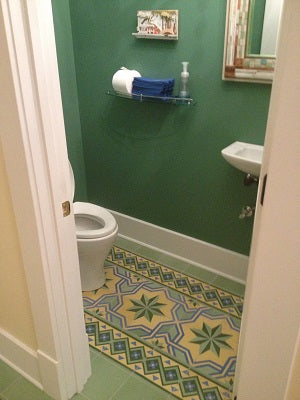
One of the most common questions I get with cement tile is, "What border tile works with this pattern?" The answer is almost any border tile pattern can work with that pattern if they are unified by color. In this installation, both the entry and adjoining powder room use cement field (solid colored) tiles and border patterns in the same color.

The bath and entry are unified with common pattern colors.
Use the same colors in patterns to unify patterns in the same room.

The colors really unify both spaces and allow for a cohesive design. It's a lot of pattern in two small spaces. However, you can see that when it's done right it works splendidly - even the pattern shy will agree!

Limit yourself to just a few patterns in a single room. Or, you can use subtle or muted patterns to help create some negative space. This typically bold, Cuban pattern (below) was muted to create a much softer effect that was used in the entry, bath, and dinning room. 


Cement TIle Pattern Cuban Heritage Design 150 in a muted colors
Cuban Heritage Design 150 in a muted color palette.

The muted pattern allows you to use more of the same pattern and provided much needed negative space.  Here's the pattern on the entry floor.

Muted Cuban Pattern Tile in Entry Muted Cuban Pattern Tile in Powder Room
Muted Cuban cement tile pattern in the entry.
Muted Cuban Pattern Tile in Powder Room
Muted Cuban cement tile pattern in the powder room.

Notice how even the muted pattern becomes powerful in the bathroom? This is because there is very little negative space with the pattern on the floor and wainscot. Contrast this to the dining room where the cement tile is only used as wainscot.

Muted Cuban Pattern Tile is used as Wainscot in Dining Room
Muted Cuban cement tile pattern is used as wainscot in the dining room.

In fact, let's step further back to get a really good view of the entire dining room.

Negative space between different patterns is required.

What do you see?  Did you notice a different pattern and some negative space between them? The wainscot and the fabric in the chairs use different patterns; but, the rest of the room is "pattern quiet." Patterns need room to breath and negative space and the right color are the perfect dance partner.

When using several patterns in a room, distribute them around the room so there is space between them to balance them out. However, if you want to draw attention to an area or wall, such as a kitchen backsplash, then concentrate the pattern to create a focal point.


To learn more about tile and pattern design, make sure to subscribe to our blog. It's published weekly, and this month, we'll continue playing with pattern.


Tuesday, January 21, 2014

Polished Cement Tile Benefits a Kitchen Backsplash

Last week, I received a wonderful email from Interior Designer Eugenia Triandos in Montreal, Canada. She shared an installation photo from a recent project that showcases Avente's popular Cuban Cement Tile!

A recent kitchen remodel in Quebec used Cuban Cement tiles.
Design by Eugenia Triandos of Triandos Creations.


She also included this kind note:
I just wanted to let you know that my project was completed and my clients are very happy with their backsplash.

Eugenia Triandos
Triandos Creations

Thanks, Eugenia!  I have to compliment you on this beautiful kitchen design. The color choices really stand out. Everything works together using the same color palette as the tiles. Nothing makes me happier than seeing an installation photo and hearing customers that are thrilled about their tile!

Now, on to this week's topic. Last week I discussed some important points about grout and cement tile for backsplash design. This week, we'll discuss why polished tiles are the best choice for a cement tile backsplash.

Benefits of Polished Cement Tile 

One subtle and widely misunderstood aspect of cement tile is the finish. Usually, cement tile is supplied in a raw, or unfinished state. For now, one Western Hemisphere manufacturer allows you to purchase cement tile with a "polished finish," while another will be offering this service in about one year. It's important to know what polishing is, what it does, and why it is so beneficial to have polished tiles for a backsplash application. If polishing is a new term or confusing, start by reading my post that answers the question, What is Cement Tile Polishing?

As I mentioned above, most factories only manufacture unpolished or raw cement tiles. Currently, only one manufacturer, Aguayo Cement Tiles, provides the option to receive factory-polished tiles. Polished tiles have a satin sheen that simulates the finish all cement floor tiles achieve over time with care and use. This sheen develops from abrasive forces acting on the tile from everyday use. Although raw tiles can be polished with a floor buffer and green pad after installation, the sheen won’t develop immediately. Buffing will also remove any surface color bleed on cement tile; but, you won’t be able to use a floor buffer on a vertical backsplash installation.

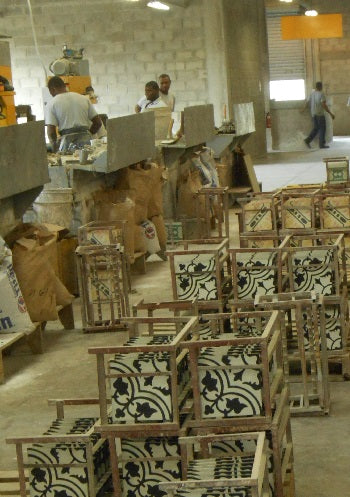
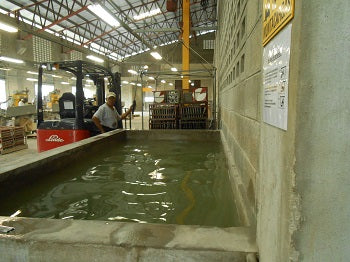
Color bleed is common on high contrast tiles, such as patterns that use black and white. Color bleed occurs when cement tiles, placed in racks, are removed from a water bath that is necessary to strengthen the tiles as they cure. The water picks up trace amounts of pigment and drains down the tile. The dark pigments wash over the lighter areas of the tile, leaving a faint discoloration. This is a normal  part of the manufacturing process; but not desirable for backsplash tiles that are in the limelight.

Cement tiles are placed on metal racks to dry after made
Cement tiles are placed on metal racks to dry after they are made.

Color bleed can occur when the tiles are removed from water bath to cure.
Racked cement tiles are lowered into a water bath to cure for 24 hours.
Color bleed can occur when the tiles are removed.

Finally, polished tile are usually easier to install because grout doesn't stick to the slightly smoother surface. In general, a grout release is not required for polished tiles. Whereas, on raw cement tile, I think it is a good precaution. As a side note, Cuban Heritage cement tiles are only sold with a polished finish.

The only time I don't recommend polished tile is for exterior patio applications. Quite simply, the polishing benefit is lost quickly over time to the elements of wind, wear and weather.

Cement Tile Backsplash: 7 Things You Need to Know Before You Buy

We came up with the 7 Things You Need to Know Before You Buy guide to help answer any questions you may have about a cement tile backsplash. Within this guide, you'll find that polishing is discussed on Point 6 with very straightforward advice:
  1. Purchase polished tile, if available.
Want to find out more? Learn what you need to know before installing a cement tile kitchen backsplash. Download and read, 7 Things You Need to Know about Cement Tile Backsplashes. You'll find answers on polishing, sealing, grout, and much more.


Do you have a question about using cement tile that we didn't answer here or in our free guide, Cement Tile Backsplashes: 7 Things You Need to Know Before You Buy? No problem! Leave your cement tile question in the comments on this blog and we'll happily answer any questions you may have.

We look forward to hearing from you!

Tuesday, January 14, 2014

Cement Tile Backsplash Design, Cost & Installation Tips

One of the biggest trends in cement tile is to use them for a backsplash – primarily a kitchen backsplash – like the one shown here and featured on Houzz by our friends, Philadelphia-based general contracting firm Buckminster Green.

A Cement Tile Backsplash using Cuban Design 110 2B
In fact, we had more orders for 50-100 sq. ft. of cement tile in 2013 than ever before. This cement tile backsplash design trend makes a lot of sense.
  • Cement tiles provide a powerful design punch that allows homeowners to create a personal statement where it matters most. 
  • Cement tiles are available in an array of geometric, traditional and contemporary patterns that can be customized with choices that include palettes with 90 colors.
A Cement Tile Backsplash using a Custom Pattern
A Cement Tile Backsplash Using a Custom Pattern
Additionally, these handmade tiles are crafted to endure decades of wear from foot traffic and have a color layer that is about 1/8” thick. They won't face anything that formidable when placed on a wall except for an occasional melee with grease, vinegar, or wine.

So, what’s not to like about cement tile? Nothing, really, as long you understand a few key differences.

Cement tile is different in many respects than its more ubiquitous cousin, ceramic tile. It’s these differences that often surprise folks and can create a "deal breaker" - an obstacle that can't be overcome or resolved. To prevent that kind of a surprise, we thought we'd detail what you need to know before buying cement tile.

Cement Tile Backsplash:
7 Things You Need to Know Before You Buy

We came up with 7 things you need to know before you decide to go with a cement tile backsplash. Here are the first three:
  1. Use a very narrow grout line when installing cement tiles. Place cement tiles as close together as possible to create a very thin grout line. Minimizing the grout line will make the design look seamless and your space look larger. We recommend a 1/16” grout joint. Non-sanded (or unsanded) grout is required for grout joints less than 1/8” wide.
  2. Pick the right grout color. You may use colored or white grout. If you decide to use colored grout we recommend that it be a color that is the same, or lighter than the lightest color used in the pattern. You can’t use black grout with white or black and white pattern tiles, the dark grout will stain the white parts of the tile and can’t be removed.
  3. Expect to spend about $1,000-$1,500 for the tiles and freight, assuming a backsplash area of about 40-50 sq. ft. The cost varies and will ultimately depend on the size, pattern, color and finish of the tile.
Want to find out more? Learn what you need to know before installing a cement tile kitchen backsplash. Download and read, 7 Things You Need to Know about Cement Tile Backsplashes. You'll find answers on polishing, sealing, grout, and much more.


A Cement Tile Backsplash - Traditional Romana Pattern
Do you have a question about using cement tile that we didn't answer here or in our free guide, Cement Tile Backsplashes: 7 Things You Need to Know Before You Buy? No problem! Leave your cement tile question in the comments on this blog and we'll happily answer any questions you may have.

We look forward to hearing from you!