With the Fourth of July Holiday just around the corner, I found my thoughts wandering toward the sunny California coast. So, I thought I'd share one of my favorite historical tile haunts, The Adamson House. It's located right on the Pacific Ocean and steps from the Malibu Pier in Malibu, California. Even if you aren't interested in tile and California history, it's hard to find a reason not to visit this lovely location.
Located right on the coast in stunning Malibu, the grounds of the Adamson house make for an enjoyable summer destination.
The grounds alone are simply stunning and open to the public every day during daylight. The Adamson house is a Spanish Colonial Revival home that was built in 1929. It has a unique mix of Spanish and Moorish architecture styles and perhaps one of the most comprehensive collections of tiles from the day. Famed Malibu Tile was manufactured just steps from there. As the trophy home of the factory owners, the home is nothing short of a showpiece. The factory produced tiles that are still coveted today and can be be found in some of Los Angeles' architectural treasures, such as the Mayan Theater and City Hall.
Glazed terracotta planters with ornate designs are clues to what await.
Today, we'll explore only the outside grounds. But, stay tuned for next week's post where we'll show more details and provide a bit of history on this tile treasure trove.
The flagstone entry pulls the eye to the resplendent tile entry
The entry to the Adamson House tiled is a tile tapestry
An exquisite peacock tile tapestry water feature faces the back patio
Moorish-inspired details such as this parabolic window are adorned with glazed ceramic tile patterns
Tiled outdoor tubs were used for washing pets - in style!
Did you enjoy today's post? Then you might want to subscribe to Avente Tile's mailing list for free! Subscribers receive our hand-painted ceramic and cement tile newsletter, Tile Talk, once per month.
Tile Talk offers great hand-painted ceramic and cement tile design ideas, tile tips, and information about new ceramic and cement tile products. We also explore historically significant tile installations, such as today's post, as well as photos of hand-painted ceramic and cement tile installations and designs, and perspectives from designers and architects who have specified and installed beautiful hand-painted ceramic and cement tiles. We think you'll find lots of inspiration!
Next week's newsletter will provide a historical perspective on Malibu tile and more information about this endearing historical landmark. Sign-up now for your free copy of Tile Talk!
With the Summer Solstice now behind us, it's time to celebrate this much-anticipated season by enjoying the outdoors. I enjoy taking my daily neighborhood walks early in the day. It's during these walks that I stop to admire the tiled walks and entries. In this post, I'll be sharing some of my favorites that not only add to a home's uniqueness, but those that also provide welcoming curb appeal.
Rustic Pavers in Mission Red create a charming tiled walk for this home
It's easy to see why a tiled cement sidewalk offers so much more style than a typical grey, poured sidewalk. Colorful tiled walks provide a bright, eye-catching entry to a home. Red is a great choice for Mediterranean, Spanish, Spanish Colonial, Spanish Revival, and Adobe style homes. If you have a large landing or patio, then consider adding a medallion or patterned stair riser tiles.
Further, the exquisite beauty of hand-poured cement tile in plain colors is unmatched. You can see the hand of the tile artisan in the installation with the variation in color and shade from tile to tile. The floor or sidewalk almost shimmers like a gem, especially in full light. Look at the Heritage Indian Red walk below and you'll see what I mean. The tiled stair risers catch your attention, while the plain red walk causes you to linger and pause.
Plain cement tile, Heritage Indian Red, makes for a bright and eye-catching entrance. A medallion using Traditional Alcala corner pieces adds interest and brings attention to the stair riser pattern
Square concrete tiles, Rustic Pavers in Cotto Dark, are laid in a running bond pattern to create a fresh look
Use our Rustic Pavers, laid on a wide grout line to accommodate their irregular shape, to create Old World elegance. If you want to replicated an antique look use Cotto Dark; Cotto Gold looks like traditional Spanish bisque. Or use a blend of the two, Spanish Cotto, to create lots of charm and interest with the color variation. Additionally, our Rustic Pavers color palette includes the tones found in Mexican pavers or Saltillo tile. So, you can even replicate the look of Saltillo, too.
DESIGN TIP: When using shapes that are not rectangular or square, like hexagons and octagons, make sure to frame the edge of each side of the path with a rectangular tile.
Rustic pavers, shown here in Buff, look like Saltillo tile but will wear better.
DESIGN TIP: Create the look of Saltillo tile or Mexican pavers with cement tile. It's more durable, requires less care and is available in more sizes, shapes and trim.
Malibu deco tiles on the stair risers with Rustic Pavers in Mission Red for the treads.
DESIGN TIP: When laying tile on paths that are not square or do not run perpendicular, consider laying them "on point" to avoid mismatched grout lines, or you can use different sizes of tile.
Whether you're recreating the rustic elegance of Old World Spanish bisque or Saltillo tiles, looking for unique formats, or the exquisite beauty of hand-poured plain cement tile, we have a tile that works with your design aesthetic, color palette, and space. Are you looking for Spanish Colonial, Spanish Revival, Moorish-inspired designs, or something slightly more contemporary? No worries. We can help you create a look for a tile walk that is extraordinary, unique and in keeping with a home's architectural style.
Sealers for cement tile should be applied to protect the tile from water and staining; but, they can also be used to enhance or restore color. A color-enhancing sealer was used on this exterior cement tile walk, stair risers, and treads to protect them and brighten the colors.
Color-enhancing impregnating sealers are used to brighten cement tile colors,
especially exterior tiles subject to fading from the sun.
Sealers remain one of the most misunderstood and confusing steps of installing cement tile. The confusion comes from the different types of sealers (impregnating, topical, color enhancing), the nomenclature used (impregnating is the same as penetrating), and the dizzying number of manufacturers and specialized products offered.
With so many sealer options available, including finishing effects (gloss, satin, matte) and applications (outside sidewalk, inside bath, or pool sideboard), you are sure to get a different procedure from different people each time you ask. So, it's easy to understand why people get confused. It doesn't have to be confusing though. The goal of today's post and short video is to demystify the use of sealers when it comes to installing cement tile,
Step #1. Select a high-quality penetrating or impregnating sealer. You may use either a water-based or solvent-based sealer. Water-based sealers are slightly easier to apply and may provide better coverage protection because they aren't as deeply absorbed into the tile. Solvent-based sealers have a strong odor when applied and may provide longer protection, especially against water. I explain this thoroughly in a previous post, Sealing Cement Tile.
When selecting a sealer, make sure it's rated for where you are using the tile. Specifically ask if the sealer can be used for:
Indoor or outdoor applications
Floor or wall applications
Wet locations (pool or bath) or dry location (bedroom)
Step #2. Select a topical sealer if you want to provide additional finish effects to the tile. Penetrating sealers usually do not effect the finish of the tile because they work by impregnating the tile below the surface. Topical sealers create a barrier on the surface of the tile so that stains do not reach the cement. Topical sealers have different finishes that include shiny, satin and matte. Often, matte topical sealers are produced by adding a chemical that cuts the shine, but also weakens the sealer. Topical sealers are not generally recommended for exterior applications as radiant energy from the sun deteriorates them quickly. Topical sealers will wear over time and generally need to be reapplied more frequently that penetrating sealers.
Color-enhancing penetrating sealers can be used to enhance (brighten or darken) the colors of the cement tile. This is a good choice for exterior applications that are subject to fading from the sun.
Step #3. Test your sealer/sealer combination. Always test the final choice of your sealer or sealer combination. Simply apply to a test tile and make sure the desired finish is achieved without any adverse reactions.
Step #4. Clean the area to be sealed. Make sure the tiles to be sealed have been cleaned, all grout has been removed and the tiles are thoroughly dry. Start with a physical cleaning with a blower or broom. Then clean with a tile cleaner or mild detergent and rinse with water and a grout sponge. If the tile looks hazy or cloudy, clean again.
Step #5. Apply the sealer. Use a lamb's wool applicator, lint-free rag or paint brush. Generally, you'll want to apply three coats allowing the sealer to dry between each application. Make sure to apply generously; but, do not allow the sealer to pool, streak, or run.
Tile immediately after applying a color-enhancing sealer. As you can see, there are no pools of sealer or streaks in the sheen.
Cement Tile Crazing
Cement tile often exhibit "crazing" or fine, hairline cracks over time. This is not a defect and does represent any problem with the tile; however, it will be more apparent when the tiles are wet or when applying a sealer. The small cracks or branches show more on dark tiles and plain tiles. Don't panic or think you've done something wrong if you see this after applying a sealer or if the tiles get wet.
Cement tile crazing can be seen in the plain red stair tread.
Small fissures, or crazing, are more apparent on dark colors and when the tile is wet.
How to Apply a Penetrating Sealer to Cement Tile Video
This short video shows how to apply a penetrating sealer to unsealed and previously sealed cement tiles. This important part of the installation process protects cement tile from water and staining. I show how easy it is to apply a color-enhancing impregnating or penetrating sealer to a tile walk and patio. I also recommend products to use and where to get them. You can see for yourself, just how easy it is to apply a sealer.
These five simple steps will ensure success for every cement tile project you do. If you aren't sure about which sealer to choose or if you should apply a grout release. We can help! These handy guides will give you all the information you need to know!
As you may know, Bill Buyok is the founder and owner of Avente Tile. He started the company as an online tile showroom and catalog so that hand-painted ceramic tiles and cement tiles are more easily and broadly available for others who share the same passion. Avente Tile's mission is to search the globe to find the finest and most extraordinary tiles for their customers while providing excellent service and product knowledge. With that in mind, here are the Designer Insights of Bill Buyok.
Editor's Note:Bill Buyok's Designer Insights were originally published Tuesday, May 19 on the Terry's Fabrics Blogby Tudor Davies. It's only one in a collection of Designer Insights compiled by Tudor and his team that profile designers and design enthusiasts. We're honored to have been included in this collection, and thank Terry's Fabrics for this opportunity. If you enjoy Bill's insights, then be sure to visit the Terry's Fabrics blog and peruse all of the Designer Insights.
The following transcript shows the interview questions and Bill's response to each.
In your own words, describe your unique style and creative aesthetic? I’m drawn to classic Spanish, Moroccan, and Italian designs, the nature-inspired design of the Arts & Crafts Movement, and a love for Hispano-Moresque design.
When starting a new project, what is your creative process? Listen to customers, understand their needs and wants. I start with facts, then develop the color scheme and apply pattern, motifs, accent colors and flourishes to establish design and personal style.
Out of the creative people you have worked with, who is it that you respect and admire the most? My customers, who include designers, architects, and residential customers, often envision something extraordinary, unique and bold. Our cement tiles allow customers to create designs and apply color to a pattern of their choice, allowing them to control the creative design process. Thus, the tile’s pattern and color have now been reinvented into something beautiful that I would have never imagined.
When looking for inspiration is there a particular thing you do to get inspired? During my early morning treks through Los Angeles neighborhoods, I find inspiration around me. I then turn those inspirations into design ideas that are unique, fun and useful.
What has brought you to this point in your career? And what is your advice for people looking to follow in your footsteps? Work hard, persevere, and do what you love! Every day presents its own unique challenges that you have to translate to opportunity. Never give up and always believe in yourself. Remember, it’s not how you handle the best days; but, how you handle the challenges and disappointments that really matter.
Last month, I reported some of my favorite tile trends and finds from Coverings in the my blog postTile Trends 2015: Variety is the Spice of Tile. One of the most unique new tile designs I spotted at the show is a relief cement wall tile line from Aguayo Tiles called Elevations. Without further ado, Avente Tile is proud to announce the premier of this exciting design line of relief cement tiles.
Elevations is a new cement tile in relief for walls.
Shown here is Drop in the color Chocolate Mousse.
Avente Tile partnered with Aguayo Cement Tiles a decade ago because of their generations-long commitment to producing quality cement tiles. This line is truly unique for the industry because it eloquently combines geometric shapes in both convex and concave relief that, and because of its extensive color palette of more than 60 colors.
Elevations Concave Rectangles used as shower accent wall.
Shown in black, white, and shades of grey.
Six shapes are available: Drop, Concave Rectangles, Petals, 3D Hexagon, Concave Hexagons, and Angles. The edgy, contemporary designs of high relief geometrical tiles really stand out for their architectural value. They are suited for wall applications and can be installed with or without grout. Additionally, the tiles are available with a standard smooth surface or an optional waxed finish that provides a classy, satin sheen. The tile come pre-sealed with a penetrating sealer and are ready to install.
Concave Hexagon tile in Jet Black with a waxed finish
3D Hexagon tile in three shades of grey. Standard finish installed without grout.
Angles relief cement tiles in grey with standard finish.
Ordering Elevations Relief Cement Tile
These new, architecturally inspired tiles are available now. However, we recommend you purchase strike-offs in the colors you desire before placing a full order. Allow about three weeks for strike-offs to be made and delivered. Strike-offs are shipped via UPS International Air Freight from the factory and cost about $150-$200 per sq. ft.
Discover the architectural collection of cement relief tile, Elevations, online now. When placing a full order, allow a lead time of 8 to 10 weeks for your tiles to be crafted by hand, carefully packed and shipped. Like all our cement tiles, these shapes can be customized with your choice of colors from the Heritage Color Palette. Tiles can be purchased with a standard finish or waxed finished. All tiles come pre-sealed from the factory with a penetrating sealer. If you have any questions, just contact us to let us know what you need.
More Exciting Cement Tiles from Avente Tile
We've got more new cement tile lines that will be ready very soon. Next week, we'll show you our new Hexagonal Cement Tiles. Coverings 2015 provided us with some exciting new tile designs that we can't wait to share with you in the coming weeks.
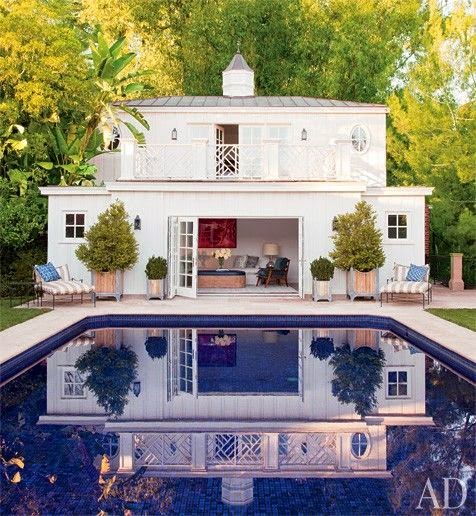
Deep indigo pool tiles, coupled with the architecture of the pool house,
make for an incredible outdoor setting. Image via Architectural Digest.
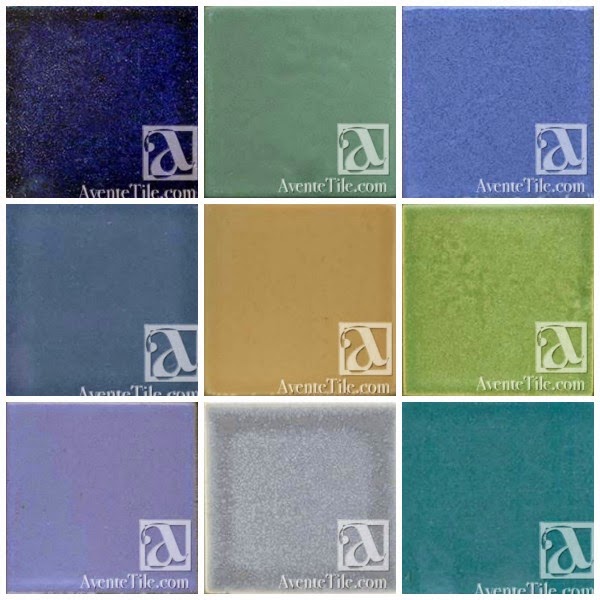
Handcrafted artisan porcelain tiles are perfect for pools and water features. The materials and methods used in art pottery are similarly applied to classic porcelain tile-making techniques to achieve rich glazes that excite the eyes and hands.
As such, these porcelain tiles embody the charm and appeal of fine handmade ceramic ware. Glaze colors on porcelain offer unparalleled depth, clarity and vibrancy. With the warmth and originality of handmade art tiles, our porcelain pool tile collection is the perfect choice for pools, spas, water features, or any outside space. It should go without saying that each tile is custom manufactured by craftspeople dedicated to preserving the tradition of functional, natural beauty.
With its historical Spanish pattern and colors, Valencia’s design is created using traditional Majolica glazing techniques. The hand-brushed patterns are a perfect complement to outdoor living areas and water features.
Hand-painted glazed ceramic deco tiles with terracotta pavers showcase the stairs, risers and the pool. Image via Houzz | Custom pool tile design by Fariba at Archarium.
Discover our porcelain pool tiles including all the colors, available trims, formats and accessories
“Water is the driving force of all nature.” ~ Leonardo da Vinci
With the end of spring coming next month, summer's energy is quietly resonating on the horizon. Summer translates to taking on new projects, perhaps one that has been set aside for years. Now is the time to replace cracked or broken pool tile, or installing that fountain or water feature you've always wanted for the garden.
Using handmade or hand-painted porcelain tile for your next outdoor project will not only enhance the look of your home, but you can rest assured the tile you choose will withstand the elements, too. For whichever project you choose to conquer, Avente Tile is here to help you reach your design goal. Our extensive Ceramic Tile Design Idea gallery features a large collection of projects dedicated to inspiring you and your living space. How can we help inspire you today?
A few weeks ago, we spoke about the history, production and properties of Saltillo tile. To recap, hand-crafted from natural clay deposits, authentic Saltillo tile can only come from one place in the world - Saltillo, in the state of Coahuila in Mexico. The process of turning this special Mexican clay into tiles has remained unchanged since 1577.
This week, we'll be addressing the what Saltillo tile is and is not, while offering a handmade, sustainable product that resembles Saltillo in looks, but inherently contains additional long-lasting, maintenance-free properties.
To recap, Saltillo tiles:
Vary in color and shape
Colors range from reds, oranges and yellows.
Tiles are shaped either by hand-presses, or carved with desired shape.
Couples perfectly with hand-painted decorative ceramic tiles
Now, let's take a look at Rustic Cement Tile Pavers. While it's not strictly Saltillo Tile, our handmade Rustic Cement Tile Pavers offer the same look that you love in Saltillo tile with the added benefits of:
Similar handmade look
Color variations
Variety of formats, textures
Made in the USA
True "through body" color
Resistant to scratches, cuts
Rated for freeze/thaw cycles
Stronger body, less maintenance
How to Buy Rustic Cement Tile Pavers
Buying Rustic Pavers is as easy as one, two, three. Color choice is the most important point. It's a good idea to get several color chips or each color to help get an idea of the variation and texture that you'll see. If you want the look of Saltillo, then select from the four paver colors below.
These four Rustic Cement Tile Pavers offer the look of Saltillo tiles.
The tiles come with a standard smooth finish; however, additional textures are available to create a weathered, antiqued patina. There are four standard Rustic Paver Textures.
To create a weathered, antiqued patina, consider adding
one of these four standard Rustic Paver Textures.
Designing with Tile
Rustic Cement Tile Pavers offer the same look as Saltillo tiles, with added benefits.
Now that Spring has arrived, it's time to spruce up the outdoors. As an alternative to Saltillo tiles, our Rustic Cement Tile Pavers offer a year-round solution. With a wide variety of colors and shapes available, your design is only limited by your imagination.
Lastly, visit our dedicated Rustic Cement Tile Paver page for any questions you may have. Of course, you can also call our office at 888.739.4972, and we would be more than happy to help with your purchasing decisions.
Coupled with decorative ceramic tiles, Saltillo tile exudes Old World charm.
Hand-crafted from natural clay deposits, authentic Saltillo tile can only come from one place in the world - Saltillo, in the state of Coahuila in Mexico. The process of turning this special Mexican clay into tiles has remained unchanged since 1577.
Saltillo tiles are shaped either by pressing quarried clay with a wooden frame, or by carving out the desired shape. After they spend some time drying in the sun, the tiles are moved to the kiln.
Now, depending on where the raw tile is positioned within the beehive-like kiln, the tile can take on hues ranging from yellow to a rich orange to dark terracotta. Coupled with hand-painted decorative ceramic tiles, such as our Barcelona, California, Malibu, or Spanish collections, a walkway, stairs, steps or risers could easily be transformed into a Mediterranean landscape, Spanish Villa or Mexican Hacienda.
Saltillo tile pavers look great with Spanish-style homes.
Traditionally, Saltillo tiles are left unglazed, although some manufacturers sell them pre-treated or pre-sealed in order to increase their durability. According to the John Bridge Forum:
"Saltillo tile floors must be sealed with a penetrating tile sealer, and usually a top finish is applied to act as a sort of glaze. The tiles must dry a minimum of three weeks after installation before the sealer is applied. It usually takes at least two applications to completely saturate the tiles. The sealer is applied with a paint roller. A brush is used at the edges. The final finish coat will probably be an acrylic, obtainable from either tile or paint stores. This also is applied with paint rollers and brushes and may require two coats to do the job. Eventually, this finish will wear off in areas of traffic and will have to be replaced. The floor will be chemically stripped of the old finish before the new coating is applied. It is best to have this done by professionals."
Moreover, it should be noted that unglazed Saltillo tile is highly porous; it soaks in liquid easily. Because of this, it's difficult to install as it will absorb water from the thin-set mortar, grout, grease pencils, etc. Once it is placed, it will stain and scuff easily if not properly sealed and maintained with a quality sealant.
Saltillo is popular in Mediterranean-like climates.
Lastly, Saltillo is not recommended for outdoor installation in freeze-thaw climates, although it is a popular choice in warmer climates, such as the American Southwest and Mediterranean countries.
Next time, we'll discuss the advantages of using Rustic Cement Tile Pavers as a better alternative to Saltillo Tile.
In the mean time, visit our dedicated Saltillo page for more background and information about this handmade tile.
Designing with Tile
"Behold, my friends, the spring is come; the earth has gladly received the embraces of the sun, and we shall soon see the results of their love!" ‒ Sitting Bull
Creating something from so little is not only ingenious; it's a testament to the determination and creative needs of ancestors. Such is the case in the creation of Saltillo tiles. With the help of ample sun and regional clay earth, two perfect, coexisting ingredients were combined to create long-lasting tiles that have graced homes, missions, and palaces over several centuries.
Now that Spring has arrived, it's time to spruce up the outdoors. As an alternative to Saltillo tiles, our Rustic Cement Tile Pavers offer a year-round solution. With a wide variety of colors and shapes available, your design is only limited by your imagination.
Make sure to check out the complete collection of Rustic Cement Tile Pavers for a wide variety of color, glaze, shape and size options.
With it's classic six-sided shape, the hexagon is gaining and maintaining it's elegant prowess in design circles (pun intended) once again. Here are three ways plain hexagon tiles lead to an overall stylish look. Our style guide below uses both ceramic, porcelain, and cement tiles - all available from Avente Tile.
Hexagon Style Tip #1. Create a simple pattern with plain hexagon tile in two or three colors. The hexagon format was common in the 1920s. These small-format "penny hexagons" or the penny hex in white was typically used for kitchen and bath floors. It gained some notoriety again in the 1960s, and now, it is once again is a design staple that provides interest without being over-used.
Penny-sized hexagon tiles, popular in the 1920s, were typically used as flooring in the kitchen and bath.
A simple repeating pattern in black and white works great with hexagon tiles. Stylistic floral patterns and simple borders can also be used with this fun, interlocking shape.
Hexagon Style Tip #2. Use hexagon tile with hand-painted glazes or cement tile in the same color. Sound boring? Not really, use an interesting glaze that exhibits variation from tile to tile. Or, use hand-painted glazes or cement tile to achieve the look you're after. The natural variation in color provides an absolutely stunning look that hides dirt, provides a sense of texture or depth, and lots of interest. It's also a more straight-forward design approach for the DIY group.
Hexagon tile looks great with hand-painted glazes. The variation of hand-applied glazes create a look that exudes depth, texture and interest.
Hexagon Saltillo tiles provide rustic charm with the natural color variations found in terracotta.
Hexagon Style Tip #3. Blend ceramic tile glaze colors or cement tile colors and texture to unique, one-of-kind designs. Feeling creative? Like to work with colors? Then this option is perfect for you. Create a colorful mosaic of hexagon tiles using three to five colors, then choose a size to accommodate the scale of the space.
6" Arabesque Hexagon Spanish Paver Tile in Normandy Cream and Vintage texture
Hexagonal cement tile from our Arabesque cement tile collection. Pictured above is a blend of red and brown tiles, our Duoro Blend, with a Vintage texture
It's easy to see why this classic shape never falls from grace. Hexagon tile, or hex tiles, are just a great way to add both style and grace to any design.
Next week get's really fun! I'll show you three ways to create style with patterned hexagon tile. Patterned hexagon tiles can be very playful - the hexagon pattern can almost disappear or form truly unique modular mosaic patterns. If you haven't seen patterned hexagon tile at play, I think you'll be surprised!
Handmade cement tiles are a great choice for commercial, hospitality, and retail spaces. Not only do these tiles deliver an unforgettable decorative impact, but because they are handmade, they can be customized to fit the client's needs, thanks to an extensive palette of colors. If it's inspiration you're craving for your next commercial design project, then make sure to view the dozens of images we've assembled within our Cement Tile Design Ideas section.
Whether a bold Cuban tile pattern in contrasting colors is specified, or a classic cement pattern in harmonizing colors is chosen, you and your client can be assured of a lifetime of usage and viewing enjoyment.
A cement tile mold acts as a blank canvas for applying your creativity with customization.
Remember, our handmade cement tiles, which are also called encaustic cement tiles, are made one tile at a time using a method that has been in use for more than a century. It's because of this handmade process that varying amounts of customization is even possible. Of course, whether used as floor tile or wall tile, the long-lasting benefits of cement tile will positively impact and transform any space.
In the meantime, for more information about cement tile selection, installation tips, customization services, or available sizes, shapes and more, please see our new Guide to Buying Handmade Cement Tile.
Designing with Tile
"Winter is the time for comfort, for good food and warmth, for the touch of a friendly hand and for a talk beside the fire: it is the time for home." - Edith Sitwell
Cement tiles work well for a fireplace or hearth. The warmth they exude is further enhanced by their ability to be customized to fit any décor, or to complement surrounding materials (such as wood, carpet, concrete, etc.). Our fireplace tile design ideas include both cement and ceramic tile installations using Avente's hand-crafted tiles. There is no better choice than tile when creating a decorative and visually appealing fireplace design.
Further enhancing their allure is the fact that cement tiles can be customized with any color from our Heritage Color Palette. After choosing colors, we recommend a "strike-off" or sample be made to verify the design on the tile before final production. Strike-offs can be shipped directly to you from the factory.
Remember, installing cement tile is a fairly simple process, but it must be done with care in order to achieve the best results. To fully enjoy the versatility of handmade cement tile, we recommend reading our Cement Tile Installation Guide. We are also proud to offer a complete line of Cement Tile Customization Services that will help you meet or exceed your design expectations. Our newly published Guide to Buying Handmade Cement Tile is an especially valuable resource to keep handy. Download a free copy here, and let the inspiration begin!
Let us know how we can assist you with your next project. Please feel free to call our offices at 888.739.4972 or email us at: info@AventeTile.com.
There is no better time than the Holidays to express our appreciation for your business and friendship. May all the joys of the season be yours.
Deer in Moonlight Ceramic Tile Mural
Take 10% off any online order placed through January 2015. Use coupon code CHEERS.





.JPG "Inspiration for Pools and Ponds via Avente Tile's Pinterest Board")