Showing posts with label glazed tile. Show all posts

Tuesday, May 5, 2015

Make a Splash with Pool Tiles


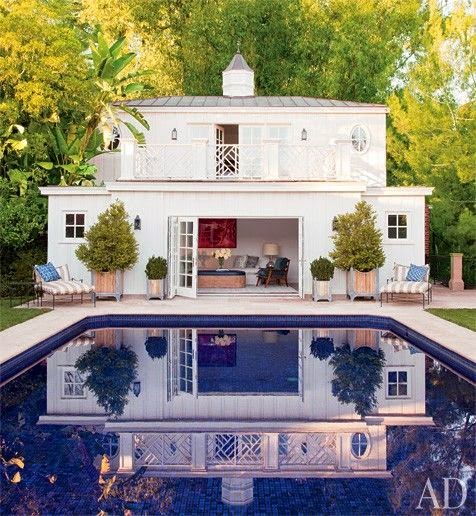
Deep indigo pool tiles, coupled with the architecture of the pool house, makes for an incredible outdoor setting.
Deep indigo pool tiles, coupled with the architecture of the pool house,
make for an incredible outdoor setting. Image via Architectural Digest.

Handcrafted artisan porcelain tiles are perfect for pools and water features. The materials and methods used in art pottery are similarly applied to classic porcelain tile-making techniques to achieve rich glazes that excite the eyes and hands.

As such, these porcelain tiles embody the charm and appeal of fine handmade ceramic ware. Glaze colors on porcelain offer unparalleled depth, clarity and vibrancy. With the warmth and originality of handmade art tiles, our porcelain pool tile collection is the perfect choice for pools, spas, water features, or any outside space. It should go without saying that each tile is custom manufactured by craftspeople dedicated to preserving the tradition of functional, natural beauty.
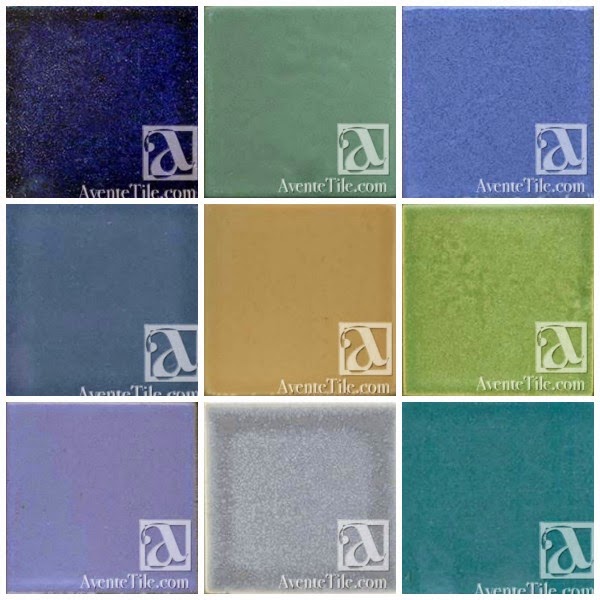
An example of the various glaze colors available with our Pool Tile Collection
An example of the various glaze colors available with our Pool Tile Collection.

Here are some important points to keep in mind when specifying or ordering hand-painted, artisan porcelain tiles:

  • 25 vibrant glazes are available in a wide-ranging palette.
  • Porcelain tiles are the optimum choice for pools and spas.
  • Ideal for interior and exterior applications.
  • Porcelain tiles are rated for freeze/thaw conditions.
  • Our tiles are made to order, so please allow 3 to 6 weeks.
  • Sample stock (3"x3") may be available, so please check with us.
  • Other formats, trim and molding available.

For additional design options, consider our Spanish Valencia 6"x6" ceramic tile, part of our extensive Spanish Ceramic tile collection. 

With its historical Spanish pattern and colors, Valencia’s design is created using traditional Majolica glazing techniques. The hand-brushed patterns are a perfect complement to outdoor living areas and water features.


Hand-painted glazed ceramic deco tiles with terracotta pavers showcase the stairs, risers and the pool.
Hand-painted glazed ceramic deco tiles with terracotta pavers showcase the stairs, risers and the pool. Image via Houzz | Custom pool tile design by Fariba at Archarium. 

Discover our porcelain pool tiles including all the colors, available trims, formats and accessories


 Designing with Tile

Inspiration for Pools and Ponds via Avente Tile's Pinterest Board

“Water is the driving force of all nature.” ~ Leonardo da Vinci

With the end of spring coming next month, summer's energy is quietly resonating on the horizon. Summer translates to taking on new projects, perhaps one that has been set aside for years. Now is the time to replace cracked or broken pool tile, or installing that fountain or water feature you've always wanted for the garden.

Using handmade or hand-painted porcelain tile for your next outdoor project will not only enhance the look of your home, but you can rest assured the tile you choose will withstand the elements, too. For whichever project you choose to conquer, Avente Tile is here to help you reach your design goal. Our extensive Ceramic Tile Design Idea gallery features a large collection of projects dedicated to inspiring you and your living space. How can we help inspire you today?

Tuesday, May 20, 2014

Islamic Star Patterns in Tile Design


As a recent Art History graduate from Loyola Marymount University, the Arts of Islam became a favorite subject among the various cultures and styles I studied.

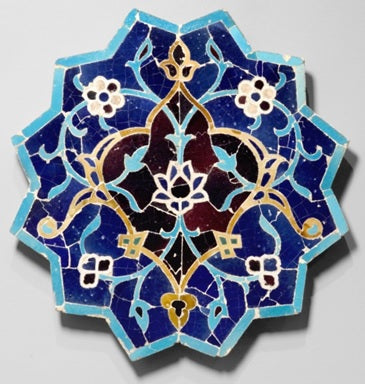
Iran or Central Asia, 15th Century. LACMA


Dating back to as early as the 7th century the Islamic Arts have influenced an array of cultures and societies, such as the notable geometric designs in their tile work. These tiles were commonly used as floor and wall applications and to decorate mihrabs, the architectural niches in mosques. Examples of this work still exist in Spain, Italy, Morocco, India, and Turkey.

Because Islamic cultural beliefs negated the use of human form depictions, creative inspirations of florals, stars, animals, and geometric designs were used in the elaborate mosaics that became readily identifiable as Islamic.

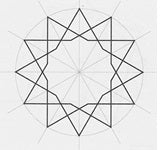
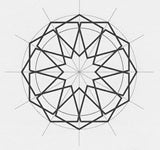
In examining the floral and star motifs, also known as arabesque, it has been determined that intricate and complex algebraic formulas were used in creating the geometry behind these patterns. One such example is the star pattern, whose beauty is contributed to by the high degree of symmetry.

Four Triangles within a Circle
Image Credit
Two Hexagons with a Circle
Image Credit


These motifs utilize what is referred to as the n-fold rotational symmetry, where n represents a range of whole numbers from 3 to 100. These patterns utilize a two dimensional plane with some polygon cells or shapes meeting at their edges, while others meet at the vertex points.

These star polygons were not limited only to the painted figure. Islamic tile were oftentimes manufactured in a star pattern where they were organized into a complex mosaic.

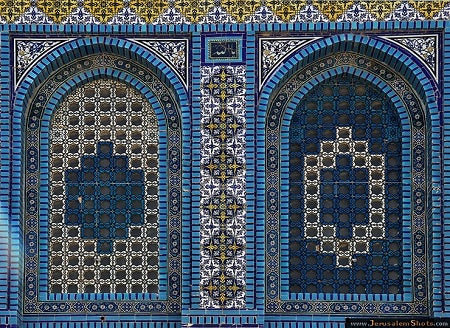
Dome of the Rock, Jerusalem
Image Credit
Early Islamic tiles involved a simple process of cutting single color, small tile fragments and assembled with the use of liquid plaster. This technique evolved to include painted pictures on plain tiles which were then glazed and fired afterwards. The color palette also extended to include oranges and yellows.

It is the mosaics of the 15th century C.E. that have become most widely known and influential, known as "mosaic faience." An interesting note is that these tiles were applied over brick in an "undulating" fashion; as the light and reflections changed throughout day and evening, so did the sheen and brilliance of the various tile colors.

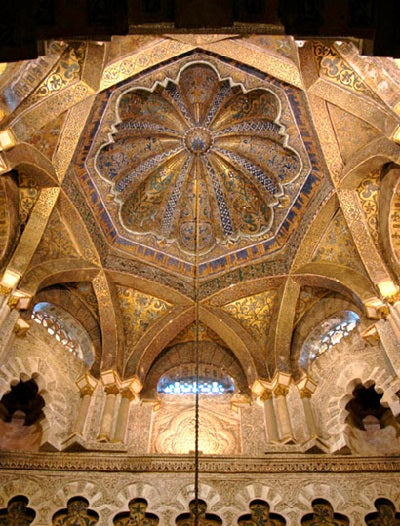
Maqsura, Great Mosque, Cordoba
Maqsura, Great Mosque, Cordoba,
Arts of Islam at Loyola Marymount University,
Dr. Aliaa El Sandouby

It is easy to see why the beauty of the Islamic tiles has spanned cultures and centuries. With their vibrant colors and eye-catching shapes and designs, artisans have a near endless variety of choices of expression.