Showing posts with label geometric designs. Show all posts

Tuesday, February 24, 2015

Geometric Tiles Create Style on any Budget


Geometric tiles in classic shapes, such as chevron, hexagon, stripes, honeycomb or octagon, are a great way to add style to your home's wall or floors. More intricate patterns reproduced on a single tile will always be more expensive than plain tiles. Here are a few tips to create style and accommodate just about any budget.

Tip #1. Create a pattern using plain or solid-color tiles using different standard formats. It's easy to create bold and unique patterns by mixing and matching less expensive plain or solid color tiles that would be less exciting on their own. Consider using field tiles from our Malibu and Yucatan lines. There are hundreds of glazes and the high-fired tiles can be used on walls and floors, inside and out - even in areas subjects to hard freeze thaws.  Grit can also be added if slip resistance is a concern for commercial and wet areas.


Plain tile can be used to create patterns and interest like this tile rug

Tip #2. Make a mosaic. You can create a mosaic-like effect with cement tile using simple patterns like our Traditional Geo #3 shown here.

The Geo 3 cement tile pattern creates a mosaic-tile design
The Geo 3 cement tile pattern creates a mosaic tile effect at a fraction of the cost.
Shown here in Pearl Gray, Sky King, and Autumn Eve

For an accent strip in your bath or kitchen, consider our Fragments line of easy-to-install, face-tape mounted mosaics. Fragments are colorful mosaic accent strips made from patterned cement tile. Available in four colorways - spring, summer, fall and winter - and in three formats (Small Squares, Large Squares, and Bar). We use a standard grout thickness of 3-4 mm on all formats.

Fragments are an easy way to add a mosaic accent strip and come face-tape mounted
Fragments are an easy way to add a mosaic accent strip 
Thankfully, cement tile comes in a myriad of sizes and shapes, so it's not difficult to create a simple checkerboard in classic black and white, or any two tones you like. Cement tiles are also available in many more shapes than just square and rectangular formats. You can find hexagonal formats, colonial paver and arabesque formats, too.

Checkerboard pattern in Jet Black and Polk Gold provide color and style

Tip #3. Blend glazes or colors using tiles of the same shape. Create a more complex and rich look by blending three or four colors. For a more organic look, blend the colors randomly. For a bold, contemporary design, you can run the colors in stripes or rows. A great example of creating a blend can be seen below with our Clay Arabesque Leon pattern, which uses three colors from our Malibu Ceramic Field Tile collection: Sea Foam Matte (#5503u), Mushroom Matte (7504u), and Winter Grey (#405c).

Clay Arabesque tiles in three glazes provide a rich look and are perfect for a backsplash.

A more contemporary look can be created using any Rustic Paver and Tile in a square or rectangular format in using the Metro Blend. The soft neutral colors and earth tones in this blend are easy to work with. Shown here in a 3"-square format, the blend consists of equal parts Charley Brown, Natural Gray, and Charcoal.

Metro Blend from our Rustic Paver line uses soft earth and neutral tones
Metro Blend from our Rustic Paver line uses soft, earthy neutral tones

Tip #4. Add texture to the color blend for a vintage look and lots of variation in color. Take it a notch further with our Rustic Pavers and Arabesque cement tiles by adding texture to the color blend. I love the look of these 6" Arabesque Hexagon tiles in Normandy Cream. This vintage look is created by blending both color and texture in these hand-crafted cement tiles. This classy color combination is created using equal parts Cotto Gold, Cotto Dark, Cafe, and Tuscan Mustard. Pieces are then finished with standard (smooth), Limestone, Travertine or Luna texture.


It's important to remember that the most cost-effective tips will be to use standard tile formats, existing colors and glazes without texture. Avente has the resources, experience and skill to make your dream a reality. Contact us via email with your project timing, budget and design requirements. We will schedule a time to discuss options that meets your goals and budget.

Tuesday, November 18, 2014

Custom Cement Tile Pattern Creates Contemporary Clubhouse Charm


Despite hundreds of existing cement tile patterns, sometimes you just have to literally "break the mold." In the commercial design of this golf clubhouse, a simple contemporary design was created specifically for this environment.

Custom cement tile patterns. like this one for a clubhouse, provide limitless possibilities for commercial design.
Custom cement tile patterns, like this one for a clubhouse, provide limitless possibilities for commercial design.

The designer hit a hole in one with a custom pattern that speaks volumes about the flexibility of cement tile and how well it works in contemporary design.  The simplicity of the repeating golf ball pattern on different shades of verdant green is a simple, fun metaphor.


A detailed look at the custom cement tile pattern created exclusively for this clubhouse
A detailed look at the custom cement tile pattern created exclusively for this clubhouse.

The design places large cement tile rugs in the lounge and dining area of the clubhouse. The clean lines of contemporary design are found everywhere in the details - from the furniture to the floor.   The decision to use a custom cement tile pattern strategically on the floor is a smart choice. It creates intimate areas in the open, expanse of the room. Notice how nicely it pairs with the neutral, large-format natural stone flooring.

Cement tile rugs create cozy, intimate dining areas in the expanse of the room.

Cement tiles are created by pouring pigmented cement into a mold that creates the pattern on each tile. If the pattern is not a available in the factories repertoire of molds, it has to be created from scratch. Of course, there is additional cost and time to create a custom mold; but, the design will certainly be unique!

Existing cement tile molds. Custom patterns require a new mold to be created.

Want to see more photos of this commercial clubhouse installation? View the slideshow below, or click to see Cement Tile area a Hole in One for Greens.


Cement tiles provide flexibility for commercial designs because they can be customized with your pattern, choice of colors and unique shapes. The tile adapt to any setting and work well in contemporary or traditional installations. Finally, you can't forget that cement tile are durable and will withstand decades of wear with little care. Designers in the hotel, hospitality, or restaurant industry use custom cement tile patterns and designs to create a look that stands out and is unique. Take a look at these commercial cement tile installations for inspiration on your next commercial design project.

Tuesday, November 11, 2014

Cement Tile Creates Calming Resort Spa


In today's hectic 24/7 world, a quiet place to escape, relax, renew, and refresh is more important than ever before. Designers cleverly chose cement tile flooring for this resort spa to achieve a calm and peaceful atmosphere in a commercial setting.

River rock mimics the cement tile pattern in the spa corridor
Commercial flooring is often dismissed as unimportant and reduced to low-cost options. In this spa, the opposite approach was taken. The flooring is the design element that establishes the theme, creates the ambiance and sets the tone. The cement tile floor utilizes a simple interlocking circle pattern and two-tone color palette in soothing green to create tranquility. Other smart design choices were made to complement the theme; one of my favorite is the use of white river rock along the corridors and stacked white rock at the reception desk. The river rock mimics the tile pattern and provides the soothing effect of a flowing stream.

Cement tile in a soothing green create calm at this resort spa.
Cement tile in a soothing green and simple pattern create calm at this resort spa.

Cement tile and smart design choices like make this spa an oasis
Cement tile and smart design choices make this spa a soothing oasis
The Geometric Diamond Pattern uses two shades of light green on a white background to emphasize the interlocking circles. I love how the darker shade of green is used to help create the illusion of over-lapping circles.

Geometric patterns like Avente's Diamond are a great choice for contemporary commercial spaces
Patterns like Avente's Geometric Diamond cement tile are a great choice for contemporary commercial spaces

DESIGN TIP - To achieve a contemporary look with cement tile, use geometric patterns. Limit yourself to two or three colors. It's best to pair a neutral color with two tones of another color, such as tan coupled with a light green and dark green.

Geometric patterns in a straight-forward color palette with only a few colors are a great way to create a contemporary look in commercial applications. To achieve a contemporary look with cement tile, choose patterns that aren't too fussy, like our Geometric patterns.  Limit yourself to two or three colors, pairing a neutral with another color in different shades or lighter/darker saturation.

Geometric cement tiles work well in contemporary commercial designs

To see more photos of this commercial resort spa installation view the slideshow below, or click to view Cement Tile Spa.


Cement tiles provide flexibility for commercial designs with their choice of patterns, colors and shapes. They work equally well in contemporary installations or traditional settings. Additionally, they are durable and will withstand decades of wear with little care. Designers in the hotel, hospitality, or restaurant industry use cement tile to create a look that stands out or speak to a special need. Take a look at these commercial cement tile installations to start getting inspiration for your next commercial design project.

Tuesday, May 20, 2014

Islamic Star Patterns in Tile Design


As a recent Art History graduate from Loyola Marymount University, the Arts of Islam became a favorite subject among the various cultures and styles I studied.

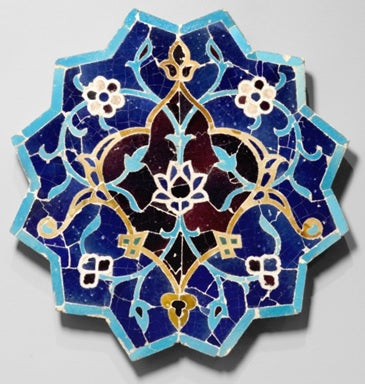
Iran or Central Asia, 15th Century. LACMA


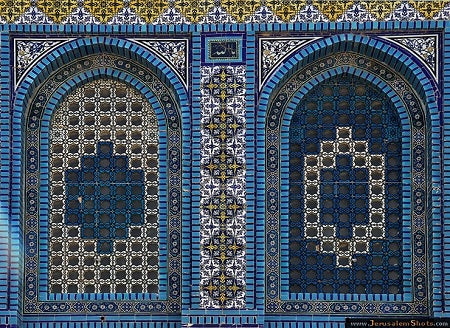
Dating back to as early as the 7th century the Islamic Arts have influenced an array of cultures and societies, such as the notable geometric designs in their tile work. These tiles were commonly used as floor and wall applications and to decorate mihrabs, the architectural niches in mosques. Examples of this work still exist in Spain, Italy, Morocco, India, and Turkey.

Because Islamic cultural beliefs negated the use of human form depictions, creative inspirations of florals, stars, animals, and geometric designs were used in the elaborate mosaics that became readily identifiable as Islamic.

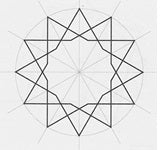
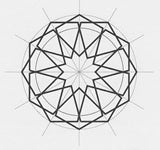
In examining the floral and star motifs, also known as arabesque, it has been determined that intricate and complex algebraic formulas were used in creating the geometry behind these patterns. One such example is the star pattern, whose beauty is contributed to by the high degree of symmetry.

Four Triangles within a Circle
Image Credit
Two Hexagons with a Circle
Image Credit


These motifs utilize what is referred to as the n-fold rotational symmetry, where n represents a range of whole numbers from 3 to 100. These patterns utilize a two dimensional plane with some polygon cells or shapes meeting at their edges, while others meet at the vertex points.

These star polygons were not limited only to the painted figure. Islamic tile were oftentimes manufactured in a star pattern where they were organized into a complex mosaic.

Dome of the Rock, Jerusalem
Image Credit
Early Islamic tiles involved a simple process of cutting single color, small tile fragments and assembled with the use of liquid plaster. This technique evolved to include painted pictures on plain tiles which were then glazed and fired afterwards. The color palette also extended to include oranges and yellows.

It is the mosaics of the 15th century C.E. that have become most widely known and influential, known as "mosaic faience." An interesting note is that these tiles were applied over brick in an "undulating" fashion; as the light and reflections changed throughout day and evening, so did the sheen and brilliance of the various tile colors.

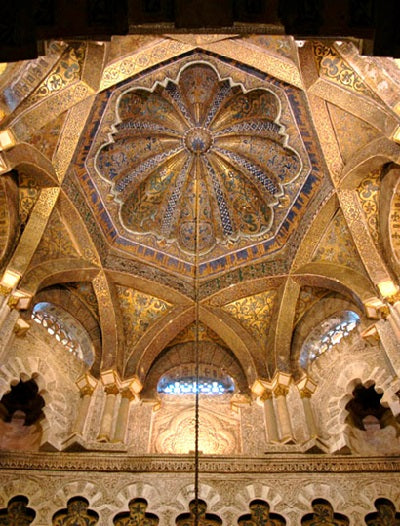
Maqsura, Great Mosque, Cordoba
Maqsura, Great Mosque, Cordoba,
Arts of Islam at Loyola Marymount University,
Dr. Aliaa El Sandouby

It is easy to see why the beauty of the Islamic tiles has spanned cultures and centuries. With their vibrant colors and eye-catching shapes and designs, artisans have a near endless variety of choices of expression.