Showing posts with label handmade cement tile. Show all posts

Tuesday, June 9, 2015

Cement Tiles Exude Warmth, Flexibility in Master Bath Redesign


Nothing excites me more than seeing a customer's installation photos. Readers of this blog know that I love color and pattern. Needless to say, I was thrilled when a customer from La Crescenta, CA called to order more tile. She was also gracious enough to send me installation photos from her previous order. As you can see, the showy bathroom uses one of our boldest, most colorful cement tile patterns, Melilla.

Melilla Cement Tile in Master Bath

Not only did the customer embrace color and pattern, they also combined cement tile with mosaic wall tiles. With the addition of exquisite fixture details, this master bathroom is nothing short of jaw-dropping. What's more, this is a truly unique look that speaks to the homeowner's attention to detail and passion for design.

Rich cement tile patterns in warm tones play off the cool blue patina of the vanity.

View of vanity and cement tile floor from walk-in shower
View of the vanity and cement tile floor from the walk-in shower.

Cement tile rug with warm mosaics show how well
patterned cement tile can coordinate with other tile styles.

Shower bench adorned with Melilla cement
 tile and plain cement tile in terracotta

The use of traditional cement tile rugs, with full pattern flooring and more contemporary mosaic wall tile, show how cement tile can adapt and work with just about any style or theme. Another way to mix-up a design is to use warm colors in a bathroom.

Conversely, blues, aqua, turquoise and cobalt are also a sensory-pleasing choice for a bathroom because of the water metaphor. I really love seeing a pool's sideboard tile in a fire red, and the warm color choices used in this bathroom. You feel the energy and can't help but feel awake and alive!

Cement tile rug surrounded in terracotta-colored plain cement tile.

Pattern floor tiles are run to the edge of the room in the master bath. However, a traditional cement tile rug is used in the shower. Both are paired with terracotta-colored cement tile and small-format mosaic wall tile. Mixing up design style and techniques really work because the color palette flows together flawlessly. No easy task considering different vendors provided the other tiles and furnishings.

Running the pattern to the edge works well.

Also notice the appropriate use of negative space and white walls. Good design has to allow for this especially when using a rich, color pattern.

The Traditional Melilla pattern in our standard catalog colorway has a dizzying array of colors that makes it difficult to work with; however, that is also what makes it so bold and exciting when used with the right color choices.
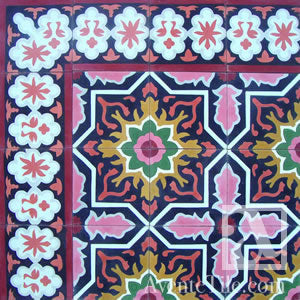
Melilla Cement Tile Pattern - Field, Border, & Corner


View additional colors available within the Heritage Cement Tile Palette here 

Kudos to our customer for creating such a warm, rich and tantalizing bathroom with Avente's cement tile. Who wouldn't want to be in this bathroom? I just love everything about it!

Cement tile rug, pattern tile and plain cement tile work exquisitely together.

Feeling inspired? Want to see more cement tile design ideas, installations, and inspiration? Let us help with our design ideas.

Tuesday, April 28, 2015

A Better Saltillo Tile: Rustic Cement Tile Pavers


Saltillo tile entry with cement tile rug
A Saltillo tile entry features a cement tile rug. Via Vanguard Studio, Inc.


A few weeks ago, we spoke about the history, production and properties of Saltillo tile. To recap, hand-crafted from natural clay deposits, authentic Saltillo tile can only come from one place in the world - Saltillo, in the state of Coahuila in Mexico. The process of turning this special Mexican clay into tiles has remained unchanged since 1577.

This week, we'll be addressing the what Saltillo tile is and is not, while offering a handmade, sustainable product that resembles Saltillo in looks, but inherently contains additional long-lasting, maintenance-free properties.

To recap, Saltillo tiles:
  • Vary in color and shape 
  • Colors range from reds, oranges and yellows. 
  • Tiles are shaped either by hand-presses, or carved with desired shape. 
  • Couples perfectly with hand-painted decorative ceramic tiles

Saltillo tile walkway features hand-painted ceramic tiles on the risers.
Saltillo tile walkway features hand-painted ceramic tiles on the risers.  

Now, let's take a look at Rustic Cement Tile Pavers. While it's not strictly Saltillo Tile, our handmade Rustic Cement Tile Pavers offer the same look that you love in Saltillo tile with the added benefits of:

  • Similar handmade look
  • Color variations
  • Variety of formats, textures
  • Made in the USA
  • True "through body" color
  • Resistant to scratches, cuts
  • Rated for freeze/thaw cycles
  • Stronger body, less maintenance

How to Buy Rustic Cement Tile Pavers
Buying Rustic Pavers is as easy as one, two, three. Color choice is the most important point. It's a good idea to get several color chips or each color to help get an idea of the variation and texture that you'll see. If you want the look of Saltillo, then select from the four paver colors below.

If you want the look of Saltillo, then select from the four paver colors below.
These four Rustic Cement Tile Pavers offer the look of Saltillo tiles.

The tiles come with a standard smooth finish; however, additional textures are available to create a weathered, antiqued patina. There are four standard Rustic Paver Textures.

For a weathered, antiqued patina, add texture to your Rustic Cement Tile Pavers.
To create a weathered, antiqued patina, consider adding
one of these four standard Rustic Paver Textures.

Designing with Tile

Rustic Cement Tile Pavers offer the same look as Saltillo tiles, with added benefits.

Now that Spring has arrived, it's time to spruce up the outdoors. As an alternative to Saltillo tiles, our Rustic Cement Tile Pavers offer a year-round solution. With a wide variety of colors and shapes available, your design is only limited by your imagination.


Lastly, visit our dedicated Rustic Cement Tile Paver page for any questions you may have. Of course, you can also call our office at 888.739.4972, and we would be more than happy to help with your purchasing decisions.

Tuesday, April 7, 2015

Saltillo Tile's Centuries-Old Allure


Saltillo tile exudes Old World charm
Coupled with decorative ceramic tiles, Saltillo tile exudes Old World charm.

Hand-crafted from natural clay deposits, authentic Saltillo tile can only come from one place in the world - Saltillo, in the state of Coahuila in Mexico. The process of turning this special Mexican clay into tiles has remained unchanged since 1577.

Saltillo tiles are shaped either by pressing quarried clay with a wooden frame, or by carving out the desired shape. After they spend some time drying in the sun, the tiles are moved to the kiln.

Now, depending on where the raw tile is positioned within the beehive-like kiln, the tile can take on hues ranging from yellow to a rich orange to dark terracotta. Coupled with hand-painted decorative ceramic tiles, such as our Barcelona, California, Malibu, or Spanish collections, a walkway, stairs, steps or risers could easily be transformed into a Mediterranean landscape, Spanish Villa or Mexican Hacienda.

Saltillo tile pavers look great with Spanish-style homes.

Traditionally, Saltillo tiles are left unglazed, although some manufacturers sell them pre-treated or pre-sealed in order to increase their durability. According to the John Bridge Forum:

"Saltillo tile floors must be sealed with a penetrating tile sealer, and usually a top finish is applied to act as a sort of glaze. The tiles must dry a minimum of three weeks after installation before the sealer is applied. It usually takes at least two applications to completely saturate the tiles. The sealer is applied with a paint roller. A brush is used at the edges.

The final finish coat will probably be an acrylic, obtainable from either tile or paint stores. This also is applied with paint rollers and brushes and may require two coats to do the job.

Eventually, this finish will wear off in areas of traffic and will have to be replaced. The floor will be chemically stripped of the old finish before the new coating is applied. It is best to have this done by professionals."

Moreover, it should be noted that unglazed Saltillo tile is highly porous; it soaks in liquid easily. Because of this, it's difficult to install as it will absorb water from the thin-set mortar, grout, grease pencils, etc. Once it is placed, it will stain and scuff easily if not properly sealed and maintained with a quality sealant.

Saltillo tile is popular in Mediterranean-like climates where freeze/thaw cycles are non-existent.
Saltillo is popular in Mediterranean-like climates.

Lastly, Saltillo is not recommended for outdoor installation in freeze-thaw climates, although it is a popular choice in warmer climates, such as the American Southwest and Mediterranean countries.

Next time, we'll discuss the advantages of using Rustic Cement Tile Pavers as a better alternative to Saltillo Tile.

In the mean time, visit our dedicated Saltillo page for more background and information about this handmade tile.


Designing with Tile

Avente Tile's Saltillo Tile Pinterest board


"Behold, my friends, the spring is come; the earth has gladly received the embraces of the sun, and we shall soon see the results of their love!" ‒ Sitting Bull

Creating something from so little is not only ingenious; it's a testament to the determination and creative needs of ancestors. Such is the case in the creation of Saltillo tiles. With the help of ample sun and regional clay earth, two perfect, coexisting ingredients were combined to create long-lasting tiles that have graced homes, missions, and palaces over several centuries.

Now that Spring has arrived, it's time to spruce up the outdoors. As an alternative to Saltillo tiles, our Rustic Cement Tile Pavers offer a year-round solution. With a wide variety of colors and shapes available, your design is only limited by your imagination.

Make sure to check out the complete collection of Rustic Cement Tile Pavers for a wide variety of color, glaze, shape and size options.


Tuesday, February 24, 2015

Geometric Tiles Create Style on any Budget


Geometric tiles in classic shapes, such as chevron, hexagon, stripes, honeycomb or octagon, are a great way to add style to your home's wall or floors. More intricate patterns reproduced on a single tile will always be more expensive than plain tiles. Here are a few tips to create style and accommodate just about any budget.

Tip #1. Create a pattern using plain or solid-color tiles using different standard formats. It's easy to create bold and unique patterns by mixing and matching less expensive plain or solid color tiles that would be less exciting on their own. Consider using field tiles from our Malibu and Yucatan lines. There are hundreds of glazes and the high-fired tiles can be used on walls and floors, inside and out - even in areas subjects to hard freeze thaws.  Grit can also be added if slip resistance is a concern for commercial and wet areas.


Plain tile can be used to create patterns and interest like this tile rug

Tip #2. Make a mosaic. You can create a mosaic-like effect with cement tile using simple patterns like our Traditional Geo #3 shown here.

The Geo 3 cement tile pattern creates a mosaic-tile design
The Geo 3 cement tile pattern creates a mosaic tile effect at a fraction of the cost.
Shown here in Pearl Gray, Sky King, and Autumn Eve

For an accent strip in your bath or kitchen, consider our Fragments line of easy-to-install, face-tape mounted mosaics. Fragments are colorful mosaic accent strips made from patterned cement tile. Available in four colorways - spring, summer, fall and winter - and in three formats (Small Squares, Large Squares, and Bar). We use a standard grout thickness of 3-4 mm on all formats.

Fragments are an easy way to add a mosaic accent strip and come face-tape mounted
Fragments are an easy way to add a mosaic accent strip 
Thankfully, cement tile comes in a myriad of sizes and shapes, so it's not difficult to create a simple checkerboard in classic black and white, or any two tones you like. Cement tiles are also available in many more shapes than just square and rectangular formats. You can find hexagonal formats, colonial paver and arabesque formats, too.

Checkerboard pattern in Jet Black and Polk Gold provide color and style

Tip #3. Blend glazes or colors using tiles of the same shape. Create a more complex and rich look by blending three or four colors. For a more organic look, blend the colors randomly. For a bold, contemporary design, you can run the colors in stripes or rows. A great example of creating a blend can be seen below with our Clay Arabesque Leon pattern, which uses three colors from our Malibu Ceramic Field Tile collection: Sea Foam Matte (#5503u), Mushroom Matte (7504u), and Winter Grey (#405c).

Clay Arabesque tiles in three glazes provide a rich look and are perfect for a backsplash.

A more contemporary look can be created using any Rustic Paver and Tile in a square or rectangular format in using the Metro Blend. The soft neutral colors and earth tones in this blend are easy to work with. Shown here in a 3"-square format, the blend consists of equal parts Charley Brown, Natural Gray, and Charcoal.

Metro Blend from our Rustic Paver line uses soft earth and neutral tones
Metro Blend from our Rustic Paver line uses soft, earthy neutral tones

Tip #4. Add texture to the color blend for a vintage look and lots of variation in color. Take it a notch further with our Rustic Pavers and Arabesque cement tiles by adding texture to the color blend. I love the look of these 6" Arabesque Hexagon tiles in Normandy Cream. This vintage look is created by blending both color and texture in these hand-crafted cement tiles. This classy color combination is created using equal parts Cotto Gold, Cotto Dark, Cafe, and Tuscan Mustard. Pieces are then finished with standard (smooth), Limestone, Travertine or Luna texture.


It's important to remember that the most cost-effective tips will be to use standard tile formats, existing colors and glazes without texture. Avente has the resources, experience and skill to make your dream a reality. Contact us via email with your project timing, budget and design requirements. We will schedule a time to discuss options that meets your goals and budget.

Tuesday, January 20, 2015

Arabesque Cement Tile Pattern Repertoire Grows


For January, I continue to welcome 2015 with our newest tiles. Today I showcase three new patterns in our ever-popular Arabesque cement tile line which is part of our curated Spanish tiles honoring traditional tile-making techniques, patterns, and colors.

What I like about the first two lines is you'll find both a large format appropriate for floors or large walls, as well as a smaller, mini-format that scales down well for a backsplash, small entry or hearth. These two new patterns are called Varona and Villatoro. Their names pay homage to Medieval Spanish castles. Can't you just imagine kneeling down in front of Queen Isabella on one of these patterns?

Varona is a new Arabesque pattern. Shown here in Normandy Cream.
Varona is a new Arabesque pattern. Shown here in Normandy Cream.

Villatoro in Tuscan Mustard with a textured, limestone finish.

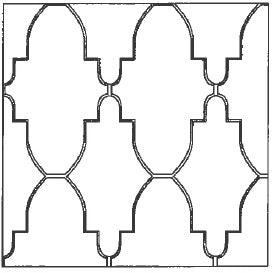
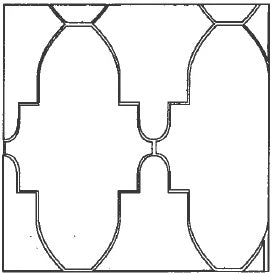
These scaled line drawings show the full-size Villatoro compared to the mini.

Villatoro Mini pattern uses 5"x8" and 5"x7" pieces

Villatoro pattern uses 7"x11" and 7"x10" pieces

Finally, the last new Arabesque pattern is Zafra. This large format measures nominally 8"x10" and is ideal for adding pattern to a master bath, larger powder room or living room floor.

Zafra is a new Arabesque pattern, shown here in Charcoal Gray

Quick Reference to Spanish Arabesque Tiles

The Arabesque collection pays homage to a deeply rooted and rich heritage of traditional Moorish and Spanish tiles that feature interlaced geometric patterns. With their nuanced curves and unusual geometric shapes, these Spanish tiles are sophisticated and charming. Choose from traditional bisque colors to create Old World charm, or use a contemporary shade such as off-white and grey. Spanish Arabesque Pavers are made to order and hand-crafted from cement in the USA. To start, select a shape, then choose a color from the Paver Color Palette. Blends and textures are also available.

Our Rustic Pavers are a unique line of Spanish floor tiles that can also be used on the wall. Look to our Rustic Paver collection if you desire square and rectangular formats (from 2"x2" to 16"x16") with a rustic feel. Not all tiles will be the exact same shape, as color variation is part of this collection's allure. Exquisitely designed and manufactured in the USA, Avente's made-to-order Spanish Pavers are hand-crafted using cement.

These Spanish Floor Tiles in classic shapes create a rustic look similar to what you'd find in traditional clay bisque tiles and pavers from Spain and Mexico. Once you've selected the size, then choose a color from the Paver Color Palette that offers classic clay bisque colors, as well as softer, contemporary shades. Blends and textures are also available.

Wednesday, October 1, 2014

Cuban Tile Makes Grand Entrance for Resort Hotel


The hypnotic pattern of our Cuban Heritage Design 110-3B 8x8 handmade cement tile features prominently in this resort's airy and grand entry. Nestled between architectural elements of arches and columns, this handmade cement tile rug, which features an original Cuban tile pattern and a polished finish, will withstand decades of high foot traffic with proper care and maintenance. Not only is it beautiful, but it adds to the sustainability factor with its long lifecycle.

Looking closely at the 110 3B cement tile pattern, you can see and appreciate the subtlest of details and the artisanal touches that went into making this tile. The tiniest nuances are accentuated with color and/or flowing decoration. Coupled with details and precision, handmade cement tiles are unlike any other flooring choice.

The colors used in this pattern, from our Heritage Cement Tile Color Palette include:


Radiance


Pecan Pie


White


Ash Gray


Steel Blue

Tips for Creating a Cement Tile Rug

The key to creating a long-lasting, successful cement tile rug installation is planning, and a good sketch or drawing done to scale showing the placement of the tiles. Here are some tips to get you started. For more information or advice, visit our page on How to Create a Cement Tile Rug Design:

  • Use the same size border tile as field tile. It makes the installation and layout much easier.
  • If you choose to use border tiles that are a different size from your field tile, your rug width and length must be a multiple of both tile sizes to avoid unsightly cuts in the border pattern. Don't run the border to the edge of the room.
  • Allow for at least one or more rows of solid colored field tile outside the border.
  • Center the rug in the main area of an irregularly shaped hallway or entry.
  • An extremely level surface is critical for any cement tile floor installation.

Handcrafted cement tiles are capable of grabbing the attention of anyone who enters your home or establishment from the moment your guests walk in. Read more about How to Create a Cement Tile Rug Design.

For more information about cement tile selection, customization services, or available sizes, shapes and more, please see our new Guide to Buying Handmade Cement Tile.


Pinterest logo

Autumnal Musings

autumn-fall

color-orange

"I cannot endure to waste anything so precious as autumnal sunshine by staying in the house." — Nathaniel Hawthorne

The trees have begun to shed their coats of leaves in preparation for their winter hibernation. With their shades of green, gold, orange and brown, we seem them fluttering onto the streets and lawns in the same way a child goes down a playground slide.

Autumn is a curious season where we take joy in Mother Nature's last hurrah until the awakening in Spring. The same sentiment holds true for upcoming remodeling or redesigning projects. Now is the perfect time to place your order for those Cuban cement tiles you've been eyeing for your patio, kitchen, bathroom, entry, and more. Add customization services, and you'll be all set for your project, with the tiles in hand and ready to be installed.

Just like Mother Nature, every good thing takes time. Handmade cement tiles are just that  handmade. Because of the Old World techniques our manufacturers still employ, some things just can't be, and shouldn't be, rushed.

Save on Spanish Cadiz Tile

Our hand-painted, Cadiz Spanish tile makes a bold design statement when used for a kitchen backsplash or stair risers.
Hand Painted Spanish Tile - Valencia PatternOur Spanish Cadiz 6"x6" Ceramic Tile is part of our extensive Spanish Ceramic tile collection. The pattern is created using traditional Majolica glazing techniques and each tile is hand-brushed by the artist.

Brighten your home with the warm gold and deep blue in this Spanish ceramic tile. This month only, we're offering 10% off any Cadiz 6"x6" purchase made. Discount applies only to stock on hand. You must place your order over the phone and mention the "FALL" coupon code at the time of purchase.

Tuesday, September 23, 2014

Designing with Cement Tile: Shapes, Sizes, Formats

Exercise your creativity with handmade cement tile!

Last month, we reviewed the time-tested quality manufacturing processes and techniques utilized in producing handmade cement tile. In this third installation, we’ll take a look at the various sizes, shapes and formats available with cement tiles.

As you can see in the chart below, handmade cement tiles not only offer beauty and dimension, they also offer flexibility in design with patterns, reliefs and moldings, and solid color cement tiles. Also, because cement tile is a handmade product, it’s further possible to exercise your creativity with Cement Tile Customization Services.

Chart - Avente Tile Shapes, Sizes and Formats of Cement Tile
Shapes, Sizes and Formats of Cement Tile: This chart includes patterned cement tile, relief and molding cement tile, and solid color cement tiles.
To further extend the design capabilities available with cement tile, Rustic Cement Tile Pavers and Arabesque Cement Tiles are also available to transform both indoor and outdoor spaces.

First, let’s take a look at Rustic Cement Tile Pavers with their rich appearance of classic clay bisque tiles - similar to those that have been used in Spain, the Mediterranean, and northern Africa for centuries. With these pavers, you get the benefit of cement in its durability and strength, coupled with a broader color palette, as well as sizes and shapes that can be adapted to any décor and environment.

Avente Tile's Rustic Cement Tile Pavers
Rustic Cement Tile Pavers manufactured from cement rather than clay offer increased durability, while the extensive color palette adds to their versatility.

Arabesque Cement Tiles pay homage to the deeply rooted and rich heritage of traditional Moorish and Spanish tiles. With their interlaced geometric patterns, each hand-crafted tile features nuanced curves and classic shapes – enhancing any setting where they are used.

Avente Tile's Arabesque Cement Tile Pavers
Arabesque Cement Tile Pavers combine the strength of cement with the timeless shapes and formats of Moorish and Spanish design elements.

Handmade cement tile offers a range of design possibilities. Whether you choose to use bold Cuban tile patterns in contrasting colors, classic cement patterns in harmonizing colors, or decide on the Rustic or Arabesque Cement Tile Pavers, the final result is guaranteed to transform any space from drab to fab!

Further, for added inspiration, make sure to download Avente Tile’s newly published Guide to Buying Handmade Cement Tile, a 14-page reference tool with easy-to-read information, vivid examples of cement tile installations, FAQs, and more!


Download: Guide to Buying Handmade Cement Tile

Of course, everyone at Avente Tile is well-versed and experienced in answering any possible question you may have. Therefore, please don’t hesitate to call us at 888.739.4972; or email: info@AventeTile.com.

Monday, September 15, 2014

Interlocking Circles: The Power and History of Pattern in Design


For thousands of years, geometric shapes and symbols have decorated homes, structures, religious buildings and art work. Influenced by nature (such as the perfect hexagon of a honeycomb made by bees), geometry has, in essence, shaped our world.

Interlocking circle patterns graces the floor tiles of this corridor.
Interlocking circle patterns grace the floor tiles of this establishment's corridor. 

Seemingly, the most prolific use of geometry and shapes is the Islamic culture. Because followers of Islam were not allowed to use human forms in art or other creative channels, geometric shapes came to represent their view of the world around them.


A closer look at the interlocking circle pattern.

According to Math Munch, a website dedicated to mathematics, "Humans have been in awe of the symmetrical laws that seem to govern the universe for thousands of years, and they've developed a type of artwork called Sacred Geometry, a way of thinking that gives spiritual significance to geometric shapes. Sacred geometry can be found in religious artwork from many different cultures, and often uses tilings of regular polygons, the Platonic solids, and interlocking circles arranged in symmetric patterns."

Example of Islamic geometry in mosaic tile art form
Example of Islamic geometry in mosaic tile art form. Image via Math Munch.

In the case of our Geo 10 cement tile design, we have four overlapping/interlocking circles. According to John Lockerbie of catnaps.org, "It is a common pattern in Arabic and Islamic geometrical design work. The sinuous lines have equal weight and the spaces contained by the lines are equal in their visual weight, though alternate shapes appear set at right angles in a regular pattern."


Avente Tile's Geo 10 cement tile pattern features interlocking circles.

Interestingly, circles and curves seem to dominate Islamic arts and culture, from calligraphy to cursive writing to interlocking circles. With the interlocking circle pattern, the Flower of Life holds the most meaning as it depicts the basic molecular beginning of life. According to Andrew Monkman's post Sacred Geometry - Flower of Life, "The most common form of the 'Flower of Life' is a hexagonal pattern (where the center of each circle is on the circumference of six surrounding circles of the same diameter), made up of 19 complete circles and 36 partial circular arcs, enclosed by a large circle.

The Flower of Life pattern contains a vast Akashic system of information.
"Indelibly etched on the walls of temple of the Osirion at Abydos, Egypt, the Flower of Life contains a vast Akashic system of information, including templates for the five Platonic Solids." Image via Sacred Geometry.

A slightly modified version of this pattern can be found in our Geometric Moroccan Circle pattern:


Avente Tile's Geometric Moroccan Circle tile pattern,

Taking the interlocking circle element even further is Avente's Geo 35 pattern with its more modern version of an ancient pattern.

Avente Tile's Geo 35 cement tile pattern.

As you can see, Avente's Geometric line, or Geo Cement Tiles, pay distinct homage to the time-tested and centuries-old interlocking circle patterns found throughout all Islamic art forms.