Tuesday, July 15, 2014

Avente Tile's Cement Tile Buying Guide: The Source for Finding Cement Tile That's Right for You

                                                                                                            
Avente Tile's Guide to Buying Handmade Cement Tile


Handmade cement tile has to be one of the most beautiful types of tile available for transforming a space into a personal expression of pattern, style and design. However, since it is a handmade product, figuring out what makes a high quality and durable cement tile isn't immediately obvious.

For that reason, Avente Tile is proud to announce the launch of its Guide to Buying Handmade Cement Tile to help you make sense of the choices available. The Guide, which is based on the hard-earned knowledge and experience of Avente Tile's founder Bill Buyok, features 14 pages of inspirational cement tile installations and patterns, and most importantly, valuable tips for buying handmade cement tile culled through Bill's vast experiences and travels involving handmade cement tile.

Avente Tile's Guide to Buying Handmade Cement Tile illustrates the beautiful and vivid patterns available with handmade cement tile.
A sample page of Avente Tile's Guide to Buying Handmade Cement Tile illustrates the beautiful and vivid patterns available with handmade cement tile.

Months of thought, preparation and revisions went into creating this cohesive Guide so that it could be referred to at any time, day or night, 24/7. Whether you choose to print out a copy of the Guide, or keep it on your computer's desktop, we wholeheartedly feel that having a readily available source at your fingertips is a priceless tool for generating creativity, while greatly expanding upon the design needs and options of your tile project.

With that in mind, the Guide is separated into several easy-to-read steps, or subsections. Not only will you be able to immediately pinpoint the topic you're searching for, but it has been designed to help you understand and appreciate everything from the nuances of cement tile to customizing your tile with colors and patterns of your choice. The six steps/subsections are:

  • What is Handmade Cement Tile? 
  • What to Look For in a Cement Tile
  • What Shapes, Sizes & Formats Are Cement Tiles Available In? 
  • What Cement Tile Design Styles Are Available?
  • How Do I Coordinate Handmade Cement Tile Sizes, Shapes, Formats and Styles? 
  • What Are the Next Steps For Buying Handmade Cement Tiles?

Further, we've included active links within the Guide that immediately direct you to comprehensive information about the topic or product you’re reading about. You don't lose your place within the Guide, nor do you lose valuable time in your quest to find more information.

Highlighted text within the Guide offer immediate answers to your questions
Active links within the Guide to Buying Handmade Cement Tile (highlighted in yellow) immediately direct you to comprehensive information about the topic or product you’re interested in.

Again, this Guide was designed with you and your needs in mind. More than a decade ago, as a first-time cement tile purchaser, Bill was frustrated with the lack of relevant and easily found information. With our help, after reading through this well-developed and cohesive Guide to Buying Handmade Cement Tile, you’ll be able to:

  • Find the cement tile that's right for you.
  • Learn how to distinguish quality cement tile from inferior ones.
  • Understand the types, formats, colors, options and designs available.
  • Set realistic budgets, costs for freight, and what to expect for delivery.
  • Tips for when to use in-stock tiles, custom tiles, and how to create your own designs.


After reading our guide, contact us with any additional questions you might have about cement tile. We encourage questions on our blog, too. Feel free to leave your question in the comments below and we'll promptly answer them within two business days.

Of course, everyone at Avente Tile is well-versed and experienced in answering any possible question you may have. Therefore, please don’t hesitate to call us at 888.739.4972; or email: info@aventetile.com.

We look forward to hearing from you!


Tuesday, July 8, 2014

Identify Cement Tile Grout Haze and Remove It


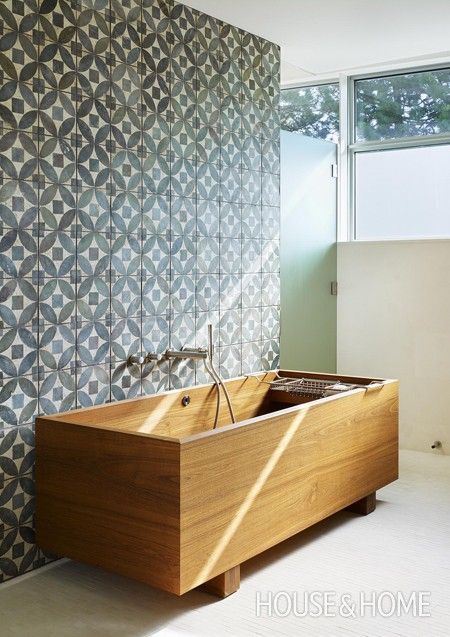
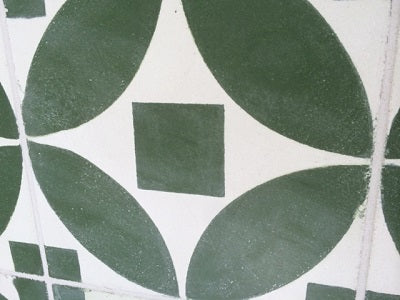
One of the greatest joys about blogging and my love of tile is sharing fabulous installations using cement tile like this one featured in House and Home. The cement tile installation uses a Geometric Moroccan Circle pattern in soothing green.

Cement Tile in a Geometric Moroccan circle pattern. Image credit: House and Home
Cement Tile in a Geometric Moroccan circle pattern.
Image via House and Home
I also enjoy educating people about cement tile and making sure they know the differences between cement tile and it more ubiquitous cousin, ceramic tile. Because it is very porous, cement tile is more prone to grout haze than glazed ceramic tile. Today, I'll explain why grout haze occurs, how you can spot it and how to remove it.

Spotting Grout Haze

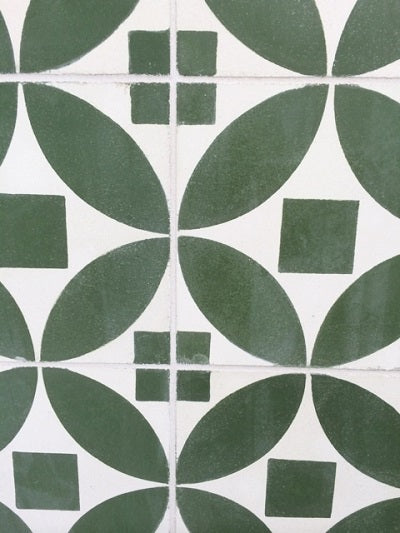
Last week I received an email from one of the design firms in Berkley, CA, that we work with. Overall, the design firm's client was thrilled with the tiles and the install. The installation featured our Geometric Moroccan Circle cement tile for a bathroom in San Francisco. The tiles were installed on both the floor and wall. Unfortunately, a "white film on the tile" could be discerned after they were sealed.
Grout Haze on a Cement Tile
Grout haze on a cement tile installation.

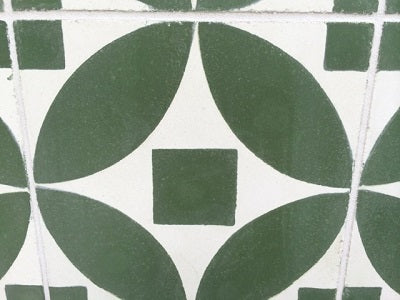
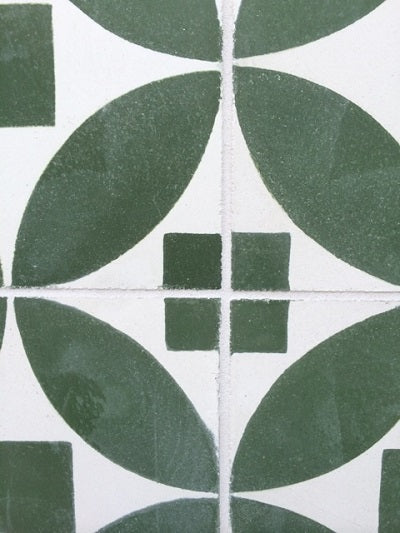
The "white film" you see on the dark green pattern of the tile is grout haze. Grout haze will generally appear as a white or grey streak on the dark colors in the pattern. The streaking color will depend on the color of grout you choose. 

Streaking caused by residual grout left on cement tile.

Understanding Why Grout Haze Occurs

During the installation, the tile is smeared with grout. The streaking occurs from the float or squeegee that is raked over the tile.

Remove grout with a rubber float and sponge right after grouting to avoid grout haze
Always remove grout with a rubber float and sponge.

The installer has to physically remove as much grout as possible with a rubber float and then with a sponge after coating the tile with grout.

A very liquid grout must be used for cement tile to avoid grout haze.

If the grout becomes too dry during application, it can penetrate the cement tile pores. The haze will become apparent after the water on the tile surface evaporates and leaves behind the minerals from the grout. Remember, the grout is applied between the spaces of tile using a tile float, and then wiped away with the same tile float and a wet sponge. Follow these best practices when grouting.

Best Practices for Grouting Cement Tile

  1. You may use colored or white grout. If you decide to use colored grout, then we recommend that it be a color that is the same, or lighter than, the lightest color used in the pattern.
  2. The grout should be fluid enough to completely fill the joints.
  3. Apply the grout with a rubber float or with a rubber squeegee, always moving diagonally across the joints.
  4. Any excess grout should be removed with a damp cloth or sponge before it dries.

How to Remove Grout Haze on Cement Tiles

Follow or share these tips with your installer to avoid, minimize and remove grout haze. These guidelines apply only to cement tile installations.
  1. Make sure to physically remove as much grout as possible with a rubber float and then with a sponge.
  2. Make sure the tile is completely dry, clean and free of grout before applying a penetrating sealer.
  3. Start with a light buff and clean. For floor installations, buff the floor with a floor polisher and white pad. Use just a bit of water and change the pads frequently to encourage the clean-up of any grout.
  4. If you don't achieve the results you are looking for, then attempt a deep cleaning. A deep cleaning is achieved by buffing the floor with a floor polisher and green pad using a lot of water and pH neutral soap. This must be done prior to applying a penetrating sealer. The goal is to really clean the floor of any dust, grout, pigments or debris prior to sealing. The use of a floor polisher and green pad isn't usually necessary on polished tiles. Polished cement tiles are "buffed" at the factory to achieve a satin sheen that simulates the look the tiles acquire after years of normal use and care. The surface of a polished tile is smooth compared to an unpolished or raw cement tile. The smooth surface of a polished tile makes it easier to install because grout is less likely to penetrate the tiles.
  5. In locally severe locations or if the tile has been sealed, use 800 grit wet sandpaper and water to remove excess grout.
Cement tile is fairly easy to clean with a floor buffer or rags, water, soap and elbow grease. Occasionally, fine grit wet sandpaper may be required to remove excessive grout haze. Always, protect cement tile from oil and acids that will severely damage it.

If you liked this post, you might also enjoy Removing Grout Haze in a Cement Tile Installation.

Tuesday, July 1, 2014

Malibu Field Tiles for Enhancing Your Space


Spanish Santa Barbara Style tiled fountain with handmade patterned and solid-colored field tiles. Image via Pinterest
Spanish Santa Barbara Style tiled fountain with handmade patterned and solid-colored field tiles. Image via Pinterest.

Summer is now in full-swing with vacations, short getaways, daily outings, and entertaining outdoors with friends and family members alike. If you're like us, you love to hear the chatter and laughter of a house full of people, especially when a day time gathering spills over into the evening.

With the same giddiness that accompanies summer, we're proud to introduce our Malibu Field Tiles, the latest addition to our extensive collection of ceramic tiles. These solid-colored, high-fired glazed tiles are the perfect companion to decorative tiles. Created using classic red bisque, this collection offers a rustic look and feel on their own, or when they're paired with our patterned, hand-painted Malibu Ceramic Tiles that are reminiscent of Old California, Spanish Revival architecture.


Malibu Field Tiles are handmade, including the glazing process, one at a time. Image by Arpi Nalbandian.

Further, our Malibu Field Tiles offer the freedom to create striking designs that withstand the elements. In addition to their wide variety of uses, Malibu Field Tiles offer more versatility and value than any other material with their resistance to abrasion, and their ability to retain their deep, rich colors attests to their longevity. These tiles are made to order (made in the USA), so please allow 4 to 6 weeks for delivery.


Malibu Ceramic Field Tile in Pumpkin
Pumpkin

Malibu Ceramic Field Tile in Cherry Red
Cherry Red

Malibu Ceramic Field Tile in Juniper Breeze
Juniper Breeze


Malibu Ceramic Field Tile in Mahogany
Mahogany

Please make sure to visit our dedicated Ceramic Tile FAQs page for any questions you may have. Of course, you can also call our office at 888.739.4972, and we would be more than happy to help with your purchasing decisions.


Pinterest logo

Appreciating Spanish Revival Architecture

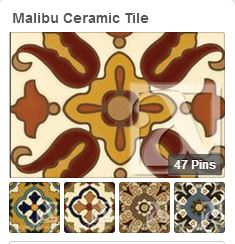
Malibu Ceramic Tile

Destination: Spain
"Architecture should speak of its time and place, but yearn for timelessness." - Frank Gehry
With this month's focus on our newly launched Malibu Field Tile collection, it was only natural to draw from the colors and patterns of Spanish Revival and Old California architecture. Having said that, we chose two boards that best reflect the timelessness of this style - Malibu Ceramic Tiles and Destination: Spain!

The synergy between the curves, colors, and shapes used in Spanish Revival and Old California styles continue to hold their place in time, similar to our handmade or hand-painted ceramics.

Remember, no matter which project you choose to conquer, Avente Tile is here to help you reach your design goal. Our extensive ceramic tile Design Ideas gallery features a large collection of projects dedicated to inspiring you and your living space. How can we help inspire you today?

Tuesday, June 24, 2014

Pavers, Tiles and Fountains: Mediterranean Gardens and Courtyards


It is a warm summer evening in the south of Italy and the garden beckons for company. The extended sunshine hours have cultivated the blooming of wisteria, star jasmine, and roses climbing along the trellises and arbors. The courtyard focuses on a babbling fountain designed in exquisitely crafted, boldly colored tile and a seating area surfaced in clay pavers where friends and family congregate over a bottle of wine and plate of cheese and fruit.

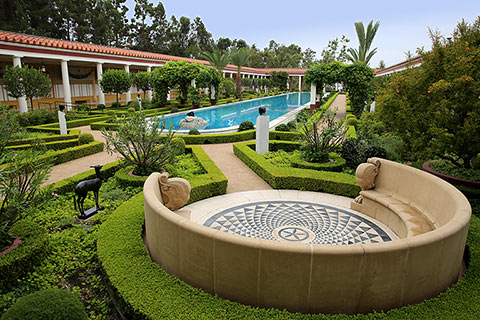
Getty Villa Outer Peristyle
Dating as far back as ancient Greece and Rome, these garden/courtyard areas were common amongst both the wealthy palaces as well as the smaller village homes. They were open to the sky and fresh air, adorned with luscious plant-life, sculpture, decorative masonry, and a fountain or pool.

The gardens of the Mediterranean are idyllic and have inspired landscapes throughout various regions and throughout the centuries. These heavenly spaces were intended to be utilized, to be lived in; they were a common gathering area and therefore were designed with both function and aesthetics in mind. Seating was intimate with both companions and attractive vegetation. Fountains were placed on rock walls as well as created as centerpieces.
Courtesy of Landscaping Network
Texture and color are important elements, as well as the notion of secluding oneself from the rest of the world. Paving for seating areas and walkways could vary from gravel, stone, and concrete, providing it offered practicality, as well as splashes of color and variance in texture.

Emphasis was given to the pools and fountains and there was great variety in these designs. Even the smallest garden could utilize a free-standing basin of elaborate or simple detail. Old monasteries may be adorned with an antiqued cistern head or simple geometric shape. Stucco was a common material, although concrete could also be used.
Getty Villa East Garden
The Getty Villa of Los Angeles has been reconstructed after an ancient Roman style villa.  Their east garden offers an exquisite example of a fountain focal point, adorned with indigenous plant life and secluded from other sections of the property.
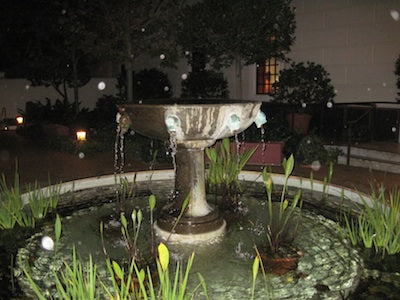
Fountain Close Up on a Rainy Night
There was no limit to the imagination for fountain designs, motifs, and materials used.  One could utilize a wall structure with bold tile colors and statuary.

Spanish Tile Fountain
A mosaic could be created using smaller, brightly colored stones, tiles, and gravel.

Getty Villa Mosaic in East Garden

The more elaborately-inclined could create pools large enough to wade in, should one desire on a hot summer's day.
Cobalt Blue Pool - Courtesy Landscaping Network
Let your creativity soar when designing your dreamy and inviting outdoor spaces. Avente Tile has a plethora of options in colors and textures to manifest your design idea!

Tuesday, June 17, 2014

Porcelain Tiles from Spain and the World Cup

If you, like millions of others, watched the Brazil vs. Croatia soccer match that marked the start of the World Cup on June 12, then you saw the Arena Corinthians stadium in Brazil where the game was played.

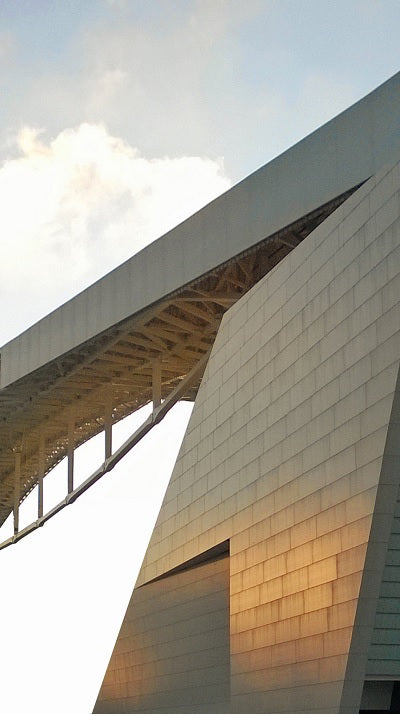
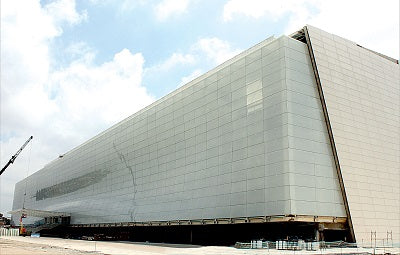
Our friends at Tile of Spain were kind enough to share some amazing tile facts about the Spanish tiles that were used for this project. The stadium's façade is covered with approximately 12,000 square meters of tile, which is equivalent to 2.97 acres or 129,000 sq. ft. of tile!

Arena Corinthians stadium in Brazil.
129,000 sq. ft. of Spanish TECHLAM® porcelain panels cover the Arena Corinthians stadium in Brazil. Photo courtesy of Tile of Spain
The tiles are TECHLAM® NEU porcelain panels developed and manufactured by Spanish company Levantina, and cover the outside of the Arena Corinthians Stadium.

The 12,000 square meters were cut into 4,000 1x3-meter panels, which are 5-mm thick and weigh 11.87 kg per square meter. The material, manufactured entirely in Novelda, Alicante, required more than 500 hours of work to create. The panels were then shipped to Brazil in 10 containers.

Arena Corinthians stadium in Brazil.
The Arena Corinthians Stadium in Brazil. Photo courtesy of Tile of Spain

Further, Tile of Spain mentions that this "cutting-edge porcelain material is highly resistant to adverse weather conditions, sudden changes in temperature and severe climatic conditions. This guarantees a very long life-cycle; when properly fitted it can last a lifetime."

Environmentally Friendly, Easy to Maintain
As a Greenguard certified product, TECHLAM® ceramic tiles are suitable for environmentally friendly uses."The Arena Corinthians Stadium has been built to sustainable design standards. Architectural solutions for energy efficiency, the use of alternative energies, improvement of interior environmental quality and efficient water consumption have been implemented in this project," noted Tile of Spain.

Further, as a 100% natural product, TECHLAM® is produced using oil-free mineral raw materials. Also, because of its thickness, it takes less energy to produce and ship than conventional tiles. Maintenance is also environmentally friendly as only water is needed for cleaning.

The Arena Corinthians stadium is one of the latest international projects in which TECHLAM®'s versatility has been utilized. Additional projects can be found worldwide, including: Hotel Hilton Times Square in NYC; Seocho and Hyehwa metro stations in South Korea; Australia's Rendezvous Hotel Perth; Germany's Frankfurt Airport; metro stations in Prague; and more.

More information about TECHLAM® by Levantina can be found here. Many thanks to the great folks at Tile of Spain for sharing this phenomenal structure and technology with us!

Tuesday, June 10, 2014

Discover Design with Historic Spanish Tile Installations in Los Angeles

By , Avente Tile

As summer starts to kicks into full swing with the solstice less than 10 days away, I find myself enjoying the perfectly splendid outdoors of Southern California with longer walks each day. This summer, our blog is dedicated to handcrafted tiles and their use outdoors. Last week we introduced our new Artisan Porcelain Tiles for the Pool! This week I share my favorite historical tile installations that I've discovered during my urban treks in the neighborhoods of Los Angeles and Beverly Hills.

These brightly colored tiles are grouped beneath a Moorish arch to create a colorful tribute to Spanish Revival Architecture
Brightly colored tiles are grouped beneath a Moorish arch
create a colorful tribute to Spanish Revival architecture.
Most of these homes, duplexes or commercial spaces were built in the late 1920s. What you’ll see in every photo is the optimism that was prevalent in the era. Optimism expressed in the colors of the tile and the details of every structure; details that you rarely find today. Each installation pays homage to a specific architectural style: a portico found in a Mission style home, an extremely decorated façade of a Spanish Renaissance commercial location, or a fountain typical of Spanish Colonial architecture found in a duplex courtyard. You’ll find that these installations show some wear; but, they are a great tribute to both Los Angeles architecture and the classic forms they honor.

Patterns grouped or "blocked together" create an impact on the entry to a California Courtyard.

Color or pattern blocking is a common method where tiles of the same color or pattern are grouped together to create maximum impact or define an area. Unlike the photo above, here you see several different patterns and formats used on a planter box below a window. The quarter design circular patter has strong ties to Moorish patterns and the smaller format cross pattern is class Spanish. The colors are typical of tiles from the 1920s with a listello border on the bottom of the planter box.

Tiles patterns on this planter box are Spanish and Moorish influenced.
The cohesive palette and tiles is circa 1925.
Something you don't see very often today is the use of brick with Spanish tile. We often think of brick as being traditionally English. However, the red clay brick plays nicely with the red clay roof tile and decorative Spanish tiles on the planter box because it has a natural "terra cotta aesthetic."  The architectural details on the home enforce the Spanish style theme.

Brick can work with Spanish tile
Brick can work with Spanish tile designs especially when the
home's architectural theme is influenced by Spanish details.
Spanish tiles are used for the stair risers on this brick path leading up to the home. Notice the planter box to the left of the door at the top of the stairs. A cohesive color scheme of different shades of blue on the tiles work well with the alternating stair rise patterns and the planter box.

A cohesive color palette allows different patterned tiles to harmoniously exist.
A cohesive color palette of blues in the stair riser and planter box tiles
allows different patterns to harmoniously exist.
Architecture often speaks to the times both in form and function. The period in the late 1920s in Los Angeles was one of optimism and hope. Sunflowers are often considered a symbol of optimism with their big, over-sized, bright yellow flowers reaching up to the blue sky in the warmth of summer. Nothing symbolizes this optimism more than these stylistic sunflower tiles used on this Beverly Hills duplex.

These stair risers are tiled with a sunflower motif
Architecture captures the mood of the times.
These stair risers are tiled with a sunflower motif (circa 1925).

Doesn't that get your attention? You can't help but smile seeing those tiles on the stair risers.  Here's a close-up of these stunning tiles!

Detail of Sunflower Tiles on stair risers in Beverly Hills circa 1925.
Detail of sunflower tiles on stair risers in Beverly Hills circa 1925.

I hope you enjoyed exploring some of my favorite historical tile installations near the Los Angeles neighborhood where I reside. These are great examples of how Spanish tile have been used to complement an existing architectural style. Throughout the summer, we'll explore more homes in the neighborhood and share additional ways to bring tile outside! If you liked this post, don't miss my previous post, Spanish Tile Details Charm this Los Angeles Neighborhood.

Want to add some Spanish tile charm to your home? Then look through our Spanish tiles or browse our Ceramic Tile Design Ideas where you can find a large collection of projects showcasing our handmade and hand-painted Spanish tile. Let us know how we at Avente Tile can assist you!

Tuesday, June 3, 2014

Artisan Porcelain Tiles for the Pool


Spanish tile design mixed with solid-colored glazed porcelain tiles brings this pool to a new dimension.
Custom tile design by Carson Magness Landscapes at The Pasadena Showcase House of Design. Photo by Karol Franks via Flickr.

With summer just around the corner, it's now time to clean and restore the backyard for a season full of fun and great memories. Along with washing the outdoor furniture, cleaning the grill for upcoming BBQs, and testing outdoor equipment, you shouldn't forget to refresh and update the look of your swimming pool with richly colored, hand-painted porcelain tiles.

Field tile, or plain, solid colored tile, is a tile found in the main "field" or area of an installation covering the walls, floors or steps of your swimming pool. You can pair field tile with our decorative Spanish ceramic tiles to create spectacular designs.

In addition to their wide variety of uses, hand-painted pool tiles offer more versatility and value than any other material with their resistance to abrasion, their ability to handle freeze/thaw conditions, and their ability to retain color. With such a wide variety of deep, rich hues and sizes to choose from, porcelain pool tiles offer you the freedom to create beautiful designs that withstand the elements. Because these are made-to-order, handcrafted items, please allow 3 to 6 weeks for delivery.

Here are examples of the soothing porcelain tile glazes we offer in our Pool Tile collection.

 Azure
Azure

 Cerulean
Cerulean

 midnight
Midnight

 Spencer
Spencer

We offer a wide variety of pool tile formats, options, trims and accessories. Also, please visit our dedicated Ceramic Tile FAQs page for any questions you may have. Of course, you can also call our office at 888.739.4972, and we would be more than happy to help with your purchasing decisions.


Pinterest logo

Celebrating Summer

Blue
Pools and Ponds

"Rest is not idleness, and to lie sometimes on the grass under trees on a summer's day, listening to the murmur of the water, or watching the clouds float across the sky, is by no means a waste of time." - John Lubbock, The Use of Life

Summer's energy translates to taking on new projects, perhaps one that has been set aside for years. Replacing cracked or broken pool tile or finally installing that fountain or water feature you've always wanted for the garden .now's the time!

Using handmade or hand-painted porcelain tile for your next outdoor project will not only enhance the look of your home, but you can rest assured the tile you choose will withstand the elements, too. For whichever project you choose to conquer, Avente Tile is here to help you reach your design goal. Our extensive ceramic tile Design Ideas gallery features a large collection of projects dedicated to inspiring you and your living space. How can we help inspire you today?