Thursday, June 7, 2012

Tile Talk Newsletter - June 2012

Project Pick: Cuban Cement Floor Tiles for a French Moroccan Bath

Cuban Cement Floor Tiles for a French Moroccan Bath
Photo credit: Celia Reiss Interiors

This month's project pick comes from Celia Reiss. She is a designer at her firm, Celia Reiss Interiors, in Manhattan, New York. Celia shared an image showing how she used Cuban Heritage cement tiles in a design for her own bathroom. Celia loves cement tiles and it shows in this design!

"The tiles were installed in my own home to be able to show my clients how fabulous it would look."

- Celia Reiss of Celia Reiss Interiors, Manhattan, NY

I love that the floor tile wraps up to surround the bath. The tiles carry the pattern on both vertical and horizontal surfaces creating a very sophisticated look. The bath tile is in perfect balance with the floor tile. The antiqued wood vanity with marble top creates a rich, but comfortable space.

Find out more about this project and Celia's design on our blog, Avente Tile Talk. There are great ideas for anybody that is considering a cement tile floor. Read:

>> A Designer Chooses Cuban Tiles for her Bathroom

You can see more images of this project on her blog at Bathroom with a French Moroccan twist. There are wonderful images that detail the vanity, pulls and sink - not to mention the tile.

The cement floor tiles are all 8" x 8". The cement tile pattern is Cuban Heritage Design 140-2B with the contemporary colors of Light Turquoise, Brown, and Caribbean Blue. Celia wisely chose not to use the border pattern for this design because the bathroom isn't big enough to accommodate both a bold border and intricate pattern. The field pattern uses only Light Turquoise and Brown:


Light Turquoise

Light Turquoise

Brown
Brown

Cuban Tile patterns are characterized by elaborate designs, bold colors and prominent borders or double borders. The Cuban Heritage cement tile patterns are from cement tile installations found in old homes or estates in Cuba.

Cuban Heritage Design 140 comes in four standard colorways:


Cuban Tile Pattern 140-1A


Design 140 1A

8" x 8"


Cuban Tile Pattern 140-2B

Design 140 2B

8" x 8"


Cuban Tile Pattern CH140-3B

Design 140 3B

8" x 8"


Cuban Tile Pattern Design 140-4A

Design 140 4A

8" x 8"

>> See the collection of Cuban Tile Patterns


Experience the Color of Provence in Arles

Cote d'Azur ner Roqubrune

Cote d'Azure near Roqubrune
Provence is the inspiration for the colors in Arles

Have you seen our new line of field tiles? Arles is a handmade tile with a stunning, reactive glaze in colors reminiscent of the seasons in Provence. If you've ever felt a cold Mistral blow against your face or seen the hay dry in the fields on a warm summer day, you'll begin to see and feel the colors in Arles.


Arles Field Tile in Mist
Arles Field Tile & Trim in Mist

Arles is available in five colors: Aqua, Mist, Hay, Cork, and Wheat. Each color is stocked in a 4"x4" field tile, a molding, and a simple liner. Rhomboids are also available. When purchasing samples, make sure to be get at least four different pieces so that you get a good idea in the variation of color.

Arles Field Tile in Hay

Arles Field Tile & Trim in Hay

There’s something very unique about the rich glazes in the Arles Field Tile. They are full of movement. The tiles are fired differently with a glaze that is reactive to the local terracotta body. It is this combination that gives each tile such distinctive qualities. The owner of the design studio where Arles is made explains, "Basically, this combination is what makes this line is so different. There is great variation in the glaze color ranges. The reactive glazes change so much, so it is never the same twice." And, don't forget, Arles is 100% handmade. You'll see the hand of the artist in each tile body and in the glaze.


>> View Arles Field Tile

>> Read Blog Post: Arles Handmade Field Tile


Tile Tip:
If you are tiling a newly finished and poured concrete slab, allow adequate cure time for the slab to avoid grout cracks. Cement shrinks as it cures and excess moisture evaporates. If tile are applied too soon, while the concrete is still shrinking, grout is likely to crack. The TCNA (Tile Council of North America) suggests a 28-day cure for concrete before tiling. Also, the TCNA cautions that many factors must be considered before determining the appropriate cure time to avoid grout cracking.

Find out more and read:

>>Our blog post on Why grout cracks in tile installations
>>TCNA's recommendations on Concrete Cure Times before Tiling

Tuesday, June 5, 2012

Spanish Tile as a Building Material


Ceramic tile use throughout Spain is prolific. Not only can it be seen on the floors and walls of Aragonese countryside homes, but ceramic tile also plays an integral role in the everyday functioning of many embellished palatial royal dwellings. It wasn’t until 2011 when I realized just how much of a role ceramic tile played, not only in the current day-to-day daily life of Spaniards, but the depth and complexity of historical value.


Spain ceramic tile historical handmade handpainted
The Basilica Nuestra Senora del Pilar, as viewed from across the Ebro river, features vibrant blue, green, yellow, white and ceramic tile on its main dome, as well as its 10 smaller domes.


Last year, along with four members of the architecture and design (A&D) community, I was asked to join the second edition Tile of Spain’s “Reign in Spain A&D Tour.” Tile of Spain is the umbrella brand managed jointly by the Trade Commission of Spain in Miami, FL, and the Spanish Ceramic Tile Manufacturer’s Association (ASCER) in Valencia, Spain. The annual media tour to Spain coincided with Cevisama, the International Ceramic Tile and Bath Furnishings Show held in Valencia. 


The group of architects, interior designers and journalists, including myself, traveled to the cities of Zaragoza, Teruel and Valencia – admiring the Spanish architecture, culture, and culinary temptations – with Cevisama being our final destination. 


Shortly after our arrival to Spain, we were taken to Zaragoza, the capital of the region of Aragon. Located on the banks of the Ebro River, halfway between Madrid and Barcelona, Zaragoza hosted Expo Zaragoza in 2008, where the country showcased its commitment to water conservation, the preservation of the environment and its utilization of sustainable practices. Of course, ceramic tile and terracotta played an integral role in all of this.


terracotta ceramic tile sustainable eco-friendly
The Spanish Pavilion on the grounds of the 2008 Water Expo features 750 terracotta pillars.


ceramic tile handmade exterior reflective energy efficient sustainable
The Conference Center of Aragon utilizes 120,000 triangular pieces of ceramic tile on the exterior walls and roof lines.


Walking through the Plaza de la Seo in Zaragoza, we came upon two basilicas, the Cathedral of San Salvador (La Leo) and Nuestra Senora del Pilar. Without a doubt, ceramic tile played both an aesthetic and architectural role in both of these historical structures. The blues, greens and yellows are as vibrant as when they were first applied to the brick exterior of La Leo and to the many baroque domes of Basilica del Pilar.


ceramic tile historic installation handmade hand-painted sustainable artistic
The tower wall of Basilica of San Salvador (La Leo) features various shapes, colors and sizes of ceramic tile.

ceramic tile historic installation handmade hand-painted sustainable artistic
A detailed view of the wall shows the vibrancy of the colors and painstaking detail of this installation. 


In my next post, I’ll focus on Teruel (a World Heritage city designated by UNESCO). As a center for Mudejar art, a style influenced by Islamic tradition and more contemporary European architectural styles, the fortress-like city is characterized by extensive use of brick and glazed tiles within its architecture. In the meantime, you can check out the beautiful hand-painted ceramic Spanish tiles offered by Avente Tile


Tuesday, May 29, 2012

Why grout cracks in tile installations

The most visible part of any tile installation is, of course, the tile but what is the next thing you see. The grout! The grout, in many ways, is more visible as the smaller lines that make that up can draw your attention away from the tile itself. If those grout lines have cracks or are crumbling, your eye will naturally shoot right to it.

So let's look at few things and how they should be handled to make sure that the grout you use compliments your beautiful tile. Do you know the difference between sanded and unsanded grout and where each should be used? Now the difference in the two is easy. One has sand, one doesn't.

Applying grout

Now where to use which one is determined, not by the tile itself, but rather by the width of the joint between them. 

"Narrow joints of 1/8 inch or less call for unsanded grout, a pudding-smooth blend of Portland cement and powdered pigments mixed with water. Joints wider than 1/8 inch get sanded grout — the same material, but with sand added. The sand helps bulk up the grout and keeps it from shrinking in the joints." - ThisOldhouse.com

Now why does grout crack? You've applied the proper grout but down the road cracks start to appear in your grout lines and there can be many reasons but most have to do with the installation long before the grout was added. Most of what we will look at today is in reference to flooring but there are many points that are similar with all tile installations.

1. The first potential reason is that the thinset below the tile was improperly applied and does not have enough thinset.

Thinset application on floor

2. The subfloor is moving and as it moves the grout lines crack.  Did you apply the tile directly to the wooden subfloor? Tile should never be applied to a wooden subfloor due to the natural movement that is part of wood.

3. Was the cementious backer board that was applied over the subfloor installed correctly? Maybe there weren't enough screws or thinset below or it was spaced improperly. Any of these could cause movement and that causes cracks.

Cementious backer board installed

4. As another possibility- Is there adequate space between your wall or wooden trim and your grout? Grout doesn't contract and expand but wood does and that could be part of the issue too. It is a good idea to leave a 1/4" space between any tile and wooden baseboards or trim so that if the wood expands, it will not apply pressure to the tile and possible crack the grout. To accomplish this a "shoe" molding can be applied to the baseboard, effectively covering the gap and allowing the baseboard to move above the tile while applying no force to the tile or grout.

5. Did you apply your tile on a newly finished/poured concrete slab? Concrete has to cure and as it does it moves, so if your concrete floor or base is new and the tile was applied too soon, it could be the reason your grout is cracking. 
I would also add there could be other reasons for grout to crack other than those listed above such as improper mixing  ie too much water in the mix. This would cause the grout to improperly dry leaving it prone to cracking later.  It could also be that water was added again later in the mixing process and this will cause the grout to be dry and crumbly.

Now if you are still in the planning stage I would offer a suggestion or rather a product and installation method that will help avoid the problem of movement and grout cracks. It's a mat that is laid in a bed of thinset and then a layer of thinset is applied above with the tile and grout.

Schluter- Ditra-X for floor tile installation

Schluter-DITRA-X


What this mat does is provide a separation between the sub flooring material, whether that be wood or concrete so that if there is movement in the concrete/wooden sub floor, it will not translate up into the tile and grout and cause cracking.The mat will take the added stress of the movement below and not the tile/ grout therefore helping to eliminate cracking. For further reading about this product-http://www.schluter.com/Schluter-DITRA-XL.aspx 


As we have pointed out before, planning ahead and armed with knowledge will lead to a successful installation as it is so much easier to do right the first time than have to go back and correct later.


Tuesday, May 22, 2012

Arles Handmade Field Tile

Today I'm excited to highlight our new line of field tiles, Arles. Arles is a handmade tile with a stunning, reactive glaze in colors reminiscent of the seasons in Provence. If you've ever felt a cold Mistral in your face or seen the hay dry in the fields on a warm summer day, you'll begin to see and feel the colors in Arles.

Lavender field
Lavender field
Provence is the inspiration for the colors in Arles

There’s something very unique about the rich glazes in Arles. They are full of movement and fluctuation.

Arles is available in five colors: Aqua, Mist, Hay, Cork, and Wheat. Each color is stocked in a 4"x4" field tile, a molding, and a simple liner. Rhomboids are also available. When purchasing samples, make sure to be get at least four different pieces so that you get a good idea in the variation of color.

Aqua ranges from inky black to aqua blue.

Arles Field Tile in Aqua
Arles Field Tile & Trim in Aqua

Mist is an intense, blue-grey tile.

Arles Field Tile in Mist
Arles Field Tile & Trim in Mist

Cote d'Azur ner Roqubrune
Cote d'Azure near Roqubrune
Provence is the inspiration for the colors in Arles

"We use a local terracotta body which allows the titanium oxide in the glaze to move the way it does. We fire it differently than our other ceramic tiles too, and that’s why each tile has such distinctive qualities," explains the owner of the design studio where they are made.

"Basically, this combination is what makes this line is so different. There is great variation in the glaze color ranges. The reactive glazes change so much, so it is never the same twice." And, don't forget, Arles is 100% handmade. You'll see the hand of the artist in each tile body and in the glaze.

Hay ranges from yellow to light brown.

Arles Field Tile in Hay
Arles Field Tile & Trim in Hay

These tiles are suitable for all indoor wall applications. They can be used in outdoor locations; but, not in frosty environments.

Cork is a mixture of rich, matte chocolate shades.

Arles Field Tile in Cork
Arles Field Tile & Trim in Cork

Wheat is a saturated earth brown that varies from medium to dark.

Arles Field Tile in Wheat
Arles Field Tile & Trim in Wheat

With its slightly irregular, handmade rustic-body, Arles looks great when laid with wider grout lines. Because there is a high degree of variation in the hand-painted glaze colors, it adds interest and movement to any installation. Arles is a great way to achieve a rustic or relaxed feel with field tiles and bring the colors of Provence into your home.

Tuesday, May 15, 2012

A Designer Chooses Cuban Tiles for her Bathroom

A few weeks ago a Manhattan designer, Celia Reiss, called to purchase some more Cuban Heritage cement tile samples. She mentioned that the Cuban Tiles she purchased at the beginning of this year had been installed and she was really pleased with the design. I am, too! Here's the results.

Cuban Tiles for a Bathroom by Celia Reiss Interiors

I smiled when Celia informed me that she installed the tiles in her home. She went on to explain, "The tiles were installed in my own home to be able to show my clients how fabulous it would look." All of the design and photo credits go to Celia Reiss Interiors. For more photos of this project read her blog post, Bathroom with a French Moroccan twist. Don't miss her most recent projects on the Celia Reiss Kitchen and Bath Blog.

Cuban Tiles for a Bathroom by Celia Reiss Interiors

One design element that I love is that the floor tile wraps up to the bath – carrying the pattern on both vertical and horizontal surfaces. This creates a very sophisticated look. The bath tile is in perfect balance with the floor tile. The antiqued wood vanity with marble top creates a sumptuous, but comfortable space.

Cuban Tiles for a Bathroom by Celia Reiss Interiors

The cement tile pattern is Cuban Heritage Design 140 with the contemporary colors Light Turqoise, Brown, and Caribbean Blue. The cement floor tiles are all 8" x 8".

Cuban Tiles for a Bathroom by Celia Reiss Interiors

I was intrigued by the vanity. Celia informed me that, “The vanity I got at the major flea market in Paris, Le MarchĂ© aux Puces. We had it shipped back. The handles say Paris on it. The sink itself is actually two sinks. The top one is like a basin without a hole, and it tips into the second sink, which has the drain.”

Cuban Tiles for a Bathroom by Celia Reiss Interiors

You can see more images of this project on her blog at Bathroom with a French Moroccan twist. There are wonderful images that detail the vanity, pulls and sink - not to mention the tile. To find out more about the designer, visit her website, Celia Reiss Interiors. You should also visit Celia Reiss Interiors Kitchen and Bath blog to see photos from other installations.

Cement tiles are an excellent way to add interest and style to a bathroom floor. Thank you so much for sharing your style and photos, Celia. Your bathroom is stunning and I love the personal touches. There is no better "seal of approval" than a designer using a product in his or her own home! We’re so glad we could help achieve this stunning look with our Cuban Heritage tiles.

Tuesday, May 8, 2012

A Tour of VISION House® in INNOVENTIONS at Epcot®

While in Florida last month, I took a tour of a new home, the VISION House® in INNOVENTIONS at Epcot®. VISION House is presented by Green Builder Media®.

VISION House® Living Room
The Vision House Living Room

A twitter friend, Mark Johnson, was kind enough to invite me and a few others to join. At the time, the attraction was not open to the public and there were countless last-minute details to complete before opening day. So, I was thrilled to get a "sneak peak" before the official unveiling on Earth Day (April 21, 2012). The tour group included architects, designers and bloggers.

VISION House in INNOVENTIONS at Epcot is an attraction – not a real home. You are a guest of the Monteverdi family and receive a guided tour. During the tour, your guide explains the features of the home and how green building technology and standards have been applied. You’ll discover how whole-home automation works, how the home can generate energy, save energy and conserve water. Technology is a key theme and you’ll see how intelligent products and advanced technologies provide a key role in reducing our impact on the environment.

VISION House® Dining Room and Kitchen
Dining Room and Kitchen

One of the cornerstones of the tour is showcasing sustainable living solutions. Another theme is that buildings are not simple shelter. They are an interactive set of systems that work together to create a green living environment for inhabitants. "Sustainable living is about taking personal responsibility," says Green Builder® Media CEO Sara Gutterman. As you explore the home you’ll discover ways to take responsibility and provide for a greener tomorrow.

VISION House® Bedroom
Triple pane windows with inert gas provide better insulation

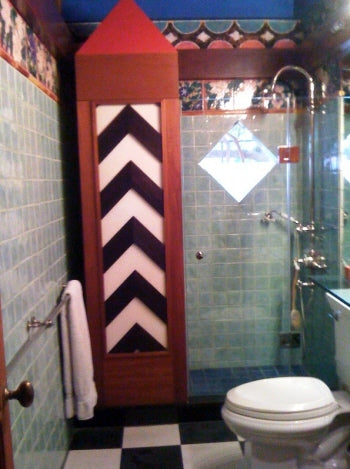
The bathroom has showers and faucets that provide spa-like experiences; but still conserve water. There is a toilet that raises and lowers the seat with a foot pedal and plays your favorite music. It also has a built-in seat warmer. I wasn't able to find out much about the tiles!

VISION House Bathroom
The Bathroom uses devices that save water

We are all familiar with the benefits of solar panels. One of the most cutting-edge innovations I saw are smog-eating roof tiles. They absorb smog in the air and filter it.

VISION House®
Detached home office with solar panels and smog-eating roof tiles

I was thrilled to see quality design being presented with sustainable and green solutions. I would liked to have seen tile incorporated more in the design and I think tile will play a prominent role in green building. It's important to remember that green living doesn't start with a new home tomorrow. It starts today with the choices you make and can be as simple as turning off a light, grocery shopping with re-usable grocery bags and re-cycling. When choosing new appliances look for the most energy efficient one and when it comes time to build or remodel don't forget about VISION house. The green building and sustainable living technologies you see are available today.

I hope you enjoyed the "sneak peak" tour. If you are at Epcot make time to visit VISION House® or feel free to explore online at visionhousegreen.com.

Thank You

Thank you Mark for organizing this tour. I appreciate Sara Gutterman and Ron Jones of Green Builder Media for making time to spend with us. Green Builder Media is responsible for a series of demonstration homes built around the country that showcase the latest in green design, building techniques, and products. I'm looking forward to VISION House Los Angeles and will share that home tour as well.

About the Sponsors

Green Builder Media’s VISION House® Series is comprised of demonstration homes built around the country that showcase the latest in green design, building techniques, and products.  Each house utilizes site-specific solutions for key green building issues including energy use, water conservation, land use and orientation, waste management, indoor environment quality, and products and materials.


VISION House® in INNOVENTIONS at Epcot® Logo
VISION House®

About Green Builder Media

Green Builder® Media, LLC is the leading media company in North America focused on green building and sustainable living. With a comprehensive suite of print and digital media solutions, demonstration projects, case studies, online training, and live events, Green Builder Media assists building professionals in preparing themselves for the new green economy and helps homeowners understand how to live more sustainably. For more information go to Green Builder Media.

About INNOVENTIONS at Epcot®

INNOVENTIONS is located in the heart of Epcot® at the Walt Disney World® Resort in Lake Buena Vista, Florida. Creativity and imagination abound as guests celebrate the inspiration and innovations that improve their lives and expand their horizons. Hands-on, interactive exhibits allow children and adults to be immersed into ideas that inform, entertain and inspire. For more information online visit INNOVENTIONS.

About VISION House® in INNOVENTIONS

The VISION House® in INNOVENTIONS at Epcot® opened on Earth Day 2012. It is a groundbreaking green show home exhibit presented by Green Builder® Media in collaboration with Walt Disney Imagineering. This experiential exhibit in the heart of Epcot® highlights the very best in green residential design and sustainable living. Visitors should leave with a greater understanding of green design, technology, and products as well as a host of sustainable living ideas that they can incorporate in their lives the minute they get home from vacation.

Other Sponsors

Other sponsors for this exciting project include Siemens, GM, Ingersoll Rand, Boral, Hanwha Solar, Panasonic, Pella, Schott, National Fire Protection Association, Armstrong, and Kohler.


Note: This is the second in series on home tours. you’ll find this post strays from our policy of discussing hand crafted tile to belatedly honor Earth Day.

Tuesday, May 1, 2012

A Customer Shares their Tile Mural Backsplash

I'm excited to share a kitchen backsplash installation from an Avente Tile customer in Seattle. The customer's home kitchen was being remodeled. She decided to use Avente's Summer Harvest Tile Mural for the backsplash. The email included a photo and went like this:

"I have attached a picture to share with your artist to show how beautifully the tile mural turned out in our kitchen remodel. Thank you for your excellent service and product. We are thrilled with the results."

Fruit and Vegetable Tile Mural for Kitchen BacksplashFruit and Vegetable Tile Mural for Kitchen Backsplash
Photo credit: Avente Customer

I'm impressed with the results too! There are three things I really like about this installation. First, the contrast in finish. The mural really "pops" because its matte finish helps set it apart from the sheen of the glossy field tile. I typically see these murals installed with natural stone, tumbled marbled or travertine. The mural's standard "twig tile frame" was replaced with bright pencil trim that really highlights the installation. My compliments to the installer for the nicely mitered corners on the frame. Well-executed installation always shows in the details. Finally, I commend the use of color in the field tile - well done! I like seeing this mural with something other than beige or neutral colors - it provides a fresh look.

The Summer Harvest mural is 23" long and 8" high. Each mural is hand painted and made-to-order just for you. Colors can be slightly customized to work more intimately with your space. For instance, the grapes can be purple or red.

Summer Harvest Tile Mural with Twig Border

Tile murals are artwork, so make sure you find something that speaks to you! If you are considering a tile mural for your home, take a look at our tile murals. Make sure to read our tips on how to to create a striking mural backsplash.


Fruit and vegetable tiles are a classic kitchen theme and one of the best ways to create an impact is with a tile mural. A tile mural is art. They look best framed (with tile of course). Not only do tile murals provide a stunning look, they simplify the design process and installation – especially, if you are a DIYer. Why? They provide a starting point for color and are the focal point of the room. Once you find a tile mural that you love, the remaining color choices, counter material and cabinets will all play supporting roles that start from here. Tile murals simplify the tile layout because the remaining backsplash ufses ield tile laid with a consistent pattern.

Our customers have great ideas and find ways to put a fresh spin on a classic look. In this installation, I like the use of different finishes between the mural (matte) and the field tile (gloss). I also like the use of color in the field tile. Thanks to our wonderful customer for sharing their installation with all of our readers. I hope it helps you find some inspiration.