Tuesday, October 9, 2012

Fragments - Our New Cement Tile Accent Strips

Meet our newest line of cement tile: Fragments! It's pretty easy to see that these tiny, tesserae have cement tile pedigree.
Fragments Cement Tile Accent Strip

Fragments are colorful mosaic accent strips made from patterned cement tile that have been cut. Fragments begin as cement tile factory extras that are cut into square or rectangular pieces. Each tessera is carefully chosen based on how it's color and pattern will integrate with the theme of the mosaic.

Fragments Cement Tile Accent Strip
Fragments Cement Tile Accent Strip - Bar Format in Winter

Use Fragments as an accent strips for a wall or bascksplash. They work well running behind a kitchen counter with other tile or can be grouped and framed to create a focal point for a larger backsplash.

Facts about Fragments Cement Tile Accent Strips

  1. Fragments come in four colorways: spring, summer, fall and winter.
  2. There are three formats:
    • Small Squares - 1.5" x 1.5" tesserae on a 12"x12" sheet
    • Large Squares - 2" x 2" tesserae on a 12"x12" sheet
    • Bar - 3/8" x 7-3/4" tesserae on a 12"x18" sheet
  3. The sheets are face tape mounted for easy installations.

Fragments Cement Tile Accent Strip
Fragments Cement Tile Accent Strip - Small Square Winter

Expect Color and Pattern Variation

While holding true to the general color tone or feel, there will be significant variation in samples and final orders because remnant cement tiles are used. The tiles, patterns and colors used for each project will be unique and different. It is this variation that make the product so unique and each installation is truly one of a kind.

Fragments Cement Tile Accent Strip
Fragments Cement Tile Accent Strip - Large Square Summer

Where to use Fragments

Fragments are designed for wall applications because the mosaic surface is not flat. With mismatched patterns, strong grout lines, and bold colors, Fragments are a great choice for a contemporary kitchen, bath or accent wall. These tiles will look marvelous in a mid-Century remodel or modern home with clean lines and neutral palette that needs color. The small and large square formats are playful and fun for casual and contemporary living. Consider using the Bar Format in a more formal or traditional style since the narrow cuts provide a softer look by blending the pattern.

Fragments Cement Tile Accent Strip
Fragments Cement Tile Accent Strip - Large Square Fall

Allow about six to eight weeks for the manufacture and delivery of your mosaic. These items can be ordered by contacting Avente Tile. Currently, many designs of our Fragments Cement Tile Mosaic accents are available online. Look for the complete collection to be available online soon.

Fragments Cement Tile Accent Strip
Fragments Cement Tile Accent Strip - Large Square Spring

Where would you use fragments? Bars along the kitchen counter or small squares as a focal point for an entry wall? Would you use one color, like autumn, or several? If you have questions about this product or would like to consider it in your next project, please contact Avente Tile or view our product catalog of Fragments Cement Tile Mosaic Accents. We'll be glad to help!

Tuesday, October 2, 2012

Innovation, Design Take Center Stage at Cersaie


Cersaie Exhibition entrance

With the close of the 30th edition of Cersaie, the International Exhibition of Ceramics for Architecture and Bathroom Furnishings held annually in Bologna, Italy, once again proved itself as the launching pad for newly developed ceramic, porcelain, glass and mosaic tile products that will soon hit showrooms and the marketplace.

Boasting more than 900 exhibitors from all corners of the globe, and 176,000 square meters (577,428 square feet) of exhibition space, Cersaie is a not-to-be missed event for distributors, retailers, interior designers, architects and installers.


The Trends

The latest trends for Italian ceramics include nature-inspired materials, a rediscovery of terracotta, monolithic tiles, textures, and cutting-edge design that remains environmentally conscious.

In terms of colors, powdery tones from grey-blue and clay, to mauve and lavender seemed popular, as did warm greys and ivory, clay and jade.

Italian manufacturers have also seemed to embrace the warmth and appeal of terracotta. Combined with modern shapes, new colors and up-to-date finishes, terracotta has been revived with a fresh, modern image.

Gaining popularity in the architecture and design fields are cement and resin, so it’s befitting that these modern, industrial, and high-impact finishes have been reinterpreted by Italian ceramic tile manufacturers in various ways.

Not to be outdone are reproductions of wood grains, or the rich veining and shading found in natural stone.

However, perfection is only one aspect of these trends. Mismatched patterns and irregularity is another facet. Imperfections such as surface-skimming cracks, and the faithful reproduction of river pebbles, added to the textural mix available at Cersaie.

Thin, monolithic tiles have also found their place in the industry in both outdoor and indoor environments, as has the need to practice good environmental stewardship. An increasing amount of manufacturers now reincorporate their processing waste back into the production process, while others use recycled glass from screens or monitors from obsolete PCs previously destined for landfills.

Let’s take a brief look now at the latest Italian tile products unveiled during Cersaie 2012.

Designer Collections

Designers and architects have unleashed their creativity with tile with several new collections made specifically for Italian tile manufacturers.

Minoo – Ornate 8"x8" porcelain floor tiles designed by Marcel Wanders, reminiscent of Persian rugs. Available in 5 decorative patterns and 8 colors, silkscreen printed on a matte background.


Bardelli's Minoo porcelain tile
Designed by Marcel Wanders, Bardelli's Minoo is reminiscent of Persian rugs.

Starck Collection – Designer and architect Philippe Starck has collaborated with Sant’Agostino to create “Flexible Architecture,” a new collection of ceramic tile that offers designers, interior designers and architects the ability to offer new possibilities where tile is no longer decorative, rather, it becomes part of the architecture, according to Starck. 

Concrete & Cement

With the popularity of concrete and cement floors gaining ground among designers and architects, Italian tile manufacturers are offering products that mimic the look and texture of these finishes. 

Gate Mark – A new textured surface for indoor and outdoor applications with a special anti-slip surface (coefficient R11 A+B). Inspired by board-formed concrete, it’s available in a range of neutral colors (Jet Black, Tube, Downtown, Breath, Broadway, Greige and Licorice) and two sizes, 24”x24” and 12”x24”. Also available in a natural or honed finish.

Gate Mark by Caesar
Gate Mark by Caesar is inspired by board-formed concrete.

Urban Concrete – Colored-body porcelain tile for interior floors & walls. It comes in 6 colors, 4 sizes (24”x24”, 12”x24”, 16”x32”, 6”x24”) and two finishes. The Natural finish enhances the delicate colors and deep shades of the collection to imbue spaces with a sense of sophisticated neutrality. Meanwhile, the Frame finish reproduces the wood textures imprinted on concrete by formwork, lending dynamism and personality to interiors. A range of graffiti and floral decors complete the line.

Flaviker's Urban Concrete
Flaviker's Urban Concrete reproduces the wood textures imprinted on concrete by formwork.

Nextra – Porcelain stoneware collection that captures the density of cement, expressing all of its strength and unprecedented smoothness. The five colors of the collection are available in a natural or polished finish and can be used in both residential and commercial environments. It is made with 40% recycled content and comes in 4 sizes (18”x18”, 12”24”, 24”x24” and 32”x32”).

Monocibec's Nextra collection
Monocibec's Nextra collection captures the density of cement.

Ink-Jet Splendor

An artist with a full palette is limitless in their creations. The same holds true for these Italian tile manufacturers who have utilized ink jet technology to much success.

Headline – A digital glazed porcelain tile that’s made in the U.S. The collection is characterized by harmonious graphics, elegant veining and unusual shades of color to renew the mood of residential and commercial spaces. Available in 6 sizes and 4 colors using Ink Jet technology, the end result is a surface that boasts high-definition design.

Coem 
Signum – Porcelain tiles for floor and wall, residential, outdoor and light traffic areas; uses digital HD printing (up to 100 different graphics) unpolished/rectified in 2 sizes (9”x36” and 6”x36”) and 4 colors (Larice Sbiancato, Rovere Grigio, Olmo Selvatico and Palissandro Brasil); two geometric decors.

Silvis – A collection of full-body porcelain stoneware inspired by four unique types of wood (Humus, Cortex, Candeo and Robur) and made of 40% pre-consumer recycled content. It has incredible richness and variety of veins thanks to high definition inkjet printing based on 40 accurately selected patterns. Available in two sizes (6”x48” and 6”48”) and two finishes: Classic, with a more refined appeal and Country, which is more rustic. 

Silvis by Cotto d'Este
Silvis by Cotto d'Este is inspired by four unique types of wood.

Mosaics
A new collaboration with mosaic artist Carlo Dal Bianco using 4mm thick glass mosaic. The new collection is lightweight, dynamic, modular, geometric and highly decorative.


Mosaico+
Mosaico+ collaborated with mosaic artist Carlo Dal Bianco for its latest collection.

Large Format

Graniti Fiandre
Maximum – Measuring 300x150cm (approximately 10' x 5'), Graniti Fiandre combines proven porcelain tile technology with new high-performances qualities: strength, lightness, flexibility, adaptability. With a thickness of only 6mm to 3mm, Maximum features a polished finish. 

Maximum by Graniti Fiandre
Graniti Fiandre's Maximum is light, flexible and strong.  

Tactile Textures

Ariana 
Convivium – A colored body porcelain tile for residential interior floors and walls. The collection combines numerous textures with 6 color options inspired by different natural surfaces (terracotta, stone and concrete) that can be used individually or in two-tone combinations. Available in 3 sizes with natural edges (12”x24”, 24”x24” and 16”x32”), 4 sizes with rectified edges (12”x24”, 24”x24”, 6”x24” and 12”x12” mosaic) and a wide range of accent tiles.

Convivum by Ariana
Convivum by Ariana is inspired by various natural surfaces.

Frame – A new ceramic tile collection conceived by Studio FM that reinterprets traditional decorations (from the ancient Azulejos to Bauhaus). It features four compositions (carpet, geometric, weave and majolica) that have sophisticated “patchwork” effects. 

Frame by Rex
Frame by Rex reinterprets traditional decorations (from Azulejos to Bauhaus).


New Collections

Cedir 
Trend Stone – A colored-body porcelain tile available in a range of neutral colors (Charcoal, Cinder, Dove-Grey, Beige and Ivory), natural and honed finishes, square and rectangular sizes and a 12”x12” mosaic. Also comes with a range of decors (Damasco, Raku, Geo and Palace) and special pieces. Manufactured using 17% pre-consumer recycled content.
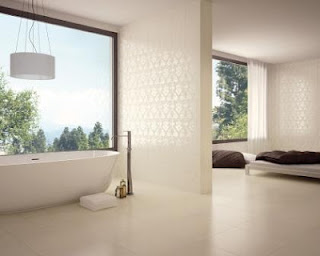
Trend Stone by Cedir
Trend Stone by Cedir offers a full range of neutral colors.
Claystone – Produces a feeling of extreme softness with neutral, almost pastel colors and the strong yet fluid grain. The surface – natural or polished – is also slightly textured, which amplifies the soft effect. Available in 4 colors (Dark, Shadow, Ray and Desert) and a range of square and rectangular sizes.

New Yorker – Pure white body wall tiles in size 4”x12” and a range of 7 dusty colors: matte white, bright white, taupe, caramel, smoke, charcoal, and night. The edges are straight for easy installation but the surface is slightly wavy, reminiscent of the classic subway tiles with a rich and soft glaze that gives nice shading effects.

New Yorker by Settecento
Settecento's New Yorker features a slightly wavy surface.

Wood Looks

Century 
Arbor – A collection of sustainable, wood-inspired porcelain floor tiles for residential and commercial spaces. Made with 40% recycled material, it comes in 5 modern colors (white, black, brown, grey, beige) and 2 “plank” sizes (6”x39” and 4.8”x39”).

Naxos  
Project – A collection of porcelain wall tiles where the concepts of wood and stone come together to create a whole new style. The range of 6 colors inspired by Leccese stone comes in 3 sizes (13”x13”, 13”x39” and 10”x24”) and can be combined with two 6”x39” oak-inspired tiles. The choice of materials and formats – all perfectly rectified and satin finished – creates endless design opportunities.

Project by Naxos
Project by Naxos skillfully combines the look of wood and stone.
Rex  
Taiga – Porcelain tiles that exploit the inherent beauty of irregularity through the use of a chromatic design that evokes the warm colors of woodlands and unspoiled natural settings. Available in 4 colors that recall the warm hues of the seasons, 2 rectangular sizes (6”x24” and 6”x36”) and a grip finish for outdoor surfaces

Taiga by Rex
Taiga by Rex boasts an irregular design  
Woodays – Porcelain tiles with 7 wood-mimicking looks – from Sycamore and Chestnut to Oak and Beech. It’s available in a variety of sizes (as large as 24”x36” and as small as 3¼“x 36”), as well as a variety of trims and ornate compositions.

Woodays by Tagina
Tagina's Woodays offers seven wood-mimicking options.

Visit Cersaie for more information about the show, or visit Ceramic Tiles of Italy for related information about the Italian tile manufacturing industry. 



Tuesday, September 25, 2012

A tile shower installation- Time lapsed video/explanation

How to tile a shower in 48 seconds! Ah wouldn't that be nice but in reality it took a bit longer.
This will give you a great overview of the process though from sealing the cement board to wiping the tile clean.


Now for a bit of the explanations behind the process.

Here you can see the cement board and the coating is a waterproof membrane that is rolled on. It's a bit of extra security and peace of mind.

This pre-made shower niche was added by cutting into the cement board exactly where it would go and once that was done the edges were sealed with caulk to ensure against future leaks.


I had already planned out the tile layout so the next part was to actually start setting the tile.

Thin set and subway tile


As I worked my way up we then came to the layer of glass tile, which actually came in a sheet and which we cut in half for the bottom and top layers.
Glass tile in a shower

Then the addition pattern was set and the second layer of glass tile will be added above.

Tile pattern in a shower


Then the additional layers of tile are added, let to sit overnight and the grout is applied.

Tile installation complete for a shower

The grout is applied and then smoothed over as an initial cleanup with a damp sponge and allowed to sit again overnight. 
Applying grout


The final clean up with again a  damp sponge.
Tile clean up, damp sponging


The finished product!

That's the basics of tiling a shower and I do have to apologize for the yellow color in the photos. This was done as the project took place and not under showroom settings without professional lighting and such. Hopefully it will give you a good idea of what goes into tiling a bathroom shower and wouldn't it be nice if it could be really done in 48 seconds!


Tuesday, September 18, 2012

Step Up to Spanish Tile | September 2012

Project Pick:
Hand-Painted Spanish Ceramic Tile Risers

Hand-Painted Spanish Ceramic Tile Risers

Avente's Spanish Tiles are beautifully hand-painted in a variety of colors and patterns on ceramic bisque using time-honored techniques.

Using the Majolica technique of glazing, our Hand-Painted Spanish Ceramic Tile designs include colorful patterns from the different regions of Spain, or the traditional blue and white found in the New Iberica border tiles and liners.

The Majolica technique utilizes an opaque white tin-based glaze that is ideal for vibrant, colorful patterns and designs for ceramics. The centuries-old technique is believed to have originated in 9th century Mesopotamia with the desire to imitate the white porcelain wares coming from China. Over time, and with the spread of Islam, the art made its way through to Northern Africa, and to what is now known as Spain, Italy, The Netherlands and the United Kingdom.

Within our hand-painted Spanish ceramic tile collection, you'.ll find craftsmanship and fine examples of the traditional Majolica ceramic method, such as those used for this Spanish stair riser project:

Alcala

Alcala Spanish Ceramic Tile

Additional Majolica-Based Patterns

Andalucia

Andalucia
Cadiz

Cadiz
Albacete

Albacete
Burgos

Burgos
Caceres

Caceres


Tile Tip

Our hand-painted Spanish ceramic tile designs include borders, corners, large decorative tiles, and accent dots. Use the 3"x6" tiles to create a border, or make a bold design statement using the 2" dots in a row. The 1" dots, used as an accent to a floor inset, are a fitting complement to a backsplash consisting of 6"x6" tiles of the same design. These versatile collections, with their stunning colors, create a timeless look that blend well with hand-painted Spanish Field Ceramic Tile, which were created specifically to complement the subtle color schemes found in our Hand-Painted Spanish Ceramic Tile line. Use these tiles for kitchens, bathrooms, warm weather pools and fountains. For more inspiration, check out Spanish Style Stair Risers, Spanish Tiles on an Entry Path, and Spanish Tile on Stair Risers.

Considering Spanish ceramic tile for your next project? Then let us help you find some inspiration. Visit our Ceramic Tile Design Ideas section.


See our Spanish Tiles

Where would you use hand-painted Spanish ceramic tiles? What pattern would you choose?

Tuesday, September 11, 2012

Cement Tiles Trend Toward Bold Patterns & Colors

Earlier this year I did a guest post for the Gold Notes blog called, Tile Trends from Coverings 2012. I reported that I was seeing a trend to use texture, color, and geometric patterns in tile. I'm excited about this trend because I like to see color and pattern embraced in design. Today I'll show a few examples of how that prediction is growing - based on the samples and installations we've been working on. Cement tiles have been extremely popular this this year and I want to show you how color and pattern are being used. Look at some of the samples we recently shipped.
Melilla Cement Tile
Melilla Cement Tile
The Melilla Cement Tile use nine colors in this bold warm palette with a playful Latin feel. Our Montecristi pattern uses five colors here including: White, Antique Ivory, Gray, Indian Red, Peach Puff.
Montecristi Cement Tile
I love the bright Indigo inset with the warm Tibetan Gold in Geo 8 – the simple pattern reminiscent of ceramic tiles and is great for breakfast nook or patio.
Geometric Pattern 08 Cement Tile
Geo 8 Cement Tile
Cement tiles in strong patterns in a black and white or black/white/gray colorway are also popular. Neiba Cement Tile illustrates how a clean pattern in "basic black and white" creates a floor with a focal point in an easy-to-use and flexible palette. Try using an accent color like red to really make the design pop!
Neiba Cement Tile
Neiba Cement Tile
Simple geometric patterns in basic colors are being used in both residential and commercial installations. The Geo 10 in our standard colorway of Cana Green and Suede remains very popular. The patterns generally work well in homes with contemporary architecture styles especially when utilizing a simple two or three-color palette.

Geometric Pattern 10 Cement Tile
Geo 10 Cement Tile
However, we have seen Geo 10 used in a residential application with the classic black and white in one bath and the Indian Red and white used in a different bathroom for the same home.
Geometric Pattern 10 Cement Tile
Geo 10 Cement Tile
Geo 9 in Indian Red and White will be used in the entry for a new bar opening in Chicago this fall.
Geometric Pattern 09 Cement Tile
Geo 9 Cement Tile
There are certainly a variety of styles and designs in the cement tile samples and installations we’ve seen recently. But, I think you get the sense that people are not afraid to try tiles with bright colors. And, there is definitely a design trend to use the classic geometric patterns in simple, easy-to-use colors like white, black, and red.

Curious? Take a look at our Geometric cement tile patterns and see if there is something that catches your eye.


What do you think of geometric patterns and bright colors in cement tile? How would you use brightly colored pattern tiles or geometric patterns in your kitchen, bath, or dinning room?

Tuesday, September 4, 2012

Moroccan Tile: In a Class of Its Own

Countries with colorful histories have always provided a deep-rooted fascination to outsiders because of their culture, traditions, food, and most importantly, the art produced within the country. It’s through this art that we, the current generation, are allowed to take a brief glimpse through the artist’s mind and eyes of what was seen, felt, and experienced at the time.

Handmade Moroccan Zillij tile
A central 10-point star is the beginning point of this expanding zillij pattern
Image Source: Ceramics Today via Saudi Aramco World. Photo Credits: Peter Sanders/Saudi Aramco World/PADIA.

But what if an art or art form remains unchanged through the centuries? Moroccan art and architecture has been steadily experiencing a renewed interest thanks to talented, visionary designer and architects. But for this post, I would like to focus on just one of these art forms -- the mesmerizing forms, colors and shapes of Moroccan tile, Zillij (also spelled as Zellige or Zellij).

Handmade Moroccan zillij tile fountain
The 17th-century Nejjarine Fountain, retiled and repaired by two generations of master zlayjis of the Benslimane family.
Image Source: Ceramics Today via Saudi Aramco WorldPhoto Credits: Peter Sanders/Saudi Aramco World/PADIA.

Zillij: Handmade through the Generations

When the Moors conquered Spain in 711 A.D., they introduced various forms of art and artistic techniques, including a unique custom of painted ceramics, called Zillij. As defined by Islamic law, which prohibits the depiction or likeness of living things, Zillij uses only geometric shapes, straight lines and vibrant colors.
These handmade creations can be seen adorning every palace, museum, home, street, mosque, fountain, wall, walkway, and so on.  It’s not only an art form; it’s an essential building material.

Moroccan Zillij pattern with taqshir calligraphic border, as seen at an Islamic School
Zillij patterns, including a taqshir calligraphic border, at the Attarine madrasa (Islamic school), built in 1325.
Image Source: Ceramics Today via Saudi Aramco WorldPhoto Credits: Peter Sanders/Saudi Aramco World/PADIA.
Throughout its handmade history, Moroccan Zillij has been created by master craftsmen called “Maalam Ferach.” From an early age, pupils would study their craft under the tutelage of a master. Often times, techniques were handed down from one generation to the next within the male members of the family.

With the guidance of their mentors, the pupils would learn the essential, but laborious, task of baking clay, meticulously hand-cutting each piece, and then painting the pieces with painstaking accuracy. According to the authors of “Zillij: The Art of Moroccan Ceramics,” authors, John Hedgecoe and Samar Damluji, “Zillij mirrors the genius of the Moroccan craftsman, his feelings, values and commitment, reflecting his inspirations, spiritual and material composition.”

Moroccan zillij
Zillij, or tilework of Morocco.Image Source: Ceramics Today via Saudi Aramco WorldPhoto Credits: Peter Sanders/Saudi Aramco World/PADIA.
The authors further go on to say, “Zillij has been employed in Morocco since the earliest times, as may be seen from the mosaic pavements of the old city of Walili (Volubilis). The Arab influx introduced, amongst other arts, the Zillij inspired by the Persian cut tile, al qishani, which still adorn the domes, mausoleums, and madrasahs [school] of Iranian cities like Isfahan. Zillij, however, was adapted to specific Moroccan and Andalusi characteristics that nearly obscured the trace of Persian origin.”

Avente Tile’s Moroccan-inspired Fez handmade cement tile collection
Handmade cement tile inspired by Moroccan patterns. "Fez" by Avente Tile.
With such attention to detail fostered by years of discipline and learning, it’s no wonder the long-lasting beauty and versatility of Zillij has remained popular amongst those who truly admire craftsmanship with the added touch of the exotic. A wonderful blog to follow for all things Moroccan is My Marrakesh. It’s written by author, designer and photographer, Maryam Montague.

How would you use Moroccan tile? Where have you traveled and seen Moroccan influences in tile and architecture?  

By Arpi NalbandianTileometry