Tuesday, May 27, 2014

Spanish Tile Details Charm this Los Angeles Neighborhood


The Memorial Day holiday marks the unofficial start of summer for just about everybody in America. I hope you enjoyed yours. For me, here in Los Angeles, I know summer is almost here not just by the long, warmer days but the early and relentless songs of the mockingbird - sometimes too early and way too long into the night.  These longer days allow longer walks in my Los Angeles neighborhood.

Spanish Tile adorn the riser and column on this Los Angeles home
Spanish tile adorn the riser and column on this Los Angeles home.

During each walk, I usually spy decorative tiles in outdoor settings that adorn the Spanish and Mediterranean homes that were influenced by Mission, Spanish, and Spanish Revival architecture. The asymmetrical arch is a rich architectural feature; but, look at the Spanish tile on the column. These are original tile circa 1928.

Spanish Tile on a column circa 1928

Brightly colored tile are influences of Spanish Revival architecture
Brightly colored tile are influences of Spanish Revival architecture. 

I do have a soft spot for tile and love seeing how decorative tile is used to add a splash of color or touch of interest to a home. Exterior stair risers are of course a common home for Spanish tile. This small, inviting patio places Spanish paver tiles and decorative Spanish tiles both on point. This "on point" layout for pavers can help small spaces like a front patio seem more expansive.

Both pavers and decorative riser tiles are on point in this open courtyard.
Both pavers and decorative riser tiles are "on point" in this open courtyard.

For a more private patio, the owner of the home below chose a high wall with Moroccan details and wood for the entry. And who wouldn't want a turret for their second-story bedroom? It's almost story book material!


Spanish tile, wood and Moroccan detailing provide a provide a provide entry.
Spanish tile, wood and Moroccan detailing provide an inviting entry.

But, let's get a closer look at those Spanish stair riser tiles.

Spanish tiles in the same pattern adorn these stair risers
Spanish tiles in the same pattern adorn these stair risers.

Not as common is the use of patterned cement tile. There is one unique example that I want to share. I love the quaint look of patterned cement tiles placed in the cement walk of this home.


Patterned cement tile placed in a poured cement walkway
Patterned cement tile placed in a poured cement walkway add interest.

The color and pattern in the walk guide you to this stunning recessed entry.


The cement tiles in the walk complement the color and pattern in this entry
The cement tiles in the walk complement the color and pattern in this entry.

I hope you enjoyed exploring just a few of my favorite homes near the Los Angeles neighborhood where I reside. These are great examples of  how Spanish tile and cement tile can be used to complement an existing design, while adding curb appeal. Throughout the summer, we'll explore more homes in the neighborhood and share additional ways to bring tile outside!

Want to add some Spanish tile charm to your home? Then look through our Spanish tiles or browse our Ceramic Tile Design Ideas where you can find a large collection of projects showcasing our handmade and hand-painted Spanish tile. Let us know how we at Avente Tile can assist you!


Tuesday, May 20, 2014

Islamic Star Patterns in Tile Design


As a recent Art History graduate from Loyola Marymount University, the Arts of Islam became a favorite subject among the various cultures and styles I studied.

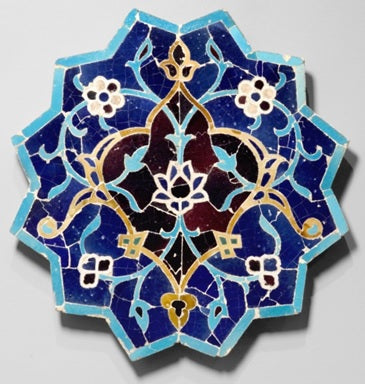
Iran or Central Asia, 15th Century. LACMA


Dating back to as early as the 7th century the Islamic Arts have influenced an array of cultures and societies, such as the notable geometric designs in their tile work. These tiles were commonly used as floor and wall applications and to decorate mihrabs, the architectural niches in mosques. Examples of this work still exist in Spain, Italy, Morocco, India, and Turkey.

Because Islamic cultural beliefs negated the use of human form depictions, creative inspirations of florals, stars, animals, and geometric designs were used in the elaborate mosaics that became readily identifiable as Islamic.

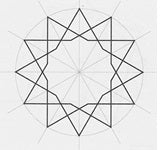
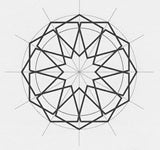
In examining the floral and star motifs, also known as arabesque, it has been determined that intricate and complex algebraic formulas were used in creating the geometry behind these patterns. One such example is the star pattern, whose beauty is contributed to by the high degree of symmetry.

Four Triangles within a Circle
Image Credit
Two Hexagons with a Circle
Image Credit


These motifs utilize what is referred to as the n-fold rotational symmetry, where n represents a range of whole numbers from 3 to 100. These patterns utilize a two dimensional plane with some polygon cells or shapes meeting at their edges, while others meet at the vertex points.

These star polygons were not limited only to the painted figure. Islamic tile were oftentimes manufactured in a star pattern where they were organized into a complex mosaic.

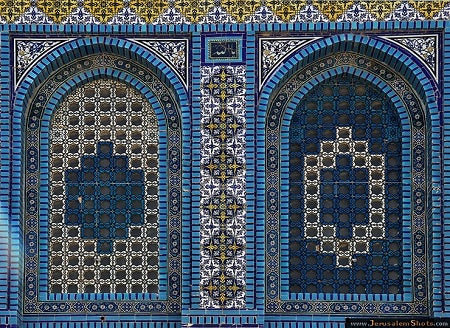
Dome of the Rock, Jerusalem
Image Credit
Early Islamic tiles involved a simple process of cutting single color, small tile fragments and assembled with the use of liquid plaster. This technique evolved to include painted pictures on plain tiles which were then glazed and fired afterwards. The color palette also extended to include oranges and yellows.

It is the mosaics of the 15th century C.E. that have become most widely known and influential, known as "mosaic faience." An interesting note is that these tiles were applied over brick in an "undulating" fashion; as the light and reflections changed throughout day and evening, so did the sheen and brilliance of the various tile colors.

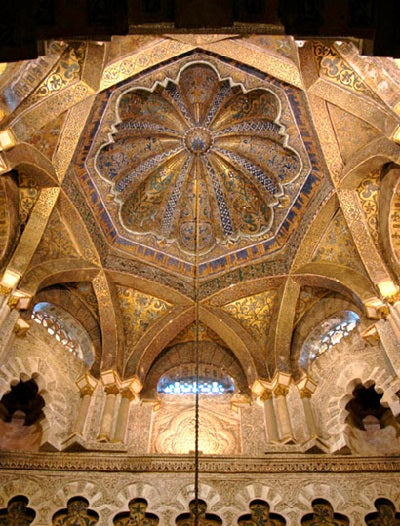
Maqsura, Great Mosque, Cordoba
Maqsura, Great Mosque, Cordoba,
Arts of Islam at Loyola Marymount University,
Dr. Aliaa El Sandouby

It is easy to see why the beauty of the Islamic tiles has spanned cultures and centuries. With their vibrant colors and eye-catching shapes and designs, artisans have a near endless variety of choices of expression.

Tuesday, May 13, 2014

Artist Series Cement Tile Collection Grows with Guillermo & Tania


Guillermo and Tania logo

In our continuing effort to bring you the highest quality in cement tile products and designs, we're happy to announce that our Artist Series now includes the Guillermo and Tania collection.


Guillermo Gomez Lama


Tania Marmolejo
Tania Marmolejo


This new collection, created by artists Guillermo Gomez Lama and Tania Marmolejo, boasts eight different designs, each presented with three color options. Further, these 10"x10" cement tiles feature new, contemporary designs that are ideal for commercial and residential spaces.

As a visual artist, graphic designer, paper lover and one who is obsessed with patterns and the production process, Guillermo began his art studies at UMASS Amherst in Boston. He continued his formal studies in Communication Design at Parsons The New School of Design in New York, which is where his interest in mechanical production processes through screen printing and engraving techniques, were born.


Artist Series Guillermo Lama
Armor Tissue 1A
10" x 10" Handmade Cement Tile


Artist Series Guillermo Lama
Asterdisc 1B
10" x 10" Handmade Cement Tile


Artist Series Guillermo Lama
Sol Mio 2A
10" x 10" Handmade Cement Tile

Guillermo's research led him to train with Master Printer Marie Dormuth, with whom artists Andy Warhol, Peter Gee and Martin Mazorra received training in the art of lithography. His works have certain influences that are based on vibrations and repetitions. He currently lives and works in Santo Domingo.

On the other hand, Tania's designs contain a mixture of her Scandinavian heritage. Her use of decorative, interwoven lines illustrate the natural environments resembling Nordic folk art, ancient Vikings styles, as well as Caribbean essences, such as: color, warmth, the Coralillo flower, tropical gardens, and the sea.


Artist Series Tania Marmolejo
Union 3A
10" x 10" Handmade Cement Tile


Artist Series Tania Marmolejo
Jardin 1A
10" x 10" Handmade Cement Tile


Artist Series Tania Marmolejo
Wave 2A
10" x 10" Handmade Cement Tile

Tania is represented by Lyle O. Reitzel Gallery, and her work has been exhibited at Art Miami Context and Pinta NY, and in national and international exhibitions. She is the author of the books "I Doodle Therefore I Am" and "To Doodle or Not to Doodle." Currently, Tania lives in New York, where she works as a textile designer for Nanette Lepore, Nicole Miller and XOXO, among others.

Part of the sales generated by Guillermo and Tania collection will be donated to a non-profit organization dedicated to the promotion of art, culture and education. The artists have named time Fé y Alegría, a popular international movement of integral education and social promotion aimed at the excluded population as the beneficiary of the donation.

To view additional patterns and designs available within our Artists Series Cement Tile collection, visit us here.


Pinterest logo

Pinterest: Artisan Tiles & Grilling

Pinterest: Artisan Tiles

Pinterest: fire up the grill


"Art is pattern informed by sensibility." — Herbert Read
The sun is shining bright and warm, seeds have begun to sprout in our vegetable gardens and we couldn't be happier! It's amazing how a burst of color can enhance someone's day or living space.

What better color is there than yellow to brighten up an area that lacks something. From an accent wall, to a wall niche, and of course tile, spaces that include yellow are associated with happiness, intellect, and energy. Yellow is also closely related to Spring and Easter, where, according to color experts, both the color and the seasonal change produce a warming effect, arouse cheerfulness, and stimulate mental activity. With this month's Pinboard selections, we know you'll soon be focusing on the fresh and colorful changes that only come around this time of the year!

To get you started on your Spring cleaning and freshening up of spaces, here are several handmade cement tile and hand-painted ceramic tiles that evoke the feelings of this season year-round.

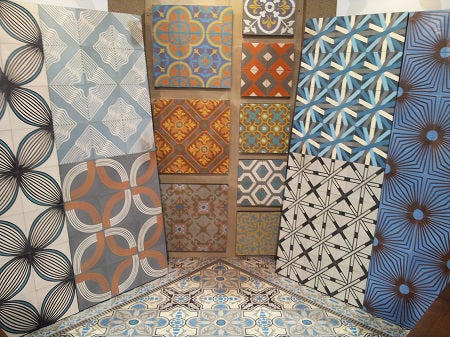
Patterns are enjoying a resurrection of sorts, as we observed recently during Coverings 2014 in Las Vegas. This annual tile and stone trade show, now in its 25th year, brings together manufacturers from all corners of the globe to showcase the latest designs, materials, colors, and patterns available with cement, porcelain, ceramic or glass tiles. Check out our latest blog post, "Patterned Tiles are Power Play at Coverings 2014," to see what we came across during the four-day event.

As with nature and handmade goods, such as Artisan Tiles, patterns play an enormous role in helping us define our space. The same could be said of what we eat - the inner rings of a horizontally cut beet, the strings on a stalk of celery, grill marks on a perfectly cooked and seasoned steak, burger, or assortment of veggies — all these things entice our inner passions in one form or another!

And with the unofficial start of summer just around the corner, spending time with friends and family, while enjoying a grilled masterpiece, will be the only pattern you'll want to follow throughout summer.

Inspired? Then visit our pages on houzz.com, our boards on Pinterest, and browse through dozens of our Cement Tile Design Ideas and Ceramic Tile Design Ideas where you can find a large collection of projects showcasing our handmade and hand-painted ceramic tile, cement tile, decorative tile, mosaic tile, and so much more. Let us know how we at Avente Tile can assist you!

Tuesday, May 6, 2014

Patterned Tiles are Power Play at Coverings 2014


While Coverings was celebrating its 25th anniversary in Las Vegas, I was celebrating something I hadn't seen much of at this annual tile and stone trade show since I've been attending: patterned tiles. Lot's of patterned tiles!
Apavisa's Hydraulic Blue pays homage to Classic Cement Tile Designs

I was thrilled to see patterned tile proudly promoting artisanal looks almost everywhere. While last week's post, New & Old Cement Tile Patterns Heat up the Strip, was supposed to be the last in a series to focus entirely on pattern and tile design, you'll see why this week's post is devoted to pattern once again: it shows how pattern is playing a big part in both design and tile trends.
Aparici Vanguard embraces bold pattern
Aparici's Vanguard embraces bold pattern and placement

Tile Returns to Its Artisanal Roots

Those of you who follow our blog know that I'm a big proponent both of color and pattern in design. So, I was thrilled to see many manufacturers embrace pattern in their 2014 tile designs! While pattern definitely took center stage, the underlying theme was a trend to create tiles with an artisanal look. I was thrilled to see porcelain tiles paying homage to traditional and contemporary cement tile patterns. A well-executed example of where pattern took precedence is with Apavisa's Hydraulic series.

Apavisa uses classic patterns and a straight-forward palette

Cement Tiles are often called hydraulic tiles in Spanish-speaking countries. To create cement tiles, each tile is hydraulically pressed as part of the manufacturing process. This is often called a "hydraulic look." Apavisa isn't shy about letting us know that the inspiration for these tiles comes from the cement tile manufacturing method that was first developed in Southern France during the mid 19th century. The tiles break from tradition using a larger 12-inch format,  and are available in four pleasing but limited colors of patchwork natural, grey natural, black natural and blue natural. 

Apavisa's Hydraulic Natural Patchwork has 27 random patterns
The patchwork natural colorway comes with 27 random patterns in each box! And remember, while the look is that of hand-crafted cement, these tiles are made entirely of porcelain.

I want to thank Lori Dolnick and Katie Sikorski for inviting me to participate in the Tile of Spain Press Conference and tour hosted by the always-insightful Ryan Fasan. As an advocate of hand-crafted ceramic and cement tile, I felt more connection than ever to these new porcelain tiles. Finally, a tip of the hat to Tile of Spain for exhibiting distinctively unique ceramic innovations at Coverings 2014!

Tuesday, April 29, 2014

New & Old Cement Tile Patterns Heat up the Strip


Greetings from Las Vegas! This week I'm in Las Vegas making my yearly pilgrimage to Coverings 2014, an annual tile trade show.

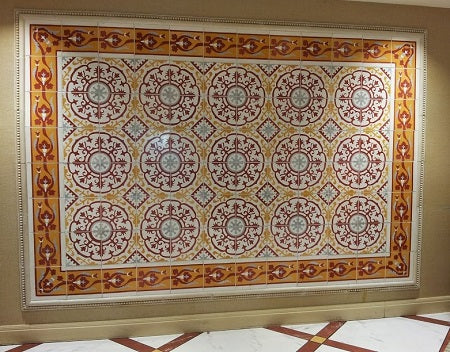
Cuban Heritage Tile Mural at the Tropicana supplied by Avente Tile
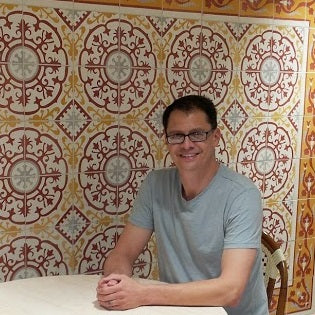
Avente Tile Owner, Bill Buyok, in front of the Cuban Heritage Tile Mural at the Tropicana.

As I conclude my final post on playing with pattern in tile design, I'm excited to share a unique wall installation of our classic, popular Cuban tiles and our newest line of cement tile offered by Aguayo Cement Tile. That's yours truly seated at a wall installation of our popular Cuban Heritage Design 140 1A 8" x 8" Handmade Cement Tile at the Tropicana Hotel & Casino in Las Vegas. Avente Tile supplied this unique installation when the resort completed a remodel a few years ago.

A wall tile mural installation at the Tropicana of Cuban Heritage Cement Tile

Guillermo & Tania Collection

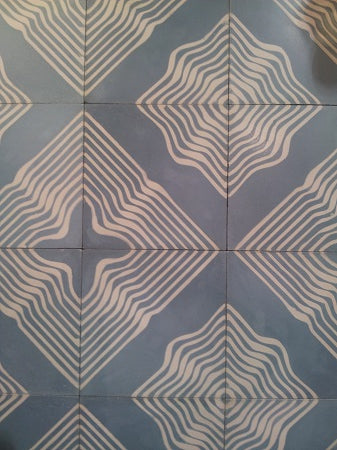
Guillermo and Tania is the sixth collection of unique cement tiles offered by Aguayo Cement Tiles that are created by artists from the Dominican Republic. These unique tiles showcase the artist's skills and elevate cement tile to functional art. This collection, created by artists Guillermo Gomez Lama and Tania Marmolejo, features eight different designs - each presented in three colorways. All tiles are in the 10-inch square format. The collection features new, contemporary designs that are ideal for commercial and residential spaces.

Guillermo & Tania Collection are new a new cement tile line.
Guillermo & Tania Collection is a new cement tile line from Avente.

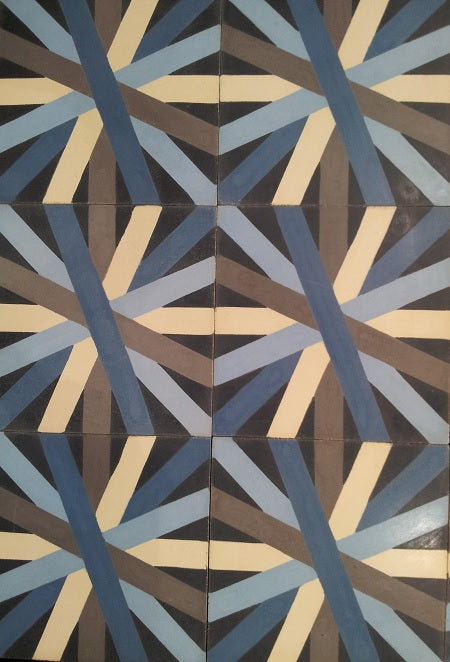
 One of may favorite new patterns from Guillermo is "Asterisk" in a bold blue colorway.

Asterisk is a new, contemporary cement tile pattern from Avente Tile
Asterisk is a new, contemporary cement tile pattern
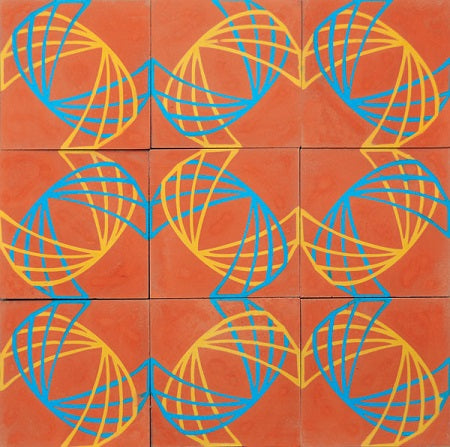
Lama is a visual artist, graphic designer, paper lover and obsessed with both patterns and the production process. His work's influences are based on vibration and repetitions of experimental electronic music, mosaics, and the patterns of human behavior. His work is also influenced by the art of lithography and giants in that field, such as Andy Warhol and Peter Gee.

The influence of Lama's graphic design and lithography are apparent in this cement tile pattern.
The influence of Lama's graphic design background and lithography are apparent in this cement tile pattern.

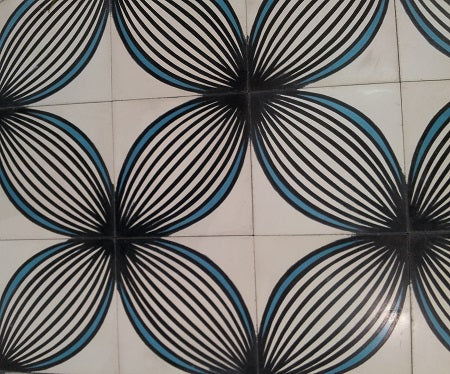
Also, I love the flowing, organic patterns of Tania, and a personal favorite is Bloom. The motif creates a three-dimensional effect as the petals converge on each bloom.

Tania Marmolejo Bloom cement tile pattern
Tania Marmolejo's Bloom cement tile pattern
For this project, Tania uses the line as a design element. She uses an eclectic mix of Swedish textile designs and Caribbean themes, such as tropical gardens and the sea.

Wave is a new cement tile pattern by Tania Marmolejo
I'm looking forward to the show and celebrating 25 years of Coverings. I've been attending the show for over a decade.

Coverings 2014 is at the Las Vegas Convention Center
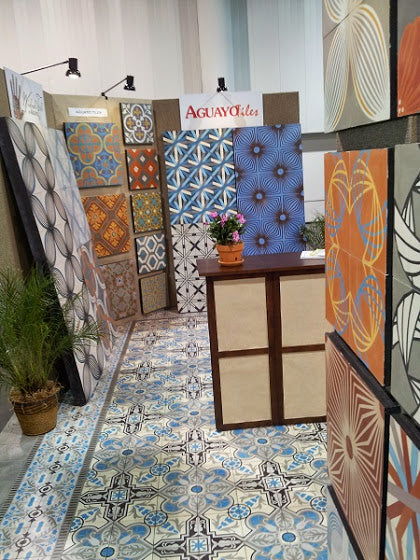
If you happen to be at the show, stop by Booth #19002 and say hello! 

Aguayo Cement Tile Booth #19002 at Coverings 2014

You'll love the new patterns; but, you'll also be able to see some of our classic patterns that are as popular today as they were when Aguayo first introduced them over a decade ago. We'll also be sharing more of the Guillermo and Tania collection here, and it will soon be available for purchase at Avente Tile.

Tuesday, April 22, 2014

Cement Tiles Add to the Impeccable Details of Tucson-Area Restaurant

By , Avente Tile. All photos provided by Sally Kane

I must begin this post by saying, thanks! Thanks to a very smart, extremely motivated, and very inspiring entrepreneur, Sally Kane! We just happened to meet because she called to talk about cement tile for her new restaurant, The Coronet, in Tucson, Arizona.

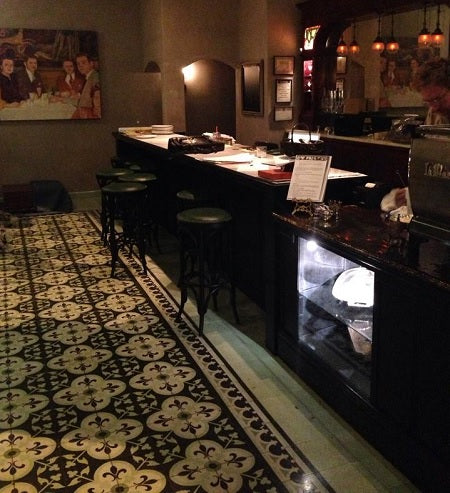
The Coronet is a brasserie style restaurant featuring Old-World cuisine & cement tile!
The Coronet is a brasserie style restaurant featuring Old World cuisine and cement tile!

Now, Sally is one of those people who has passion and takes ownership of every part of her project. She's good at what she does; from color choice and tile design, to finding just the right plates and chairs for her bistro, to hiring the right team. She has every detail down. And, we haven't even started talking about the menu.

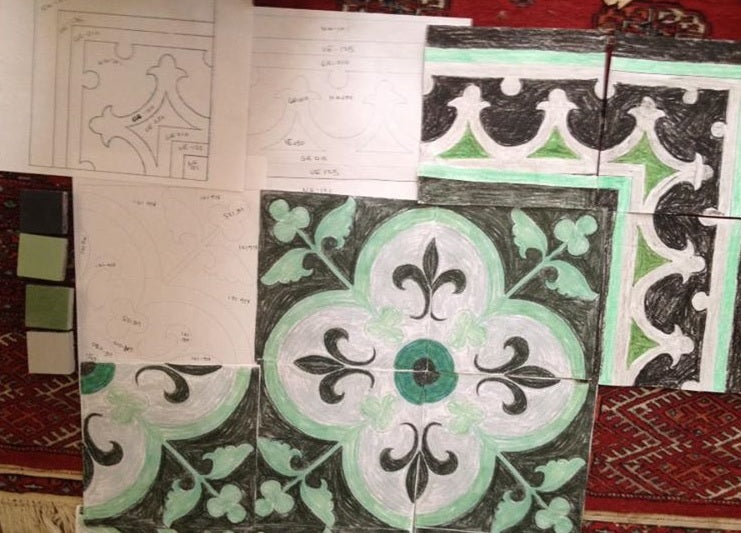
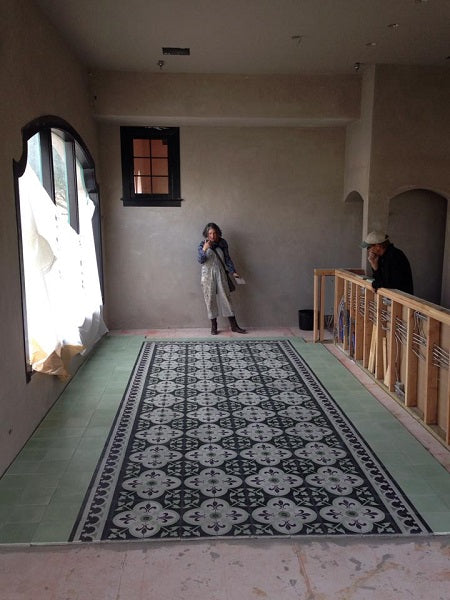
It was almost a year ago she called to order the Heritage Solid Color Chip Set for her cement tile project. Soon after the color chips arrived, she had decided on the palette: a mix of lovely greens on a classic pattern and border also boldly applied to a geometric pattern. She had "done up" some full size renderings using crayons in the closest match to the color chips. She wanted to know what I thought.

Cement Tile Renderings by Sandy Kane
Cement tile renderings by Sally Kane


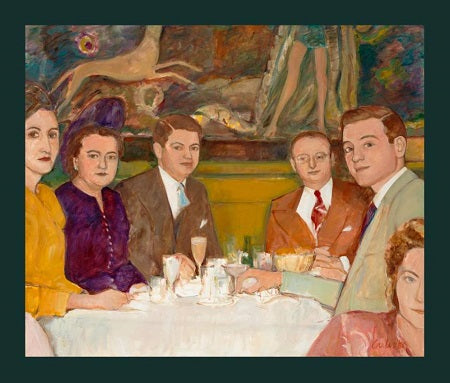
Sally mentioned she had this painting that would be the focal point of the main dining room and the tile pattern and colors should draw you to the painting; but, not take your attention away. The painting, El Morocco, is by Jerome Carlin and depicts a well-healed family having dinner in a nice restaurant.  

El Morocco, by Jerome Carlin is a focal point in the main dining room of The Coronet.
El Morocco by Jerome Carlin is a focal point in the main dining room of The Coronet.

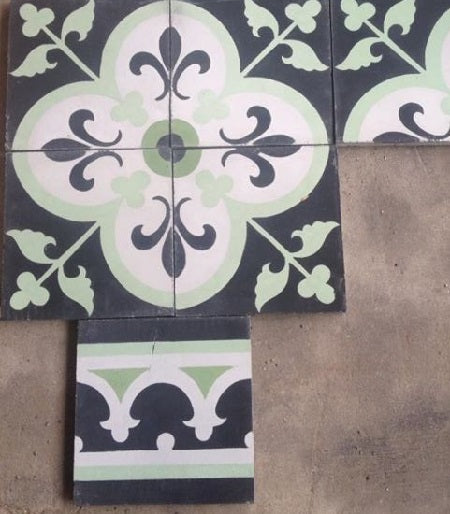
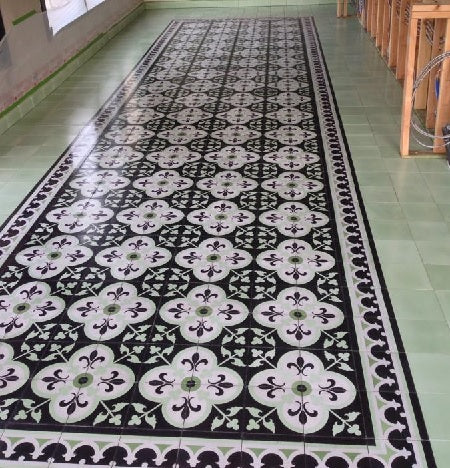
I questioned, “What type of restaurant is this going to be? What type of food, style, and ambiance do you want to convey?” Sally replied, “It will be a French-style bistro. But, don’t box me in. It will honor that style but not slavishly follow the tradition!" I could see it all working together now. The Traditional French floor tile in cool Misty Jade with hints of bold Peapod set against a complex Pearl Grey and defining Jet Black. Yes, the pattern was honoring the style in a new and fresh way. The colors and pattern added to the main dining room's focal point -- the painting. I remember being very impressed with Sally's effortless ability to have all the details of the design working together.

After she placed the order for this commercial installation, I asked if she wanted to see strike-off samples before proceeding with the full order. Feeling confident with her design, she didn't even bat an eye when she replied, "No." She patiently awaited her tiles, which arrived with some damage from the carrier and incorrect trim. We worked to resolve the problems, while Sally patiently allowed us the time to correct her order!

The Traditional Fleur-de-Lis quarter design with Macoris Border
The Traditional Fleur-de-Lis quarter cement tile pattern with Macoris Border tile.

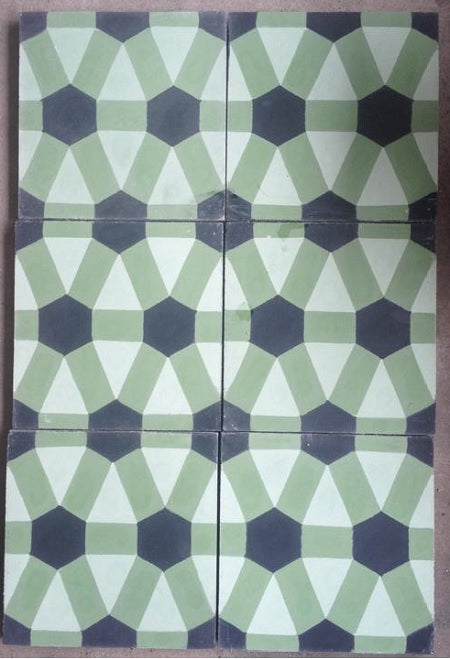
The Geometric Diamond Pattern was the choice for the bathroom
A Geometric Diamond cement tile pattern was the choice for the bathrooms.


Sally was kind of enough to keep me updated with the progress of the work through The Coronet's Facebook Page. I loved seeing the thought that went into the layout, installations, and progress.

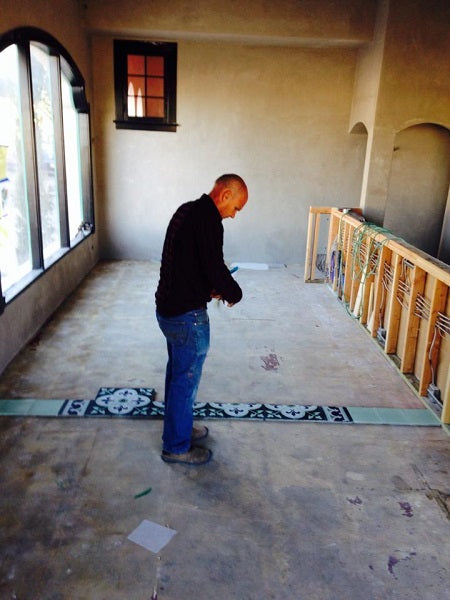
The Fleur-de-Lis and Macoris Border in a dry layout.

Sally Kane inspecting the icement tile nstallation.
Sally Kane inspecting the installation.


The Cement Tile Carpet Install is Complete!
The Cement tile carpet install is complete!
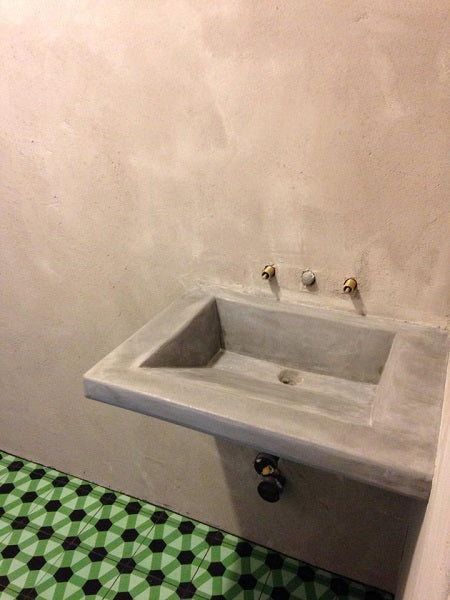
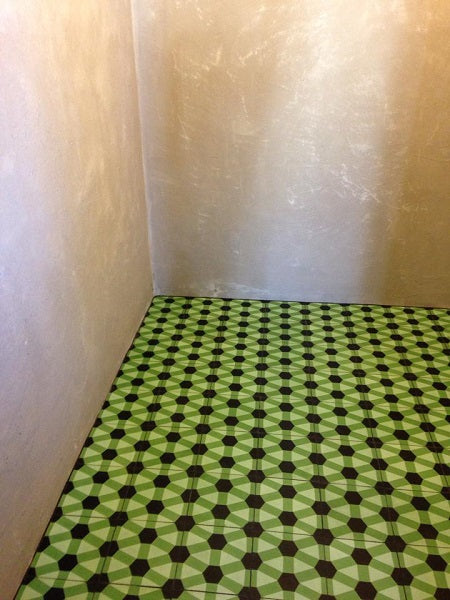
 And, the progress with the bathrooms and concrete sink. Notice the texture on the Venetian Plaster walls.

A bold geometric pattern for the lavatory.
A bold geometric pattern for the lavatory was selected.

The Cement Tile Pattern is Avente's Diamond.
The pattern used in the lavatory is Avente's Traditional Diamond handmade cement tile.

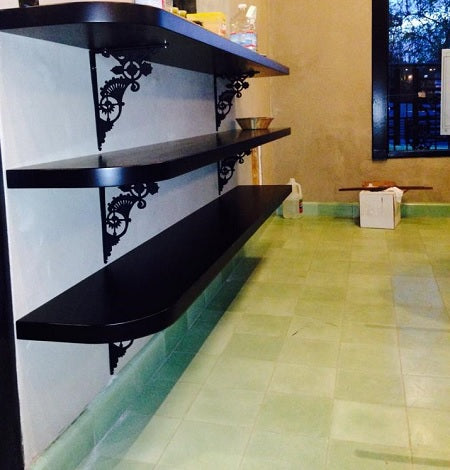
Finally, one of my favorite effects is the use of plain tile throughout the restaurant. The subtle variation in tone creates a sophisticated, Old World charm that you just don't find in manufactured tile. Here's a great shot that showcases the color variation.

Plain cement tile create visual interest with their natural color variation.
Plain cement tile creates visual interest with their natural color variation.
Well, there is so much more I could share about this amazing woman and the stunning space she has created. All I've done is talk about the tile! The food is already getting great reviews and if you find yourself in Tucson, Arizona, please stop by The Coronet. Sally says, "The Coronet is a brasserie style restaurant with Old World rustic cuisine and a cute, yet full, bar." You are sure to find quiet music, a big patio, good shade, outstanding coffee, and some stunning cement tile! All of us at Avente Tile wish you much success, Sally Kane!

Tuesday, April 15, 2014

Tile Patterns: Playing with Pinwheel Designs


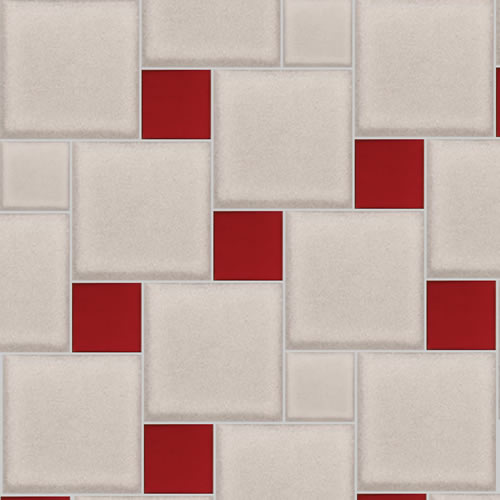
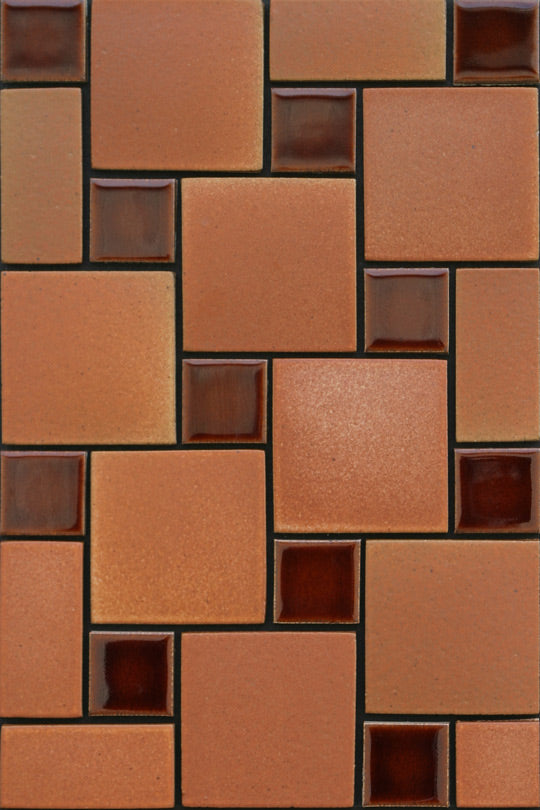
The pinwheel pattern is a popular and versatile tile layout that adds great visual interest by integrating solid color with decorative tiles into a timeless design. Here's a great example of a pinwheel tile pattern that pairs glazed ceramic dots with large ceramic tiles in a matte finish.

A pinwheel pattern with striking gloss and matte finishes.
A pinwheel pattern with Yucatan Glazes in striking gloss and matte finishes.
You can create a pinwheel pattern using only plain, solid color field tile. In the example above, tiles in similar colors are set-off by contrasting matte and gloss glazes. You can also add brightly glazed tiles with neutral colors to add a punch of color. If you're hesitant of using too much color in the pattern, then consider randomly alternating the brighter colors dots with dots in the same glaze as the larger tile, as seen in the example below.

Brightly colored glazed tiles can be randomly added to add interest to the design.

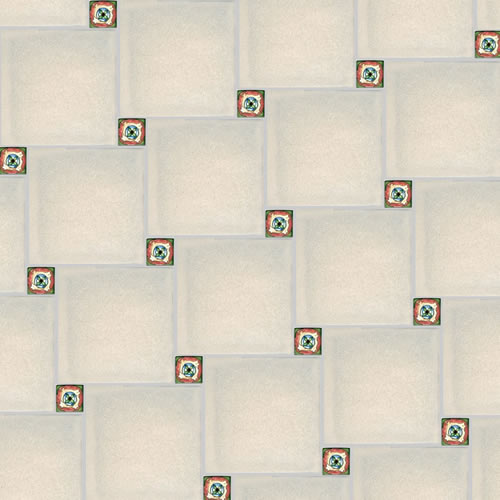
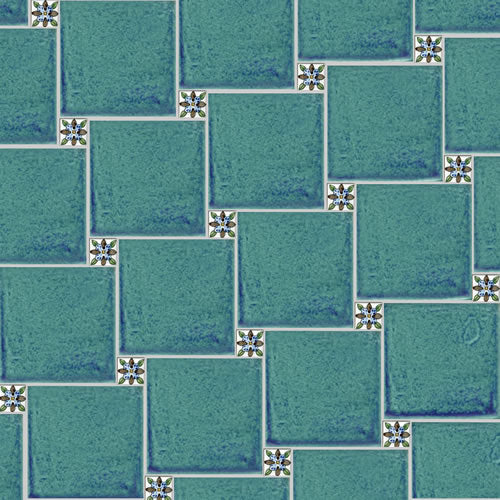
Or, you could choose to incorporate decorative tile with plain field tile, as seen in the two concepts show below.

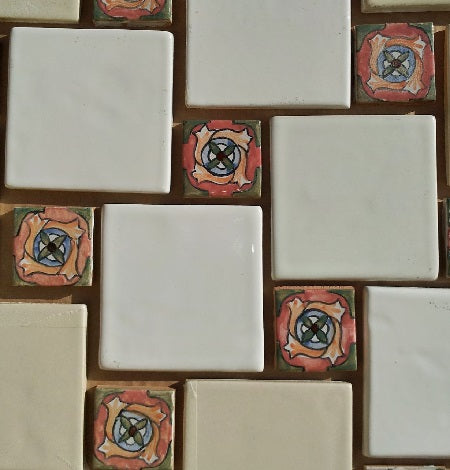
Decorative 1" ceramic tiles, referred to as dots, can be paired with 4" plain white tile.

Decorative 1" ceramic tile dots are paired here with 4" plain blue tile.

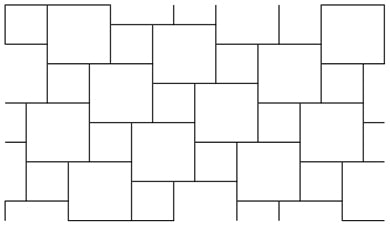
The pinwheel pattern is created by combining two different tile formats, usually with squares of different sizes.

A pinwheel pattern for tile often uses two different sizes of square tile.
A pinwheel pattern for tile often uses different sizes of square tile.

But, you can also create a pinwheel using tiles in different formats, such as squares and rectangles.

A Pinwheel Pattern for tile can use both square and rectangular formats.

When using square formats, you can use two squares that are relatively close in size.

Large Square / Medium Square Pinwheel
The pinwheel pattern is a common tile layout.

Or, you can use squares that are distinctly different in size.

Small "dot" tiles used with a much larger format tile create a pinwheel.
Small "dot" tiles can be used with larger format tile to create a pinwheel.

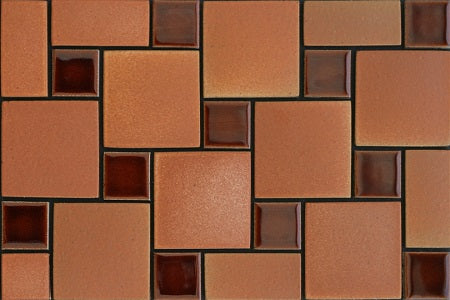
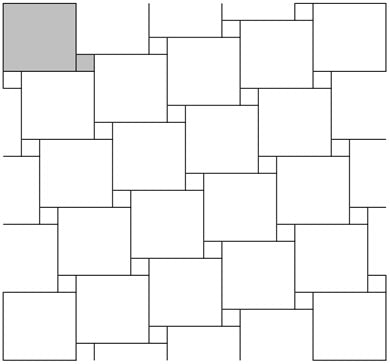
The pinwheel pattern works equally well on floor installations as it does for a backsplash or wall. In this installation, Mission Red Rustic Pavers in different formats are paired with glazed field tile. This random pattern draws its design inspiration from the classic pinwheel pattern.

This random floor tile pattern draws its inspiration from the pinwheel pattern.
This random pattern draws its inspiration from the pinwheel pattern.

Tile Tip: Calculating Other Tile Formats
If you aren't using a standard layout where we provide the ratio of tiles required, or you find yourself with uncommon tile sizes, then you'll need to calculate the tiles required by finding the ratio of small tiles to larger tiles using the exact area of each tile. So, measure the tiles and get out the calculator, then follow these easy steps. 
  1. Find the exact square inches of each tile to get an accurate amount. Do NOT use the tile's nominal dimensions.
  2. Find the area of the large tile in inches.
  3. Find the area of the smaller tile in inches.
  4. Divide the the area of the smaller tile by the larger tile.
  5. The ratio can be used to determine the number of smaller and larger tiles required for any job.
Example
Say the exact dimensions of the larger tile are 12"x12"; the smaller tile dimensions are 4"x4".
  • 12"x12" = 144 sq. inches
  • 4"x4" = 16 sq. inches
  • 16 / 144 = 0.1111
For a tile job that requires coverage of 100 sq. ft., you'll need 11.11 sq. ft. of 4"x4" and 88.89 sq. ft.of the larger format tile.

A Tile's Nominal Size 
Remember that tile is sold in nominal sizes. A 12"x12" tile might be as small as 11-5/8" or as big as 12-1/2".  Nominal means "about." Read more about nominal tiles sizes on our website.

The percentages shown are based on a full layout with no cuts. Actual percentages will vary depending on the area to be tiled and the layout.

Tile Tip
Perform a dry layout before you start. Layout the tiles in the pinwheel pattern using the grout width you desire. When you do this before installing, you will be able to pinpoint problems. Remember, with any layout, you want to avoid small cuts, cuts on small tile, and cuts by doorways on flooring tile. You will minimize waste, save time and avoid problems with a dry layout.

A dry layout with Andalucia dots & Yucatan Milkweed 4"x4"
This dry layout features our Spanish Andalucia ceramic tile dots and Yucatan ceramic tile in Milkweed 4"x4".

To see more tile layout patterns besides the pinwheel pattern discussed here, see our post on Rustic Cement Tile Paver Patterns.


To learn more about tile patterns, see my previous posts on Tile Tips for the Pattern Addict and Tile Tips for the Pattern Shy. You'll be a pattern pro!